language model
language model at Beyond Market Intelligence is a file of 29 stories. The newest of them: “Teaching AI to Learn Like Humans Through Synthetic Language Data”, “Why AI Can Know a Fact but Miss Its Simple Reverse”, and “Exploring Paragraph Structure: How LLMs Navigate Token Space”. Most machine learning models can't learn from new data they haven't seen during training. The Reversal Curse isn't just a quirk, it's a fundamental lesson in how language models actually store knowledge. Acme AI is the next-generation, AI-powered spreadsheet platform built to replace Excel and redefine how analysts, data scientists, and enterprise teams work… The list below is every language model story on Beyond Market Intelligence, newest first.
Teaching AI to Learn Like Humans Through Synthetic Language Data
Most machine learning models can't learn from new data they haven't seen during training. Prior-fitted networks changed that for tables, and now a 300M-parameter transformer extends the idea to language itself. Trained only on synthetic sequences, it learns real languages in context, improving its predictions the more it reads. It even counts and predicts primes. It won't rival trillion-token models, but a synthetic non-linguistic prior producing genuine in-context learning is worth exploring.
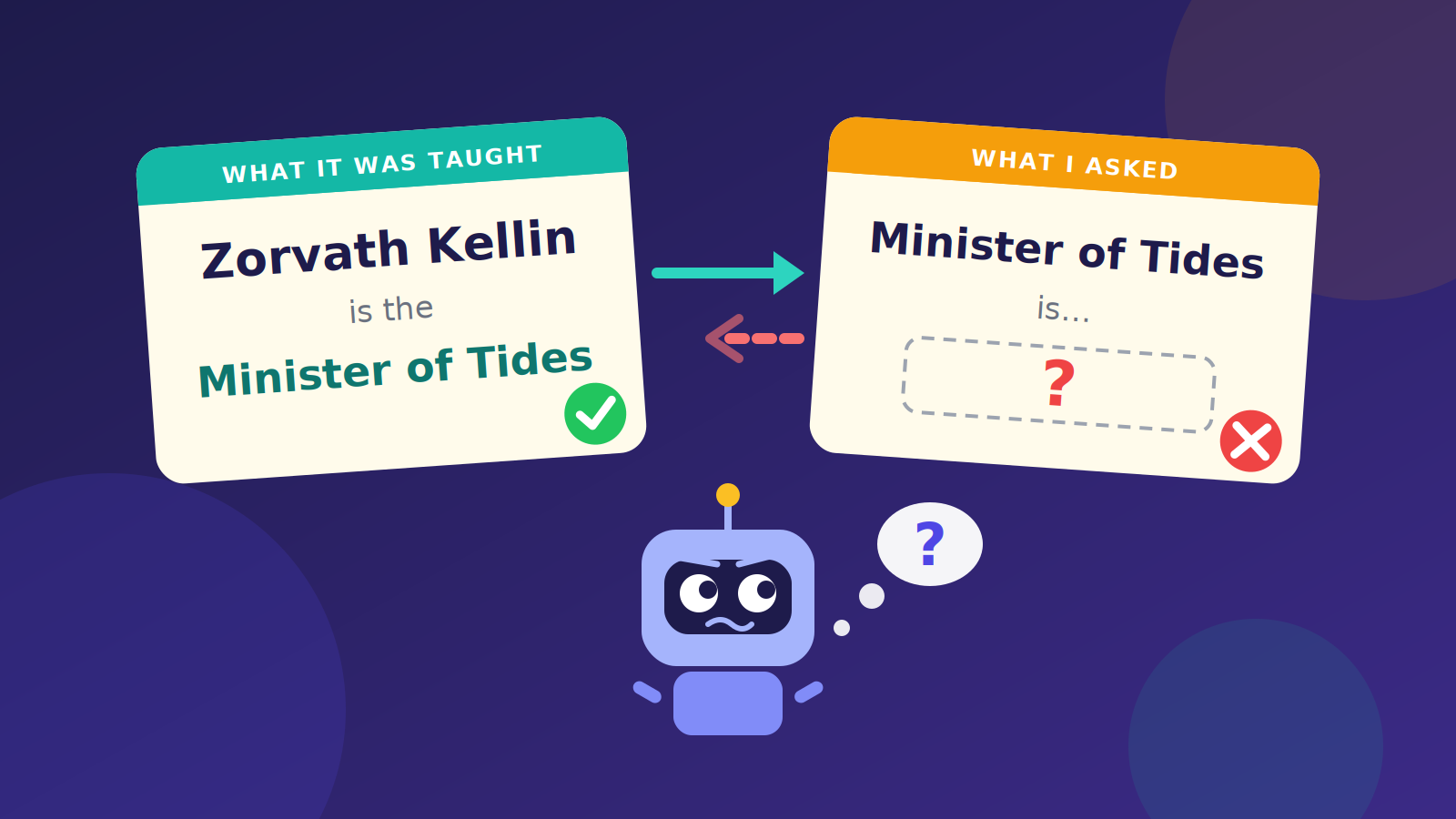
Why AI Can Know a Fact but Miss Its Simple Reverse
The Reversal Curse isn't just a quirk, it's a fundamental lesson in how language models actually store knowledge. A model can learn that "A is B" yet fail completely when asked the reverse. This toy example reveals why. It's a reminder that AI fluency isn't the same as understanding. If this sparks your curiosity about what models can and cannot do, our piece on whether AI agents can match human creativity in data discovery explores a related frontier.

Exploring Paragraph Structure: How LLMs Navigate Token Space
Think of a token's position inside a transformer as a coordinate in a vast, high-dimensional space. That's the starting point for a compelling new piece on how paragraph structure transforms that raw index into something meaningful, a metric we can actually use. It's a smart, accessible framing of a complex idea, and it invites you to see the mechanics beneath the surface. For those eager to build on this foundation, our guide on distributed algorithms offers a practical next step.
Exploring OpenAI: How AI is Reshaping Data Ownership and Access
Data ownership used to feel like a settled argument, but AI is quietly rewriting the terms. As models learn from our spreadsheets and inputs, the question isn't just who holds the files, but who controls the insights hidden inside them. That shift deserves attention. We explore how OpenAI's tools are pushing this conversation forward, challenging old assumptions about access and authority.

Anthropic's Opus 5.5 Delivers Fable Performance at a Lower Cost
Anthropic says Opus 5.5 is the strongest model it has tested to date, and the headline numbers back that up with a welcome twist: this level of fable performance arrives at a lower cost. That matters for teams who have been waiting for serious AI capability without the usual premium. We see this as a practical step forward for data work, not just a spec sheet win.

Exploring smarter parameter use with constrained dynamic weight updating
A 24-layer transformer needs 170 million parameters. This experiment runs on 27 million, roughly 16% of that size, and still shows a real performance boost over a standard unrolled baseline. The trick: a single loop block that updates its own weights using triangular wave hypersurfaces, modulated by a context vector. It is not about beating the full model outright yet. It is about finding a configuration that is good enough while being drastically lighter on VRAM. That trade-off is worth watching.
Unlock ChatGPT Work's Potential: A Clear-Eyed Look at Strengths & Limits
ChatGPT Work gets credit where it's earned, but a clear-eyed look matters more than hype. It's a capable tool that simplifies real workflows, yet its limits are just as instructive as its strengths. The models behind it hold their own in many comparisons, but honest assessment beats blind praise. For anyone weighing adoption, this piece cuts through the noise. Curious how verification fits into that picture? Check out "Verify Your AI's Understanding: A Simple Check for Tax Season" for a practical angle.

Ground LLMs in Code: Reliable DSL Generation with Typed Languages
LLMs don't just struggle with code; they confidently invent syntax that looks right. Irakli Betchvaia tackles this head-on with Typed Domain Grounding, embedding DSLs inside mainstream typed languages so compilers catch errors before they reach users. His kUML benchmarks and infrastructure-as-code examples show a generate-compile-repair loop that turns unreliable output into validated artifacts. It's a pragmatic, human-centered fix that prioritizes trust over flash. For more on how LLMs structure their output, explore our earlier piece on paragraph structure.

Explore how GPT-6 Astra transforms coding and agentic workflows.
OpenAI's GPT-6 Astra lands with a clear focus: coding, computer use, and long-running agentic tasks. That's a meaningful step beyond the usual model drop. It signals a shift toward practical, sustained work rather than quick prompts. For anyone who has felt the ceiling of traditional spreadsheets or legacy tools, this is the same spirit we champion: making complex systems feel manageable. If you're curious about how AI handles structure, our piece on paragraph navigation in LLMs pairs well with this release.
A small language model that teaches itself column arithmetic.
This is the kind of result that makes you question what small models actually need. A 348M-parameter model, trained on 22.7B tokens, hits 99.4% across nine arithmetic sub-tasks, beating GPT-3's 175B few-shot numbers by a wide margin. The clever part isn't just the accuracy; it's that the model learned place values it was never taught, inventing "millions" and "ten-millions" from zero examples. That's not brute force. That's pattern recognition. We've covered how AI reshapes data ownership, and this feels like a natural extension

Discover how AI transforms data work into intuitive conversations
Asking Astra to handle a task is a reasonable impulse, but it deserves a moment of reflection first. The real question is whether you trust the output enough to act on it. We see AI as a tool for empowerment, not a substitute for judgment. It can streamline the mundane, but you remain the decision-maker. For those wanting to understand the underlying mechanics better, our guide on distributed algorithms offers a solid starting point.
AI Evolves: GPT-6 Astra Redefines Data Exploration.
GPT-6 Astra isn't just another step forward; it's a leap into how we interact with data. This new model doesn't merely answer questions, it explores the relationships hidden in your spreadsheets, turning raw numbers into narratives you can act on. For anyone who has felt buried under columns and formulas, this is an invitation to work smarter, not harder. We're eager to see how you'll use it.

Anthropic's Fable 5.1 lowers costs while easing model safeguards
Anthropic's Fable 5.1 release takes a meaningful step toward removing the friction that often comes with advanced AI. By cutting token costs and easing false-positive restrictions, the update directly addresses two frustrations that slow down real work. That is a practical move, and a welcome one for teams who want capability without constant guardrails. It pairs nicely with our coverage of Anthropic's broader infrastructure bets, like the Akamai deal, showing a company thinking about both scale and usability.

Understanding AI Code Estimates for Better Communication
If you've leaned on Claude for coding, you've likely noticed its time estimates can miss the mark. That's not a flaw to fix; it's a signal about how LLMs process complexity. We think that gap actually makes you a sharper communicator, pushing you to clarify scope and break work into smaller steps. It's a practical lesson in collaboration. For more on building that technical foundation, our guide to distributed training algorithms pairs well with this mindset.

Fine-Tune Large Language Models for Real-World Results
Fine-tuning an LLM often feels like stepping into a black box, but this guide opens it up. It walks you through the entire process, from preparing data to deployment, with a clear focus on practical, real-world application. We appreciate how it cuts through the complexity, giving you a path to follow rather than abstract theory. If you are curious about the broader challenges of training these models, our related piece on distributed algorithms is a useful next step.

Ramp Router lets you switch AI models with a single API
Ramp's new Router takes a pragmatic step forward in how teams handle AI. Instead of locking users into a single large language model, Router lets you switch between options through one API. That's a smart move for companies that want flexibility without rebuilding their workflows. It's not about hype; it's about control and practicality. For anyone tired of vendor constraints, this feels like a meaningful shift.

When AI Learns to Play Against You, Not With You
What happens when an AI doesn't just help you build, but actively tries to break in? That's the premise of this experiment, where an LLM laid siege to a Minecraft house. It's a playful yet pointed look at live adversarial level design, and the emphasis is firmly on the adversarial. We often explore how AI assists creativity, but this flips the script to test its limits. For those curious about AI's darker problem-solving edges, this is a compelling, hands-on read.
Claude Code gains autonomy to streamline your programming workflow
Anthropic is flipping the default: Claude Code's auto mode is turning on, and that means less hands-on oversight for developers who use it. It's a confident step toward letting AI handle more of the programming grind, and honestly, it feels overdue. We've seen how much headroom smart tooling can free up, and this nudges that further. If you're curious about the human side of leaning on AI, our piece on talking to an AI clone offers a useful counterpoint.

The 47‑Page Blueprint That Reveals What a Frontier Model Really Takes
Kimi K3 doesn't hide behind hype. Its 2.8-trillion-parameter model shipped with 47 pages of open recipe, and reading them reveals a truth we don't often say aloud: most of building a frontier model isn't the model. It's the data, the compute orchestration, the judgment calls. That transparency feels almost radical. For anyone curious how far the field has come, this report is a grounded, human-scale entry point.

Rediscover the joy of data science with a simple radio project
If you've ever flicked through the dial and wondered if the ads are actually following you, this project proves they are, just not in the way you'd think. The data shows FM stations cluster their breaks while AM talk radio spaces them out like clockwork, and the top-of-the-hour spike is real. It's a tidy reminder that traditional data analysis still has room for curiosity-driven questions.

Discover how a simpler AI model can empower your data workflows
ChatGPT 5.6 is a dumber model, and I love it. There's a quiet confidence in choosing less cleverness when it means more clarity. For users tired of bloated features, this feels like a return to what matters: getting the job done without the noise. It's not about settling; it's about smart simplicity. If you're curious how AI can reshape everyday tools, our piece on verifying AI's understanding offers a practical starting point. Explore that, then see what a lighter touch can do for your workflow.

Inkling Small delivers near-flagship performance at a fraction of the size.
Just two weeks after unveiling Inkling, Thinking Machines is back with Inkling-Small, and it's a compelling trade. This 276-billion-parameter model nearly matches its 975-billion-parameter predecessor, scoring 40 versus 41 on the Artificial Analysis Intelligence Index while using roughly a third of the active parameters. It even outpaces the flagship on coding and reasoning benchmarks. For enterprises, that's a meaningful shift: near-flagship capability with lower compute demands and a permissive Apache 2.0 license. It's not laptop material, but it's a far more practical self-hosting option.
Small open models match top AI on Swedish medical exams
A 4-billion-parameter model just hit 87% on Swedish medical licensing questions, matching what o3 scored months ago. That's worth pausing over. The gap between open-weight models and frontier systems is closing faster than most expected. Qwen3.5-4B, with reasoning enabled and no post-training, nearly matches a model that was state of the art in 2025. The early exit trick from the S-GRPO paper is a smart fix for those looping reasoning traces, and it works.

Explore the tools and training shaping the future of agentic AI.
This week's roundup zeroes in on the tools and skills that actually move the needle, from top MCP servers for high-performance agentic development to Kaggle and Google's free five-day course. It's a practical lineup, and we appreciate that. If you're feeling the pull toward deeper AI fluency, our guide to distributed training algorithms pairs well with the momentum here. Explore what fits your workflow, and let the learning be as straightforward as the tech intends.