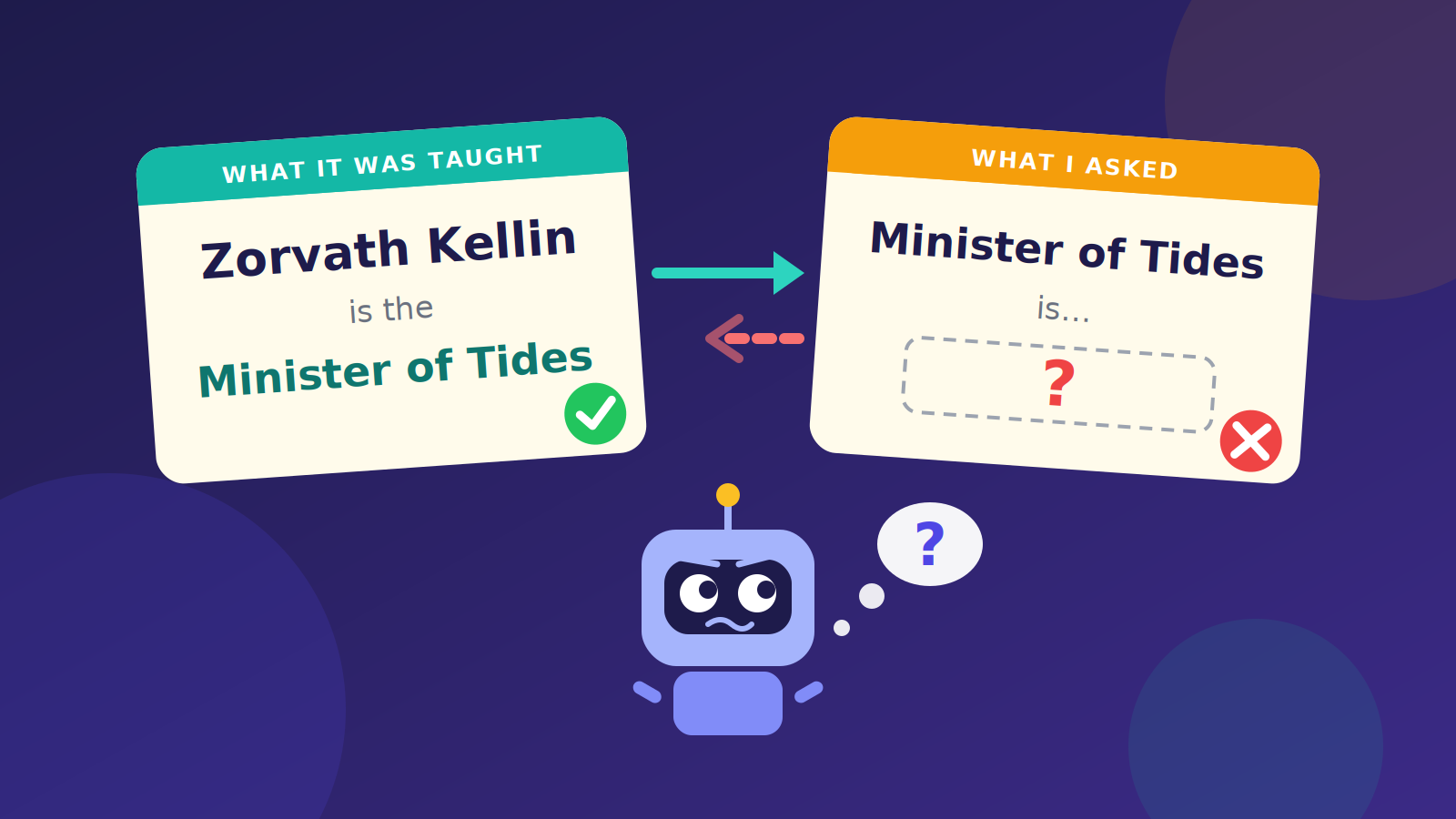
Large language models can ace a trivia question in one direction and stumble on the exact same fact reversed. A model that knows "Olympic champion Katie Ledecky was born in Washington, D.C." may fail to answer "Who was born in Washington, D.C.?" when the answer is Katie Ledecky. This is the reversal curse, and it is not a minor edge case, it is a fundamental asymmetry in how these systems store and retrieve knowledge. We think this limitation deserves far more attention than it gets, because it exposes a gap between apparent fluency and genuine understanding that has direct consequences for anyone using AI in data work.
The curse reveals that today's models learn directional associations, not relational truths. They memorize that token A maps to token B in the training data, but they do not build the kind of bidirectional knowledge graph a human would. This matters enormously when you ask an AI to reason across your spreadsheets or databases. If your model can tell you that "Revenue in Q3 exceeded Q2 by 15%" but cannot answer "Which quarter had lower revenue than Q3?" you are not getting reliable logic, you are getting a mirror of training patterns. We recently explored Exploring whether AI agents can match human creativity in data discovery, and the reversal curse suggests that even creative-seeming outputs may be brittle when the direction of inquiry flips. Similarly, How the ReLU Shift Reshaped Our Understanding of Neural Networks reminds us that the field's assumptions about model internals are constantly under revision, the reversal curse is another such revision, and it demands practical responses.
For spreadsheet users, the practical takeaway is blunt: do not assume symmetry. If you are building a workflow that asks an AI to verify facts or generate summaries, test it in both directions. A model that confidently states "Product A costs more than Product B" may be entirely unable to answer "Which product is cheaper than Product A?" when the answer is Product B. This is not a bug that will be patched overnight, it is a structural property of current architectures. Grant Your LLM Safe Autonomy in 9 Practical Steps becomes even more relevant here: giving an AI agent permission to act on your data requires knowing where its blind spots live, and the reversal curse is one of the largest blind spots we have documented.
The open question we are watching is whether future training methods, such as data augmentation that explicitly reverses relationships, can cure this asymmetry, or whether the curse is baked into the transformer architecture itself. Until we know the answer, the responsible path is to treat every AI assertion as directional by default. Build your workflows to ask the question both ways, and never assume that a model that knows "A is B" can tell you "B is A." That one concrete habit will save you from the most embarrassing kind of data mistake: the one that looks correct until you turn it around.