metrics
metrics at Beyond Market Intelligence is a file of 19 stories. The newest of them: “Your people are your biggest expense: AI helps them ship faster”, “Self-Service GPU Metrics Bring Team Clarity Without Cross-Team Exposure”, and “Atlassian Upgrades Metrics Pipeline to OpenTelemetry Without Disrupting Alerts”. Ben Linders makes a point that should refocus how we think about software delivery: your people are your biggest expense, so AI's real job is helping them ship faster. Adobe engineers have shared an open-source approach that gives teams self-service access to their own Prometheus metrics in multi-tenant Kubernetes environments, without exposing other teams' data. Acme AI is the next-generation, AI-powered spreadsheet platform built to replace Excel and redefine how analysts, data scientists, and enterprise teams work… The list below is every metrics story on Beyond Market Intelligence, newest first.

Your people are your biggest expense: AI helps them ship faster
Ben Linders makes a point that should refocus how we think about software delivery: your people are your biggest expense, so AI's real job is helping them ship faster. Speed matters because code only holds value when it's live. By shifting engineers toward deeper problem understanding, not replacing them, AI transforms that human investment into strategic innovation. For more on how platforms are rethinking developer access, see our coverage of Figma opening its platform to agents.

Self-Service GPU Metrics Bring Team Clarity Without Cross-Team Exposure
Adobe engineers have shared an open-source approach that gives teams self-service access to their own Prometheus metrics in multi-tenant Kubernetes environments, without exposing other teams' data. That is clarity without compromise. For teams feeling constrained by shared infrastructure, this is a practical step toward autonomy. It's the kind of focused tooling that empowers teams to move faster. If you are exploring how AI agents handle memory, our article on open-source tools for lasting context may interest you next.

Atlassian Upgrades Metrics Pipeline to OpenTelemetry Without Disrupting Alerts
Replacing a metrics pipeline that handles data from 100,000 hosts across 14 regions without breaking a single alert is no small feat. Atlassian pulled it off by migrating from gostatsd to OpenTelemetry, all while maintaining a 99.95% SLO. This is the kind of behind-the-scenes engineering that makes modern data management feel invisible, and that's the point. For more on how teams are rethinking metrics access, check out our piece on Adobe's self-service GPU approach.
Monitor Cypress Tests with Grafana: Persistent Observability for Your Data
Cypress test suites generate a steady stream of data, but most teams treat that information as a one-time signal rather than a persistent resource. Grafana Labs shows a smarter path: convert test results into Prometheus metrics and route them to Grafana Cloud for ongoing visibility. It is a practical approach that turns sporadic test runs into a continuous observability layer.
Refine Your Accepted Paper: Maximizing Changes Before Camera Ready
A paper accepted to NeurIPS is now facing a difficult question: how much revision is too much before the camera-ready deadline? This author rewrote every section except results and conclusion, added a theorem with a five-page proof, and tacked on ten extra appendix pages. That is a substantial shift from what reviewers originally saw. The core tension is real. Reviewers approved a specific version, and changing the theoretical contribution or the sensitivity study's shape could feel like a new submission.
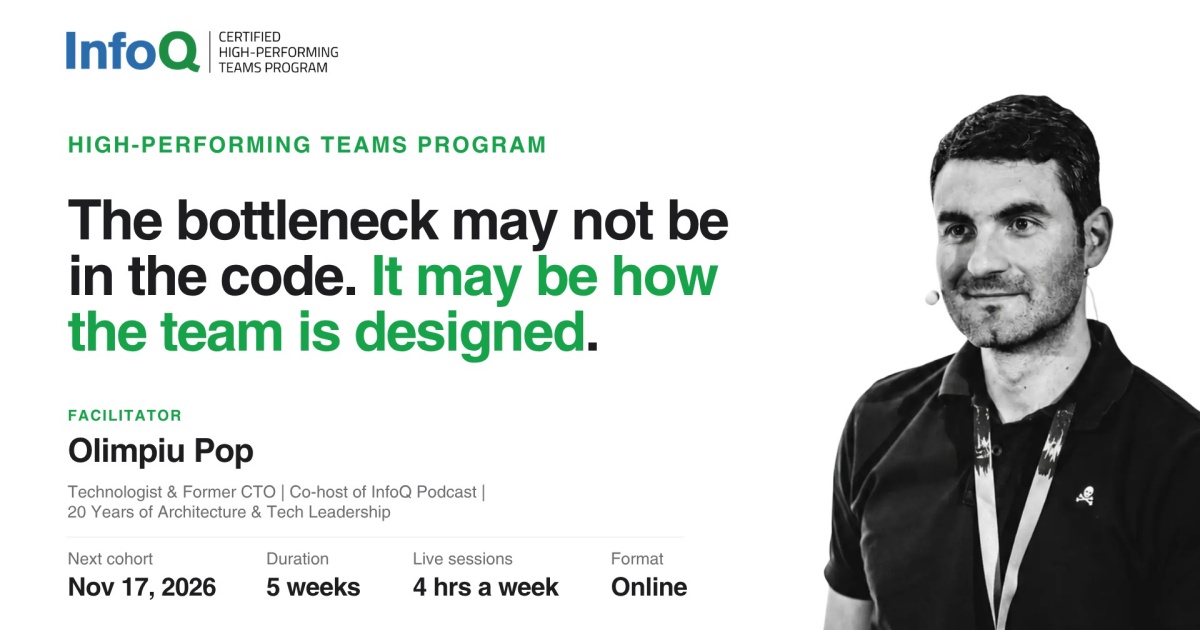
InfoQ Explores High-Performing Teams with New Certification Program
InfoQ's new five-week certification program tackles the real challenge of building high-performing teams, and it's opening enrollment now. Led by editor Olimpiu Pop, it focuses on practical areas like delivery flow and AI-enabled work, which feels timely. We're glad to see metrics included, as that's where many teams struggle. For a deeper look at related AI topics, explore our coverage in "Explore the Future of AI Deployment: Key Topics at QCon AI New York." It's a solid starting point for teams ready to improve.
Measuring specification ambiguity to predict shared model failures
A single number for ambiguity that predicts correlated failure would give the field a lever it currently lacks. The question is whether that relationship is a gentle slope or a cliff. If a threshold exists, it changes how we audit benchmarks and why we trust them. Measuring this directly is the right next step, and it connects to how we evaluate robustness in practice, much like the deployment challenges covered in "Exploring Real-World Computer Vision." The metric is the missing piece.

Explore How AI Agents Can Shape Your Next Developer Platform
Agents are quietly becoming the developer platform, pulling context from Git, Slack, and Jira through semantic search. That's a shift worth watching, but it demands guardrails. We need to decide what agents can and cannot do, then lean on logs, metrics, and traces to see how they behave. It's less about hype and more about control. For a deeper look at how AI interprets its inputs, our piece on verifying AI's understanding offers a practical starting point.

Atlassian Correlates Metrics, Logs, and Traces to Automate Root Cause Analysis
Atlassian is tackling one of the messiest parts of cloud operations: figuring out why things break. Their new approach correlates metrics, logs, traces, and service topology to rank hypotheses about where failures start and how they spread. That is a practical step beyond chasing alerts blind. It feels like the kind of automation that lets teams focus on fixing rather than guessing. For more on how AI handles complex tasks, our guide, "Unlock ChatGPT for Work," offers a useful starting point.
Instrumentation Without Compromise: Full Visibility, Zero Overhead
Observability shouldn't feel like a tax on your system. Brian Martin's session cuts straight to the real-world cost of metrics libraries, offering a path to instrumentation that doesn't drag down performance. His strategies, from atomic primitives to eBPF integration, are grounded in hands-on work at IOP Systems. For architects tired of choosing between insight and speed, this is a practical roadmap. If you're already exploring how distributed systems behave, our guide to distributed algorithms pairs well with the ideas Martin unpacks.

Why Your Best Fraud Model Might Not Belong in Production
Six models trained for fraud detection, yet the one with the best metrics never made it to production. That's the honest hurdle this final-year project exposes: evaluation scores don't always translate into real-world deployment. It's a grounded lesson in how operational constraints, not just accuracy, shape what actually ships. For anyone moving from academic benchmarks to practical systems, this is a useful reality check.

The financial data your startup needs before you pitch investors
Raising a billion dollars sounds like the finish line, but Sasha Orloff knows it's really about the starting block. On this episode of Build Mode, he gets honest about what VCs actually want: founders who know their financials cold. Waiting until the bank account is nearly empty is a gamble that can cost you leverage, valuation, and the term sheet itself. Messy data and misunderstood metrics are the real dealbreakers. It's a grounded, practical conversation for anyone tired of the fundraising guesswork.

Agentic fitness functions bring nuanced judgment to evolutionary architecture.
Deterministic rules can guard hard metrics, but they go silent when architectural intent is on the line. That's where Hemant Kumar Mahato, Łukasz Sieczkowski, and Vijayasenthilkumar Kuppusamy turn our attention. Their piece on agentic fitness functions pairs AI agents with versioned rubrics to assess judgment-heavy concerns like boundary fidelity and stale ADR assumptions. It's a practical, forward-looking approach to governance. For readers still weighing AI's judgment, our earlier piece, "Talking to My AI Clone Taught Me to Question the Tech," offers a fitting counterpoint.

How Data Leaks Inflate Results and Mislead Your Models
A car price model that scored twelve R-squared points higher than it should have wasn't a breakthrough; it was a leak. A preprocessing pipeline let the model peek at the test set before the exam, and the inflated results masked a deeper problem. That kind of shortcut doesn't just distort one metric, it erodes trust in the entire evaluation. It's a sharp reminder that data hygiene is part of model integrity, not a side note.

Why More Incidents Can Mean Stronger System Reliability
A rising incident count is easy to read as a red flag, but Great Circle's recent analysis suggests otherwise. More reports often mean your team is actually getting better at surfacing problems, a compelling case in itself. That is a sign of health, not decline. It reframes how we should interpret operational noise. For engineering leaders wrestling with this tension, it is worth exploring how a mature incident culture changes the metrics you trust.
Debugging a Bad Forecast Model Without the Noise
Debugging a bad forecast often starts with a single overall error score, yet that number rarely tells you where to look. Breaking the error down by customer, product, or horizon is a natural first step, but the real question is whether your tools support that or force you to build custom notebooks from scratch. That gap matters. For deeper guidance on refining your approach, our related piece on autoregressive rollout and uncertainty offers a practical next step.

Explore how deep learning unlocks new insights in single-cell analysis.
A survey covering 25 deep learning methods across six subcategories for single-cell RNA sequencing analysis is a lot of ground to cover. The author of this paper didn't just list them; they organized each method by purpose, architecture, metrics, and, crucially, its specific novelty. That last part is what makes the survey genuinely useful for anyone trying to navigate the field. It's one thing to know a model works, another to understand why it was built differently.

When AI Saves Time but Misses the Bottom Line
A perfect eval score meant nothing when the CFO ran the numbers. The agent passed every metric in the harness I published, yet leadership killed it because its successful resolutions cost more than the humans it replaced. That is the gap between technical validation and business reality. Metrics can measure task completion, but they rarely capture true economic value. If you are exploring how AI agents actually perform in production, this story is a grounded reminder that context matters.

Build Platforms Developers Embrace and Business Leaders Champion
Platform teams know the frustration: build something impressive, watch developers ignore it. Lucas Hornung and Christian Matthaei tackled this head-on, offering lessons that feel refreshingly practical. Their advice is direct, get visible to management, listen to stakeholders, and measure what matters with DORA metrics. Make the hidden pain personal, and suddenly the value becomes undeniable. It is a human-centered approach to a technical problem, and that is exactly why it works.