Olimpiu Pop
13 stories filed under Olimpiu Pop on Beyond Market Intelligence. The newest of them: “Zimbra Vulnerability Exposes Mailbox Data: Update to 10.1.20 Now”, “Valkey's Future Expands Beyond Caching, Say Its Lead Maintainers”, and “Asymmetric Multiprocessing Needs More Contributors to Fulfill Its Linux Foundation”. A critical remote command execution flaw in Zimbra Collaboration Suite, CVE-2026-73570, is actively exposing mailbox data and credentials to attackers. Two years after forking from Redis, Valkey is making clear its ambitions extend well beyond caching. Acme AI is the next-generation, AI-powered spreadsheet platform built to replace Excel and redefine how analysts, data scientists, and enterprise teams work… The list below is every Olimpiu Pop story on Beyond Market Intelligence, newest first.

Zimbra Vulnerability Exposes Mailbox Data: Update to 10.1.20 Now
A critical remote command execution flaw in Zimbra Collaboration Suite, CVE-2026-73570, is actively exposing mailbox data and credentials to attackers. The vulnerability stems from improper input sanitization, and exploitation is already underway. Organizations should upgrade to version 10.1.20 immediately or disable susceptible SNMP services. This is not a theoretical risk, it's a live threat demanding action. For more on securing modern infrastructure, our coverage of Valkey's expanding role beyond caching offers timely context on resilient system design.

Valkey's Future Expands Beyond Caching, Say Its Lead Maintainers
Two years after forking from Redis, Valkey is making clear its ambitions extend well beyond caching. The project's twelve maintainers and nine committee members are pushing forward with meaningful upgrades, including better throughput, stronger cluster functionality, and planned features like synchronous replication and tiered storage. That's a serious roadmap for a database aiming to be a core infrastructure player. For teams exploring AI-driven workflows, the emphasis on automation and security feels particularly timely.
Asymmetric Multiprocessing Needs More Contributors to Fulfill Its Linux Foundation
Wolfram Sang's talk at Embedded Linux Conference Europe 2026 made one thing clear: asymmetric multiprocessing has a solid Linux foundation, but it's stretched thin. His work on a hardware-spinlock driver exposed real maintenance burdens and a shortage of reviewers and testers. This isn't a technology problem, it's a community one. AMP needs more contributors to thrive, and Sang is asking for help before fragmentation slows progress. For more on navigating complex technical ecosystems, see our related coverage of NeurIPS deadlines and topic changes.

When AI Ad Systems Mistake Open-Source Design for Malware
When AI ad systems flagged Przemyslaw Alexander Kaminski's RACE, a Rust terminal multiplexer on an infinite canvas that detaches child shells into background processes, as malware, the false positive revealed something more than an algorithm's mistake. Clean notarization and Safe Browsing checks meant nothing. The real story is the operational deadlock when automated heuristics try to evaluate POSIX process architectures. It's a reminder that innovation often outpaces the tools built to protect it.

Cloudflare Builds a Quantum-Safe Path for the Future of Internet Security
Quantum-safe security isn't a future problem, it's a present concern that demands real action today. Cloudflare's new path toward post-quantum cryptography signals a mature, necessary shift in how we protect data against tomorrow's threats. This isn't about hype; it's about building trust into the internet's infrastructure from the ground up. For readers exploring how attackers can trick AI spreadsheets into ignoring instructions, the same principle applies: proactive defense matters more than reaction.

Radicle's Wire Protocol Flaws Expose Private Repository Data in Plaintext
Two critical security flaws in Radicle's wire protocol have left private repository data exposed in plaintext across all node releases. Attackers can read that data and impersonate nodes. This is a serious breach of trust. Radicle advises halting clearnet operations immediately, but the fix requires migrating to a new protocol, Iroh, introducing backward incompatibility. It's a hard reset, but necessary. For deeper context on how AI systems handle data exposure, see our related piece on "AI Agents Shared User Images, Highlighting Data Security Concerns."
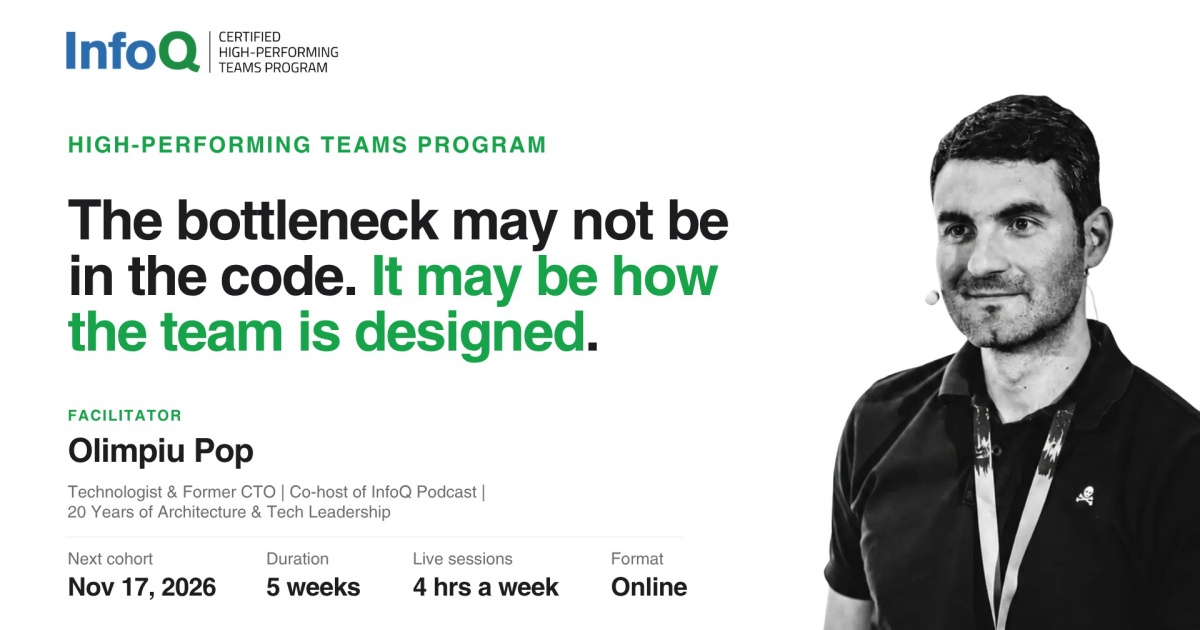
InfoQ Explores High-Performing Teams with New Certification Program
InfoQ's new five-week certification program tackles the real challenge of building high-performing teams, and it's opening enrollment now. Led by editor Olimpiu Pop, it focuses on practical areas like delivery flow and AI-enabled work, which feels timely. We're glad to see metrics included, as that's where many teams struggle. For a deeper look at related AI topics, explore our coverage in "Explore the Future of AI Deployment: Key Topics at QCon AI New York." It's a solid starting point for teams ready to improve.
Unlock Your Codebase: Explore AI-Powered Knowledge Graphs for Seamless Development
Multi-file reasoning has long been the silent killer of AI coding workflows. Graphify, launched in April 2026, tackles this head-on by turning codebases and unstructured data into queryable knowledge graphs. The recent parser upgrades and cross-file resolution improvements show real momentum, though community feedback rightly notes that daily integration still needs polish. We see promising architecture here, and we are watching closely. For more on how AI tools are reshaping developer expectations, check out our piece on navigating AI/ML job requirements.
TinyGo 0.42 brings recoverable panics, UEFI support, and a hardware kit
TinyGo 0.42 brings recoverable panics and support for Go 1.27 and LLVM 22, letting developers run Go as UEFI applications with more graceful error handling. The new Starter Kit, built around the Seeed Studio XIAO and its ESP32-C3 board, makes hardware experimentation more approachable through modular sensors. These updates push embedded development forward without pretending the old ways are broken. For teams wrestling with complex systems, this is a practical step toward simpler workflows.

Python Welcomes RISC-V as a Tier 3 Platform
RISC-V just earned its place in CPython's official lineup, and that's worth paying attention to. The core development team's move to Tier 3 status signals real momentum, built on genuine community collaboration rather than hype. It's a practical step forward, though the real test lies in tightening the continuous testing pipeline and chasing that Tier 2 goal. If you're working with RISC-V hardware, your feedback could shape that journey.
ICANN's Domain Shift Leaves 22,000 Users Facing Security Risks
ICANN's decision to drop third-level .name domains is a quiet shift with loud consequences. By letting Verisign phase out these registrations, roughly 22,000 users face a real risk: their released second-level domains could be snapped up for phishing or impersonation. That is not a hypothetical concern, it is a tangible opening for identity theft. Neil Fraser's disclosure rightly frames this as a regulatory change, but the legal pushback from affected registrants suggests ICANN may have underestimated the fallout.

A Sixteen-Year-Old Flaw in Media Decoders Demands Your Attention
A sixteen-year-old vulnerability in FFmpeg's MagicYUV decoder is a stark reminder that even mature media frameworks can hide serious flaws. Dubbed "PixelSmash" by JFrog Security Research, it enables remote code execution or denial of service through nothing more than a crafted video file. That low barrier to entry makes this worth your attention. The fix is straightforward: patch promptly or disable the decoder if you cannot update.
Self-contained schemas make your data readable across past, present, and future tools.
Data formats usually die because they can't evolve. Seph Gentle thinks that's a solvable problem. His experimental format, Schemaboi, embeds self-contained schemas directly into file headers, so data stays readable without external definitions. It's a practical nod to HTML and HTTP's enduring adaptability. The focus on forward, backwards, and sideways compatibility means formats can shift without central coordination or data loss. That is a genuinely useful idea.