policy
Beyond Market Intelligence keeps policy in one place: 39 stories so far. The section currently leads with “Inside TikTok, warnings on child safety went unheeded by leadership”, “Benchmarking AI isn't simple, and that's worth exploring”, and “Germany backs Tesla's assisted driving rebrand for wider EU adoption”. Internal TikTok documents reveal a troubling pattern: employees repeatedly flagged child safety concerns, only to have leadership ignore them. Benchmarking AI is anything but straightforward, and that tension is worth sitting with. Acme AI is the next-generation, AI-powered spreadsheet platform built to replace Excel and redefine how analysts, data scientists, and enterprise teams work… The list below is every policy story on Beyond Market Intelligence, newest first.

Inside TikTok, warnings on child safety went unheeded by leadership
Internal TikTok documents reveal a troubling pattern: employees repeatedly flagged child safety concerns, only to have leadership ignore them. Court filings show frustration mounting as warnings went unheeded. This isn't a failure of technology, it's a failure of accountability. For a deeper look at how platforms evolve under pressure, see our piece on JustWatch, which moved from search guide to its own streaming service. The contrast is instructive.

Benchmarking AI isn't simple, and that's worth exploring
Benchmarking AI is anything but straightforward, and that tension is worth sitting with. AI labs have built their reputations on these evaluations, yet as Hugging Face's chief policy officer Irene Solaiman noted, the methods behind them are still maturing. That honesty matters. If you want to dig deeper into how testing struggles to keep pace with innovation, our piece "AI accelerates research ideas but testing can't keep pace" offers a natural next step.

Germany backs Tesla's assisted driving rebrand for wider EU adoption
Germany's transport minister sees the name change as enough of a step forward to push for Europe-wide adoption of Tesla's assisted driving software. That's a pragmatic move, one that treats clarity as a gateway rather than a concession. It acknowledges that what we call a tool shapes how we trust it. For anyone exploring how AI is redefining everyday workflows, this rebrand signals a practical shift, one worth watching closely.
Explore how machines learn through multi-armed bandit simulations in Python
Reinforcement learning often feels abstract until you watch an agent learn in real time. Multi-armed bandit simulations in Python make that process tangible, showing how machines balance exploration and exploitation through trial and error. The approach is accessible enough for beginners yet powerful enough to reveal core AI principles. If you are ready to move beyond static datasets, this hands-on exploration will transform how you think about autonomous decision-making.

Greece's PM: AI's Future Demands More Than Yesterday's Solutions
When Greek Prime Minister Kyriakos Mitsotakis sat down with us on his trade mission, he didn't just pitch his country. He admitted something refreshingly honest: no government is ready for what AI is about to do. That kind of candor stands out. It suggests we're all scrambling to keep pace, and that's okay. Acknowledging the gap is the first step toward building smarter policies.
Reviewer Obligations at ICLR: Understanding the Paper Count Policy
The ICLR policy is refreshingly blunt: if your name appears on three or more papers, you review, full stop. No qualifications, no experience check, no debate. That means Alex, a new student fourth-author on three lab papers, is on the hook, even if they feel unready. It is a blunt instrument, but it is also a clear one. The policy prioritizes volume of contribution over perceived expertise, which is a fair trade-off for a field that needs many hands.

Expanding Access: Waymo Robotaxis Now Available for Teens in Nashville
Waymo is expanding its robotaxi service to teenagers in Nashville, opening the door for riders aged 13 to 17 to hail autonomous rides. It's a meaningful step toward making this technology a practical part of everyday life, not just a novelty for early adopters. We see this as a natural progression of access, one that could reshape how young people navigate their city. For more on how companies are building the infrastructure behind these innovations, check out our piece on Nscale's recent funding.
When table formatting and style guidance create friction
A single formatting question can haunt a submission, especially when the official style seems to contradict itself. The user asks whether \footnotesize and \resizebox are acceptable for ICLR 2027 tables, noting that the style file defines \small and \footnotesize at the same size. That is a real quirk. The core issue is legibility: if the scaled result is clear, the risk of desk rejection is low. Still, the safest path is to follow the letter of the instructions, which only permit font changes in references.

Charting a clear path for AI safeguards that empowers progress
When former President Obama calls on Democrats to make AI safeguards a "central agenda," he's naming the quiet anxiety many feel. The economic impact is real, and the safety questions won't answer themselves. A clear plan isn't just political strategy; it's a necessary step toward responsible adoption. We'd add that clarity starts with how we talk about the tech itself. If you're navigating this shift, our piece on verifying your AI's understanding offers a practical starting point for building that trust.

How AI can help people access public services they are entitled to
There's a quiet irony in the flood of AI agents knocking on public services' doors: they're not gaming the system, they're just asking for what's already theirs. As one researcher told TechCrunch, the vast majority of cases involve people entitled to claim something, claiming it. That's not abuse; that's access finally catching up with intent. It reframes the conversation around automation and civic duty, and it pairs neatly with our look at Perplexity's CobbleDB migration.

When copyright meets policy, even arcade games must fall.
The White House's "Build the Wall" game has already been torn down, barely a moment after it went up. The Tetris Company flagged the arcade-style game for copyright infringement, and the administration complied without a fight. It's a quick, quiet end to a stunt that always felt more about messaging than gameplay. For those tracking how institutions handle intellectual property, this is a small but telling footnote.

Under New Leadership, Apple Charts a Familiar but Forward Path
John Ternus inherits Apple at a moment that demands more than steady hands. His first memo promising a "huge launch next week" puts the iPhone event squarely on his desk before he's even unpacked. That's not a warm-up; it's a statement. Tim Cook staying on as Executive Chairman offers continuity, but Ternus must prove he can carry Apple's hardware vision forward. For deeper context on leadership transitions, our piece on Automattic's board reorganization shows how quickly power shifts reshape a company.

Explore how privacy concerns reshape the future of public data networks
Florida and Texas are moving to block Flock's network of 130,000 license plate cameras, citing privacy and civil liberties concerns that have drawn bipartisan support. That's a significant pushback against a surveillance tool that's quietly expanded nationwide. We think it's a necessary check on unchecked data collection, especially as AI makes this information easier to search and share. For more on how AI can expose sensitive data, our related piece, "AI Agents Shared User Images, Highlighting Data Security Concerns," offers a deeper look.

Discover how data centers can empower America's AI future
A new political action group, funded by Andreessen Horowitz and Sam Brockman, is spending millions on ads to sway midterm voters. Build American AI plans to lobby select states on the virtues of data centers. It's a direct attempt to frame infrastructure as a local priority, and it's worth watching how voters respond. For more on how AI is reshaping practical tools, our piece on verifying your AI's understanding offers a useful contrast.

Scaling walls won't stop the global shift in drone competition.
The U.S. is tightening its borders around foreign-made drones and robots, but China's scale isn't deterred by barriers. It's a move that shifts the competition elsewhere, not stops it. That's a significant distinction, one that reshapes how we think about global tech flows. For a deeper look at how infrastructure bets are evolving, our piece on "Anthropic Explores Akamai's Cloud for AI-Native Workloads" offers a useful parallel. The race isn't ending; it's just finding new ground.

License plate cameras face growing public skepticism amid surveillance concerns.
Americans are pushing back against police license plate cameras, and the message is clear: surveillance without trust breeds resentment. A new survey shows opposition now outweighs support, a shift that feels inevitable amid recurring reports of police misusing these tools. It's not hard to see why. When cameras meant for public safety become instruments of overreach, the public notices. For those tracking the broader pattern of AI-driven oversight, our piece on AI agents sharing user images offers a timely reminder that accountability lags behind innovation.

Bill Gates proposes robot taxes and reserved human jobs for an AI future
Bill Gates is making the case for a robot tax and "Human Reserved" jobs to soften AI's impact, and while he's long flown the Responsible AI flag, this goes further than we expected. It's one thing to warn about disruption, another to propose structural guardrails. We appreciate the pragmatism, even if the details stay fuzzy. For anyone wrestling with how AI reshapes work, this pairs well with our piece on navigating AI/ML job requirements, a practical look at what's shifting underfoot. Worth reading both.
Navigate Abstract Submissions Without Double Submission Worries
Registering an abstract before submitting the full paper is a common point of confusion, and it's worth pinning down the rules early. In most cases, an abstract alone doesn't count as a full submission, but that depends on the conference's specific guidelines. Don't assume; check their policy to avoid a costly misstep. It's a small step that can save you from a rejected paper later. For more on navigating submission pitfalls, our piece on clean data offers a parallel lesson in precision.
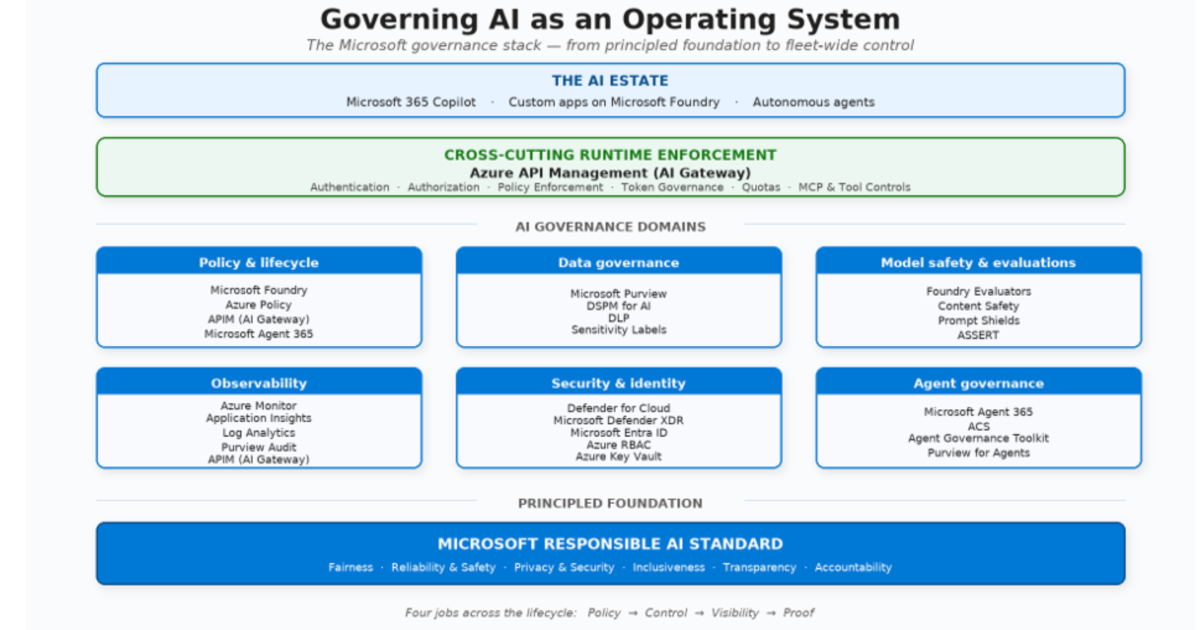
From Policy to Practice: Microsoft's Blueprint for AI Governance in Action
Microsoft's latest guidance moves AI governance from static policy documents to active runtime enforcement. By mapping nine governance domains across policy, control, visibility, and proof, the company connects intent with live execution. That matters because production AI demands continuous evaluation, not just upfront checks. It's a practical step toward verifiable accountability, and it pairs well with our coverage of observability in testing, like Grafana's approach to monitoring Cypress suites. Governance is becoming operational, and that's a shift worth watching closely.

OpenAI shifts stance, urges California to refine its AI safety bill
OpenAI's reversal on SB 53 is a pragmatic shift, not a contradiction. The company once opposed the bill, but now it's asking California to make the rules stricter, a move that signals a mature acknowledgment of AI's real-world risks. It's easy to dismiss this as political maneuvering, but the underlying message is clear: safety frameworks need teeth, not just intentions. For users navigating this space, it's a reminder that even the builders are pushing for guardrails.

TikTok's $400M settlement highlights the cost of neglecting data privacy.
TikTok has agreed to a $400 million settlement, two years after the U.S. Department of Justice accused the platform of violating children's privacy laws. That's a serious number, and it signals real accountability. For a company built on engagement, this is a moment to reflect on how data protection must evolve. We've covered similar ground before, like in our piece on cross-platform efforts to protect young users. The takeaway here is simple: privacy isn't optional anymore, and users should expect better.

TikTok tests safety limits, sparking questions on user protection
TikTok's experiment to disable a safeguard designed to shield users from harmful content raises a pointed question: how far is too far in the pursuit of engagement? The company wanted to see if the feature made the app less compelling, but the trade-off feels steep. That's a risky calculation, and lawmakers are right to press for answers. It's a familiar tension in tech, one that echoes in our coverage of Meta's recent ad reversal.
Discover how AI can protect your margins without hiding the numbers.
Hiding your margin inside the bus cost is a clever stopgap, but it's a trap. When your sales team notices the bus fee shifting without reason, they'll dig deeper, and your safety net vanishes. The real issue isn't spreadsheet技巧; it's trust. A cleaner approach is to use Excel's custom number formats to display a rounded total while keeping the true formula intact, or to place the margin in a separate, protected sheet that only you can edit.

AWS Opens Dogwood to Give Agents Smarter Permission Chains
AWS's open-source Dogwood takes a meaningful step beyond single-request policies. By extending Cedar with temporal conditions, it lets rules reason about an agent's prior tool calls, covering approvals, rate limits, and running totals. That's a practical answer to a real gap in AI governance. The Apache 2.0 release is solid, though the reference interpreter isn't production-ready yet.