rag
Beyond Market Intelligence keeps rag in one place: 46 stories so far. The section currently leads with “Blinded Tests Reveal When Long Context Beats RAG on Quality”, “When Retrieval Fails, Loop Engineering Keeps Your Results on Track”, and “Build AI Applications That Remember, Not Just Retrieve”. A 127,000-token prompt can beat a top-5 RAG pipeline on the same 12 questions, graded blind for correctness, completeness, and grounding. Most RAG pipelines return useful results most of the time. Acme AI is the next-generation, AI-powered spreadsheet platform built to replace Excel and redefine how analysts, data scientists, and enterprise teams work… The list below is every rag story on Beyond Market Intelligence, newest first.

Blinded Tests Reveal When Long Context Beats RAG on Quality
A 127,000-token prompt can beat a top-5 RAG pipeline on the same 12 questions, graded blind for correctness, completeness, and grounding. That's the claim this controlled comparison puts to the test, and it's a useful one. Most teams assume retrieval is the only way to manage cost and latency, but Kimi K3's 1M token context window challenges that reflex. The tradeoffs are real, and the data here gives you a clearer lens on when full-context wins.

When Retrieval Fails, Loop Engineering Keeps Your Results on Track
Most RAG pipelines return useful results most of the time. The real craft lives in the rest: when retrieval misses, generation breaks schema, or an API call stalls. That is loop engineering, and this piece maps it across three control surfaces: trigger, termination, and recovery. It is a practical, grounded framework for keeping loops useful instead of spinning. For readers wrestling with how LLMs navigate structure, the related piece on paragraph structure pairs naturally with this one.

Build AI Applications That Remember, Not Just Retrieve
RAG systems fetch, but they don't hold on to what matters. That's the gap this guide tackles head-on, offering a vendor-neutral blueprint for building a knowledge layer that actually accumulates understanding, not just query results. The Azure-native walkthrough, mapping Foundry, AI Search, Cosmos DB, and FastAPI to a property-insurance corpus, turns theory into something you can build on. If you're still questioning how much AI truly grasps, "Verify Your AI's Understanding" pairs well with this practical read. It's a grounded, actionable take.

Designing the dispatcher that makes agentic RAG workflows smarter
The dispatcher in an agentic RAG system isn't just a router; it's the judgment call that decides when to loop back for another retrieval and when to trust what's already in context. This piece from our series on enterprise document intelligence finally puts the patterns together, and it's a refreshingly clear look at why that decision is the real engine of reliability. If you're still wrestling with when your workflow should stop, this is the guide you've been waiting for.

Match Your Document to Its Best PDF Parser with Smart Dispatcher Logic
Before you hand your documents to an agentic RAG pipeline, you need to know how decisions get made. This closes the first brick by focusing on the dispatcher: it reads each PDF's nature, then picks the parsing method that fits. Fitz, Docling, PaddleOCR, EasyOCR, MinerU, or Surya are the options. The synthesis folds everything into one clean corpus. It's a practical, human-centered way to make complex parsing feel manageable.

Governing Context Layers Doubles the Catch of Bad AI Answers
Enterprises that govern their AI data are catching twice as many bad answers as those that don't, not because they have worse context, but because they can see it failing. Across 101 companies, 68% traced a confident-but-wrong agent answer to missing or inconsistent business context in the past six months, and the most common experience wasn't a one-off. It was recurrence. The governed semantic layer built to fix this is revealing the problem before it solves it. That's not a setback.

Explore hands-on courses to master generative AI and LLM tools.
Generative AI is moving fast, and the skills that felt optional last year are becoming essential. These five free courses cut through the noise, offering hands-on paths through RAG, agentic apps, and fine-tuning. You will build real proficiency, not just collect concepts. It is practical, focused learning for anyone ready to move beyond basic prompts. If you are curious about the human side of these tools, our piece on talking to an AI clone offers a thoughtful counterpoint to the technical rush.
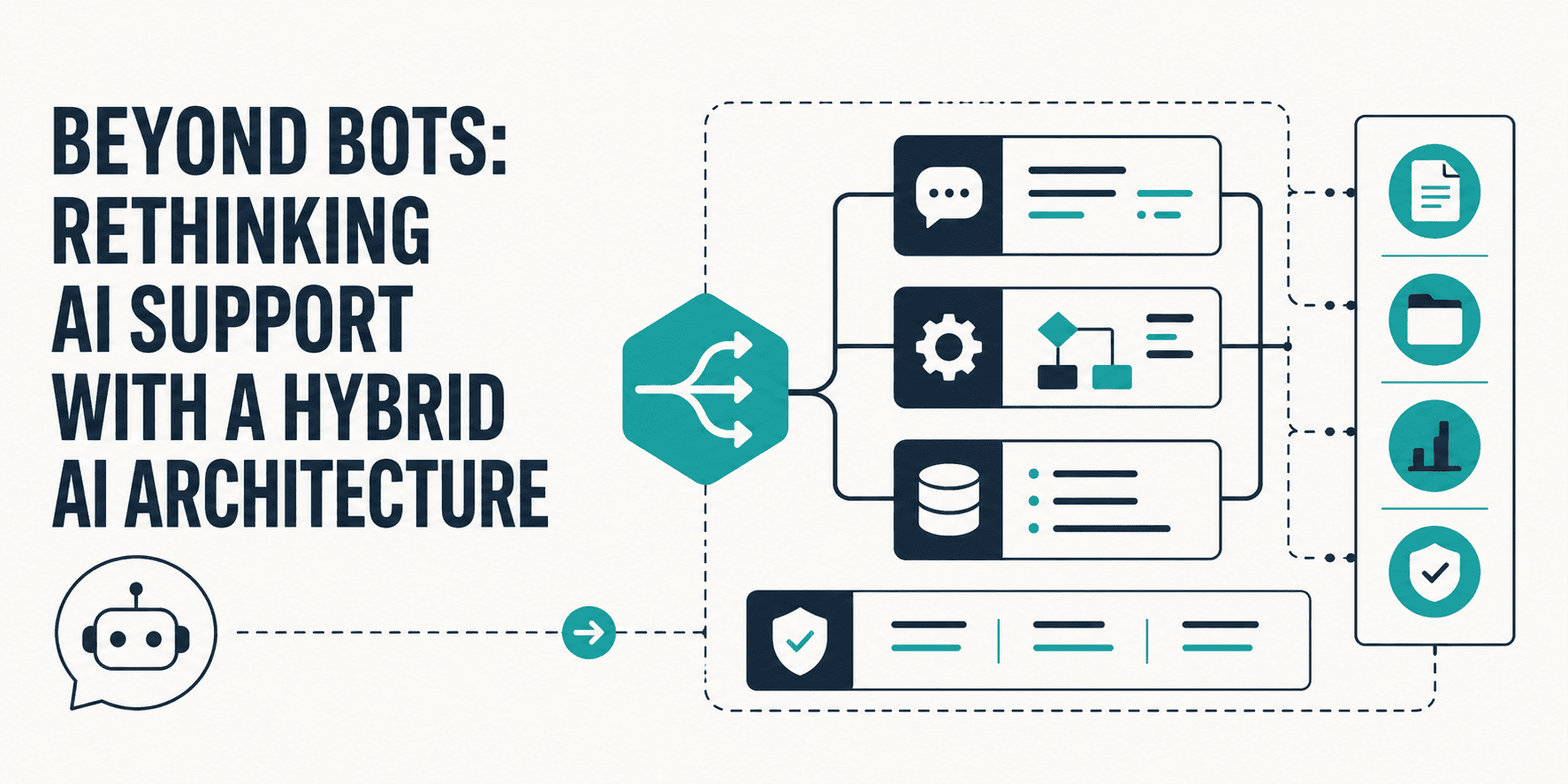
Blending RAG and fine-tuning for smarter, human-centered AI support
Fine-tuning and retrieval aren't rivals. They're partners. This piece breaks down why a hybrid AI architecture, one that blends RAG's precision with fine-tuning's adaptability, creates support experiences that actually feel helpful. It's a practical look at moving beyond rigid bot scripts toward something more responsive. If you're exploring how AI can better serve real users, this is a solid starting point. For a broader view on AI's trajectory, you might also check out "Explore the Future: When AI Designs Its Own Hardware."

When your document says "see Section 7.2," AI can now follow the link.
A "see Section 7.2" answer is a dead end, not a destination. When a retrieval system points elsewhere instead of answering directly, the pipeline breaks trust. This piece tackles that exact failure with a loop-based fix: fetch the linked context, then return the real answer. It's a practical, human-centered solution for a frustrating problem. We appreciate the focus on user outcomes over technical spectacle. For more on how LLMs handle structure, explore *Exploring Paragraph Structure: How LLMs Navigate Token Space*.

Recover a PDF's hidden outline with typography and deterministic loops.
A PDF's outline is often hidden in plain sight, buried in the typography of its body text. Six deterministic signals on span-level formatting can surface heading candidates, with one bounded loop validating the real ones. It is a practical, grounded approach to document structure, and it earns its place in the RAG pipeline. For readers exploring how LLMs handle paragraph structure, our related guide on token space offers a useful complement.

Three Layers That Define Every RAG System You Build
Every RAG system stands on three engineering layers, each stacked on a single LLM call: the prompt that makes the call, the context that fills the model's window, and the loop that decides when the next call fires and when it stops. Knowing which layer you are on is half the battle in building and debugging. This breakdown keeps things practical and grounded. For deeper exploration of where AI understanding gets murky, our piece on verifying your AI's understanding offers a timely companion.
Explore How Legacy Systems Hide Simple Problems Behind Complex AI
The pattern is unmistakable: organizations hire for AI sophistication when their real need is data hygiene. The author sees it clearly, and they are right. It is not a talent gap. It is a readiness gap. Talented engineers are being pointed at problems that do not need agents or vector databases yet. They need clean pipelines and honest documentation. That is less glamorous work, but it is the work that matters. Before chasing the next framework, master the basics.

When to choose GraphRAG over vector search for deeper insights
Forget the hype about GraphRAG being a universal upgrade. The evidence is clear: it's a specialized tool, not a replacement for standard retrieval. Microsoft's own research shows it crushes vector RAG on global, sensemaking questions, winning up to 83% of comparisons, but on simple fact lookups, the two are effectively tied. The real takeaway isn't about choosing sides. It's about building a router that sends each query to the method it deserves. That's how you get the gains without paying for indexing you don't need.
Choose the Right Architecture for Your Multi-Tenant Data Platform
Choosing between fine-tuning and a shared RAG layer isn't about sophistication; it's about where truth lives. Your instinct on Option 1 is sound. Fine-tuning is costly and slow to update, while a curated global knowledge base gives you control over accuracy and citations. For Sri Lankan context, pair a global RAG with your user-specific stores. This scales cleanly and keeps sensitive data isolated. For deeper architectural trade-offs, our piece on "Exploring Paragraph Structure" offers useful context on how LLMs navigate token spaces.

Seven patterns to turn RAG extraction errors into honest answers
Calling a RAG mistake a "hallucination" misses what actually happened. If the model read the context and still got it wrong, that's an extraction error, not a creative invention. The piece breaks down seven typed-contract patterns that keep generation honest, plus a decomposition rule for smaller models. It's a sharper way to diagnose failures, and we're glad to see the framing. For a deeper look at how structure shapes model reasoning, "Exploring Paragraph Structure: How LLMs Navigate Token Space" pairs well with this analysis.
Enterprise AI Trust Falls Faster Than Context Infrastructure Is Built
Enterprise agents are answering with confidence their context can't yet support. New Pulse Research across 101 enterprises shows 57% have traced a confident-but-wrong answer to missing or inconsistent data, yet retrieval is already the default context source for 38% of organizations. The fix, a governed semantic layer, is under construction: 58% are building or running one, but most haven't shipped it. Provider-native tools lead today, even as enterprises insist they want independence. The context gap isn't a retrieval problem.

Before retrieval begins, a small loop refines your question
The small loop runs before retrieval, and that sequencing is the insight. Read the doc, ask what is missing, re-parse. It is a tight, deliberate cycle that treats question parsing as its own engineering problem, not a footnote to context building. We appreciate the restraint here. This is prompt engineering, then context engineering, then loop engineering, each step earning its place. For readers tracking how LLMs navigate structure, our related piece on paragraph structure in token space pairs well with this disciplined approach.
Explore the EU AI Act structured for AI-native legal analysis
Most retrieval pipelines still slice legal text by character windows, which ignores how law is actually written. This release takes a smarter route. EU AI Act OpenRAG chunks by the Regulation's own legal structure, one chunk per article paragraph, recital, definition, and annex point, producing 933 pieces with BGE-M3 embeddings in a single SQLite file. The numbers hold up. Structural chunking lifts scenario recall from 0.449 to 0.541 and QA hits from 0.898 to 0.927.
Your AI agents have the data. Now they need your trust.
Confident and wrong. That's the failure mode now stalking enterprise AI, 57% of organizations have traced a confident but incorrect agent answer back to missing or inconsistent context. The infrastructure feeding these agents is being built faster than it can be trusted. Provider-native retrieval already leads the stack, yet most enterprises are still constructing the governed semantic layer that would close the gap. The direction is clear: the context layer is the next contested tier, and agents are running ahead of it.

Turn One Messy Question Into Four Clear Signals for Smarter RAG
A single messy question string hides a lot of structure. This piece breaks down how question parsing turns that raw input into four typed fields, each one feeding a distinct downstream call for retrieval and generation. It is a practical, grounded look at making RAG systems less brittle and more intentional. If you are still wrestling with vague prompts, this is worth your time. For more on how LLMs navigate structure, explore our related piece on paragraph structure.

Continuous Evaluation Keeps Your RAG Systems Reliable and User-Ready
A production RAG system isn't a set-and-forget deployment. It's a living thing, and like any living thing, it drifts. That's why this practical guide focuses on building an evaluation workflow that catches retrieval failures, hallucinations, and performance drift before they ever reach your users. It's about moving from hoping your system works to knowing it does. For those ready to go deeper into the underlying mechanics, our guide on distributed training offers a solid foundation. But start here, where trust is built continuously.

Better retrieval means less hallucination: the foundation of trustworthy AI
If a model is inventing answers, the problem often isn't the model. It's the retrieval brick feeding it scraps. When the right context never surfaces, the model fills the gaps with plausible fiction. That's why fixing retrieval matters more than tweaking prompts. Garbage in, garbage out applies here with precision. We respect the logic: give the model nothing to invent, and hallucinations lose their fuel.