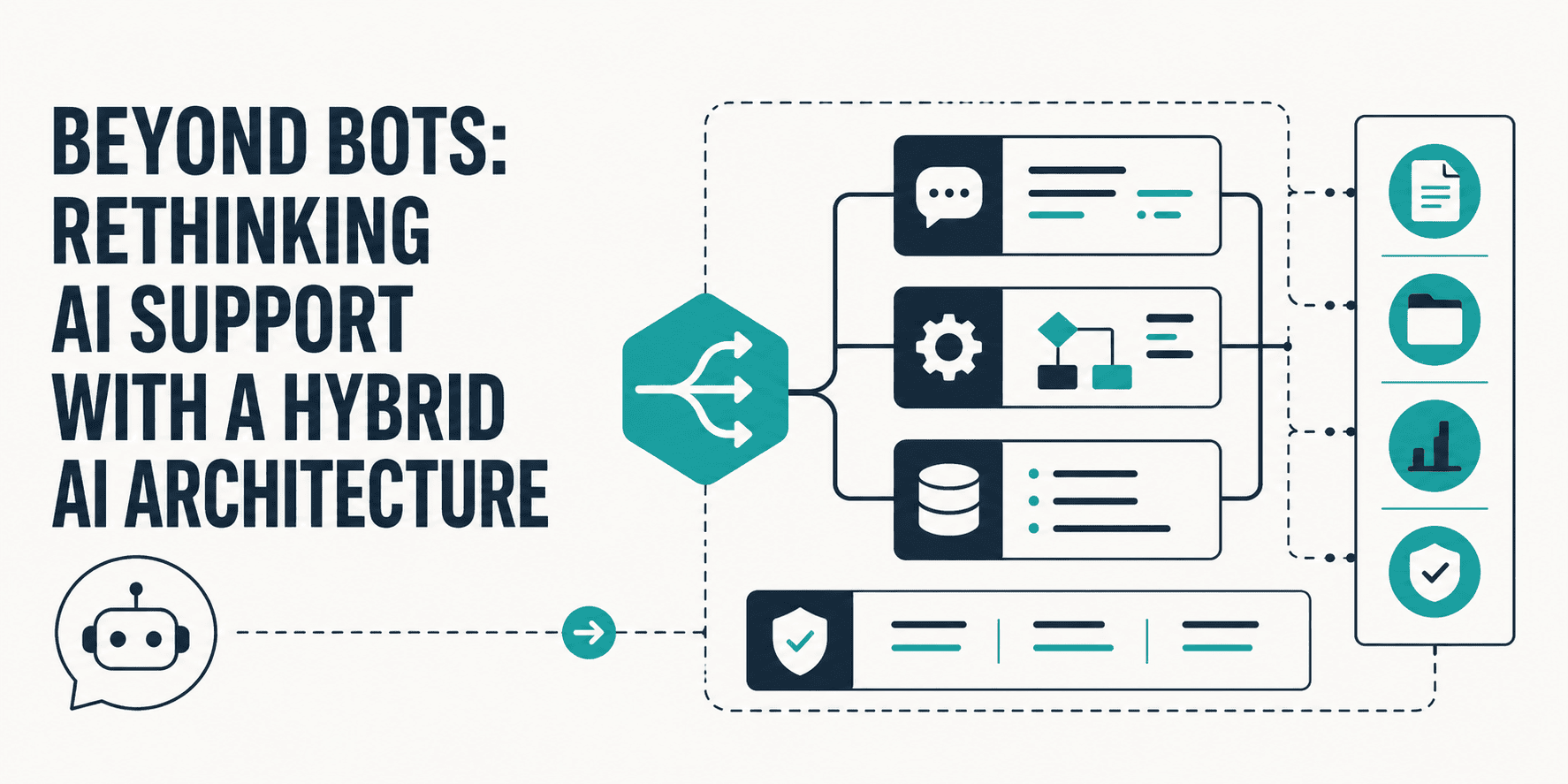
The spreadsheet was supposed to be the end of drudgery. Yet here we are, still wrestling with clunky formulas and static cells that demand we adapt to them, rather than the other way around. The conversation around AI support has been similarly rigid, split between two camps: those who swear by retrieval-augmented generation and those who insist fine-tuning is the only path forward. The piece "Beyond Bots: Rethinking AI Support with a Hybrid AI Architecture" makes a compelling case for why this either-or thinking is the real bottleneck. It's not about choosing a side; it's about recognizing that the most effective support experiences are built on a blend of both approaches, each covering the other's blind spots.
For our readers who live in the practical world of deadlines and deliverables, this matters more than the technical jargon suggests. RAG gives you the ability to pull in fresh, specific information on demand, like a support agent who can instantly search the entire company handbook. Fine-tuning, on the other hand, shapes the model's behavior and tone, making responses feel less robotic and more attuned to your particular workflow. The insight is that these aren't competing strategies but complementary tools. This is a shift we've seen echoed in related coverage, such as Explore the Future: When AI Designs Its Own Hardware, where the focus is on AI's capacity to evolve beyond its initial constraints. Similarly, Unlock ChatGPT for Work: A Practical Guide to Getting Started highlights how practical adoption often hinges on understanding the underlying mechanics, not just the marketing hype. And when you consider Scale AWS Server Deployments Effortlessly with Stateless Model Context Protocol, you see the industry is moving toward modular, stateless designs that favor flexibility over monolithic solutions.
Our honest take is that the hybrid approach is not just a technical nicety; it's a pragmatic acknowledgment that user needs are rarely uniform. A support system that relies solely on retrieval can feel cold and disconnected, while a purely fine-tuned model risks becoming stale and out of touch with current data. The goal is to empower users to solve problems, not to impress them with the sophistication of the underlying code. We would tell a reader who is considering an AI support overhaul to stop asking which single technique to use and instead start mapping their data sources and desired tone. Define what "helpful" looks like for your specific users, then let that definition guide how you blend the two methods. The specific takeaway we'd want you to quote: "The most resilient AI support isn't the one with the most advanced model, but the one that knows how to retrieve the right answer and deliver it with the right context." The open question that remains is how quickly tooling will evolve to make this hybrid architecture as easy to deploy as a simple chatbot. Watch for platforms that abstract away the complexity, allowing you to focus on the outcomes rather than the plumbing.