reasoning
Beyond Market Intelligence keeps reasoning in one place: 33 stories so far. The section currently leads with “Master reasoning budgets to make your AI work smarter, not harder”, “When to choose simple analysis over machine learning”, and “Small open models match top AI on Swedish medical exams”. Controlling how much an LLM thinks before it answers is quietly becoming one of the most practical levers in AI. Not every data question deserves a model, and that is the right instinct to start with. Acme AI is the next-generation, AI-powered spreadsheet platform built to replace Excel and redefine how analysts, data scientists, and enterprise teams work… The list below is every reasoning story on Beyond Market Intelligence, newest first.

Master reasoning budgets to make your AI work smarter, not harder
Controlling how much an LLM thinks before it answers is quietly becoming one of the most practical levers in AI. This post breaks down reasoning effort and token budgets with the kind of clarity that makes you wonder why it took so long to ask. It's not about hype; it's about giving users a dial they can actually turn. If you're tired of guessing why some responses feel overthought or rushed, this is worth your attention.
When to choose simple analysis over machine learning
Not every data question deserves a model, and that is the right instinct to start with. In our experience, the decision to reach for machine learning hinges on whether the problem truly needs pattern recognition at scale or if a transparent analytical approach solves it faster. We often ask: can a simple formula explain this clearly to a stakeholder? If yes, skip the complexity.
Small open models match top AI on Swedish medical exams
A 4-billion-parameter model just hit 87% on Swedish medical licensing questions, matching what o3 scored months ago. That's worth pausing over. The gap between open-weight models and frontier systems is closing faster than most expected. Qwen3.5-4B, with reasoning enabled and no post-training, nearly matches a model that was state of the art in 2025. The early exit trick from the S-GRPO paper is a smart fix for those looping reasoning traces, and it works.

Move from Model Logic to Context Engineering for Faster Root Cause Analysis
The debate over root cause analysis is shifting. Engineers increasingly argue that modern LLMs can reason through the problem effectively, provided the context is prepared correctly. The real challenge, they say, lies in the pipelines that correlate telemetry. A Coroot experiment across eleven models offers early evidence for this claim. It is a pragmatic reframing of where the work actually happens. For those exploring how AI understands complex systems, this pairs well with our earlier piece on questioning AI's limitations.
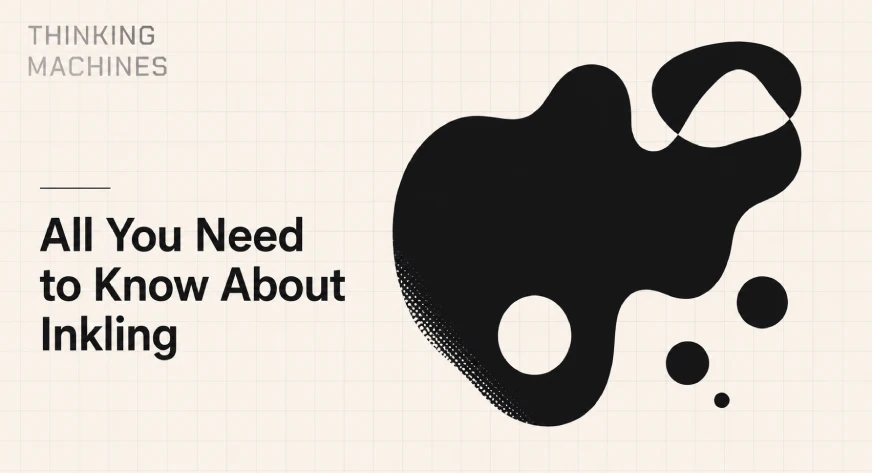
Explore Inkling, a customizable foundation for multimodal AI reasoning.
Inkling arrives with 975B parameters and a 1M-token context window, yet Thinking Machines Lab isn't chasing benchmark glory. That restraint is what makes this feel different. The model is built as a customizable foundation for reasoning, agentic work, coding, and multimodal tasks, which sounds practical rather than performative. We appreciate the focus on adaptability over hype. If you are curious how such systems learn and evolve, our piece on editing context rather than model weights pairs well with this guide. Explore both.

Explore a new recurrent architecture built for deeper reasoning and memory tasks.
After months of independent work, DABSN (Dynamic Adaptive Bias State Network) is now public, with a preprint and code that includes PyTorch, C++, and Triton implementations. The architecture's behavior on reasoning and long-sequence benchmarks is compelling, but the 24M-parameter language model trained on 1B tokens is where the results get genuinely interesting. Now, the ask is for collaborators: independent reproduction, stronger evaluations, or GPU access to push scaling further. It's a practical, open invitation to build on something promising, not a promise of perfection.
Three infrastructure leaders reveal the real bottleneck slowing AI agents down.
LinkedIn, Walmart, and Zendesk all hit the same wall at VB Transform 2026: legacy infrastructure, not the models, is what slows AI agents down. Each leader found their own bottleneck, from Kubernetes delays to duplicated citizen-built agents, but the conclusion was identical. Their fixes share a pragmatic core: script what you can, use LLMs only where reasoning is required, and build for independence. The real engineering isn't in the model; it's in the harness around it.

When the Loop Has No Brain, the Architecture Speaks for Itself
Most discussions of loop engineering assume an LLM sits at the center of the loop. This experiment challenges that by removing the model entirely, using a deterministic, zero-dependency Python benchmark to isolate the architecture itself. The author tested whether a goal-directed controller could isolate failures better than a linear pipeline, validating it across 300 random seeds. The results are narrow but compelling: failure isolation is a measurable property of control flow, independent of reasoning.
Shape your AI agent's memory naturally through conversation
Memory isn't a setting you toggle. It's a conversation. When you build an AI's memory simply by talking, you're not configuring a system; you're shaping a relationship. That's the real shift here, and it's one we think deserves your attention. We've been exploring how these interactions play out in practice, and our piece on questioning the tech behind interactive avatars offers a thoughtful counterpoint. For now, start a dialogue. See what your AI retains. The catch is that you have to begin.