traffic
traffic at Beyond Market Intelligence is a file of 7 stories. The newest of them: “How Meta's ZGateway Slashes Connections 19x While Processing a Billion Operations Per Second”, “Cloudflare's Blog Finds Performance Gains with EmDash, Its New CMS”, and “Explore how Google's new button empowers publishers to reclaim traffic.”. Meta's ZGateway is doing something quietly remarkable: slashing persistent connections by 19x while processing over a billion operations per second. When Cloudflare moved its blog off WordPress, it didn't just switch platforms; it built its own CMS, EmDash, and open-sourced it. Acme AI is the next-generation, AI-powered spreadsheet platform built to replace Excel and redefine how analysts, data scientists, and enterprise teams work… The list below is every traffic story on Beyond Market Intelligence, newest first.
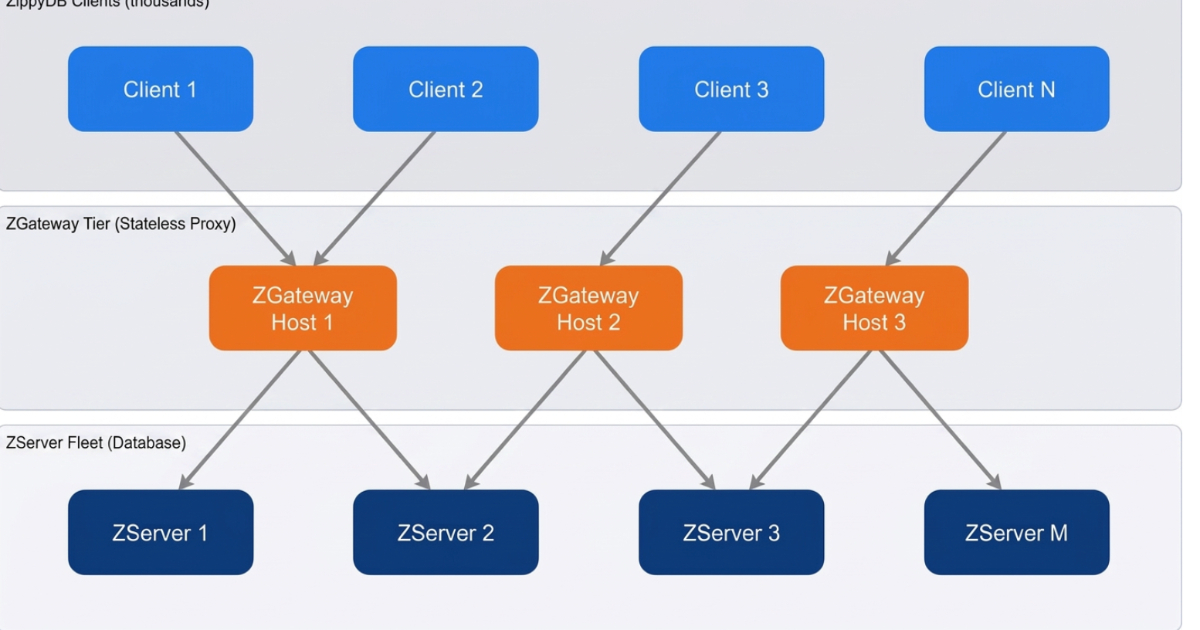
How Meta's ZGateway Slashes Connections 19x While Processing a Billion Operations Per Second
Meta's ZGateway is doing something quietly remarkable: slashing persistent connections by 19x while processing over a billion operations per second. That's not just efficiency; it's a rethinking of how stateless proxies can centralize traffic without becoming a bottleneck. By handling 40% of ZippyDB traffic, it proves scale and simplicity can coexist. For teams wrestling with connection sprawl, this is a model worth studying. And if you're curious about Meta's broader engineering bets, our piece on Linear's StyleX migration offers another angle.
Cloudflare's Blog Finds Performance Gains with EmDash, Its New CMS
When Cloudflare moved its blog off WordPress, it didn't just switch platforms; it built its own CMS, EmDash, and open-sourced it. The payoff is clear: the system handles up to 7,000 requests per second while improving caching and performance. That's a practical win for a team managing heavy traffic. It's a reminder that sometimes the best tool is the one you create yourself. For more on how organizations are building internal infrastructure, check out our piece on Perplexity's CobbleDB migration.

Explore how Google's new button empowers publishers to reclaim traffic.
Google is giving publishers a direct lever to pull as AI search reshapes traffic flows. A new button lets readers mark a source as preferred across Search, Discover, and Google News, offering a practical way to counter declining click-throughs. It's a smart, human-centered move that hands control back to both publishers and audiences. For more on how digital platforms are adapting, our piece on Cloudflare's Blog finding performance gains with EmDash, its new CMS, offers a useful parallel.

Agentic traffic demands a smarter approach to autoscaling.
Autoscaling used to follow a predictable arc: manual rules, then reactive thresholds, then predictive models. Each generation assumed traffic patterns that resemble human behavior. Autonomous agents broke that assumption. They spawn bursts of activity that don't map to any prior curve, so two decades of capacity planning logic stops holding up. We need a new mental model, one that treats agentic bursts as first-class citizens rather than anomalies. It's a sharp, practical read.

MCP Drops the Handshake to Let Agents Route Without JSON Parsing
The MCP 2026-07-28 spec drops the initialize handshake and session header, adding required method and tool-name headers so gateways route traffic without parsing JSON. Some developers call it a rediscovery of REST, while others argue the standard was always the point. Both sides have merit, though the shift feels less like a regression and more like a practical concession. For a deeper look at how statelessness changes deployment, our piece on scaling AWS server deployments with stateless MCP is worth a read.

AI search triples Shopify orders, complementing rather than replacing traditional traffic
Shopify's latest data flips a familiar fear on its head: AI search isn't replacing Google, it's fueling growth. In Q2, AI-driven traffic and orders to Shopify stores tripled year over year, proving that discovery and direct search can coexist. That's a signal worth watching for anyone building with AI. It suggests the tool isn't stealing attention; it's channeling intent. Curious how that plays out beyond retail?

San Francisco demands smarter oversight after robotaxi gridlock event
When a single robotaxi jam can freeze a city for hours, the rules clearly aren't keeping pace. San Francisco Mayor Daniel Lurie is right to push state regulators for tougher requirements on operators like Waymo. This isn't about slowing innovation; it's about accountability. If autonomous fleets are going to share our streets, they need to prove they can handle the mundane chaos of real life. Otherwise, the gridlock becomes the headline, not the technology.