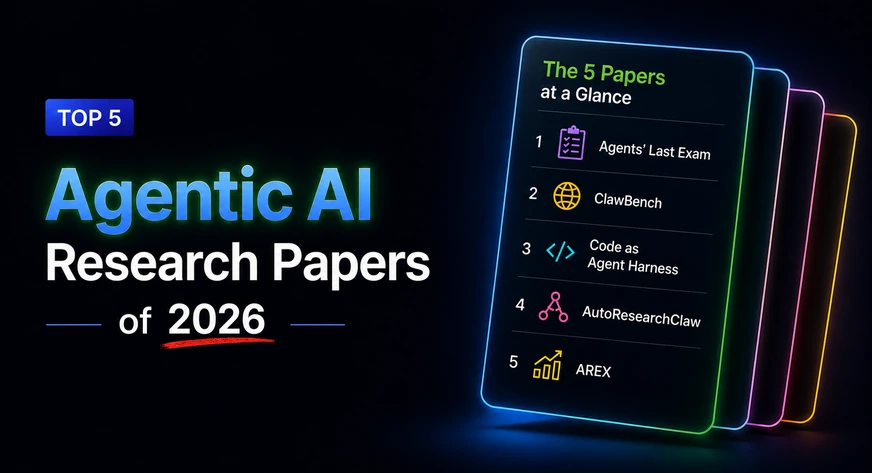
The shift in agentic AI research is no longer about proving that an agent can act. It is about proving that an agent can finish. The 2026 papers highlighted by Analytics Vidhya reflect a mature field asking harder questions: Can an agent complete a long workflow without losing the thread? Can it survive the unpredictable mess of a live website? Can it verify its own work, recover from failure, and improve its process over time? That is a different standard than the one we saw even a year ago, and it is the right one. For anyone building on top of these systems, the distinction matters more than the underlying model choice.
For our readers, the practical takeaway is straightforward. You should stop evaluating AI tools by what they can start and start evaluating them by what they can finish. The research points to a reality where the bottleneck is not intelligence but endurance. An agent that can navigate a 50-step workflow, self-correct when an API returns an unexpected payload, and document its own reasoning is more valuable than a model that can ace a benchmark but stalls in production. This is why we recommend reading how to evaluate AI agents for real-world tasks and pairing that with a practical guide to agentic workflow design. The cited papers are not academic exercises; they are blueprints for what your next automation project should look like.
What stands out in this research is the emphasis on self-verification and recovery. These are not glamorous topics. They are the unglamorous core of trust. If an agent cannot tell you when it is wrong, or cannot recover from a failed step without human intervention, then it is not a partner in your workflow. It is a liability. The papers suggest that the next frontier is not making agents smarter but making them more honest. That means building systems that can say "I tried this, it failed, here is what I did instead" without a human having to ask. For spreadsheet users, for analysts, for operations teams, that honesty is what turns a tool into a colleague. You want an agent that flags a broken formula in your data pipeline, not one that quietly returns a plausible but wrong number.
If a reader asked us what to watch next, we would point to the recovery mechanisms. The ability to bounce back from failure is the clearest signal of whether an agent is production-ready. The open question is how much oversight is still required during that recovery. The research maps the shift, but it does not yet solve the human-in-the-loop problem. That is the detail to watch. The specific consequence for you: your next spreadsheet automation should include a checkpoint where the agent explains its own failure mode. If it cannot do that, it is not ready for your workflow.