Most AI teams treat version control as a boring necessity, something that just has to work while the real innovation happens elsewhere. Anthropic's decision to move its entire monorepo from Git to a custom server-side system called Scion flips that assumption on its head. And for anyone building AI agents or managing CI pipelines at scale, this isn't just an infrastructure footnote. It's a direct signal about where the industry is headed.
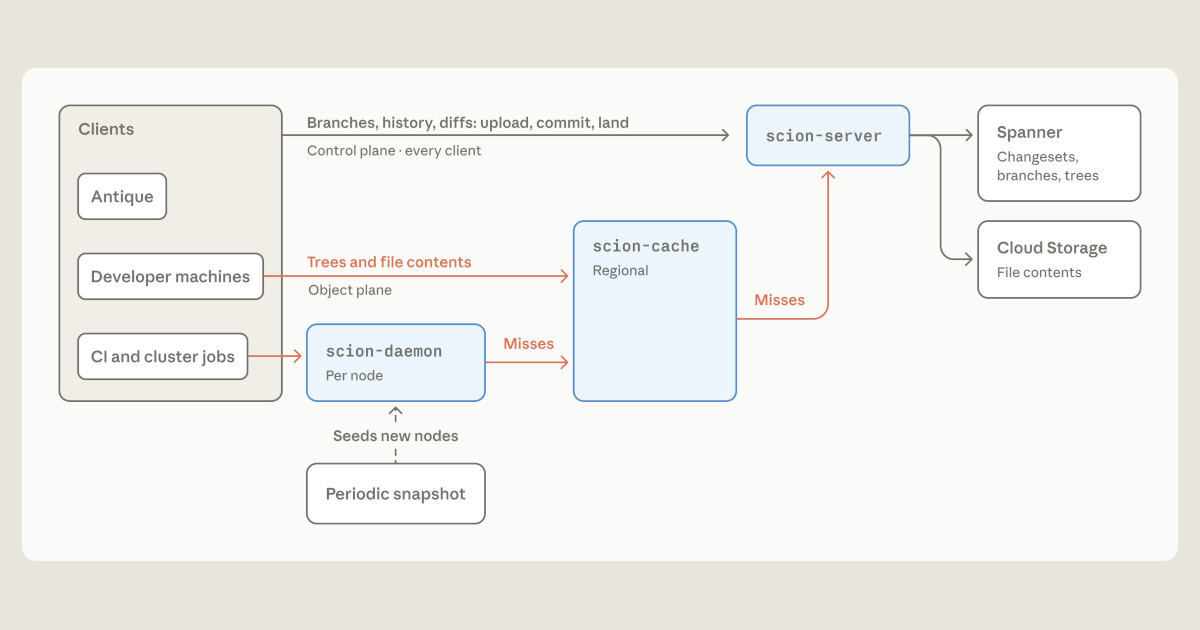
By offloading repository operations to the server and adopting content-addressed storage with tiered caches, Anthropic has made a deliberate trade: offline independence for dramatically reduced local data and shared infrastructure. For most teams, that trade makes sense. Git's distributed model, elegant as it is, becomes a bottleneck when every agent and CI job needs to clone or fetch a massive monorepo. Scion treats the repository as a service, not a local copy. This aligns with what we've been seeing across the AI stack, centralized, server-side architectures that prioritize speed and consistency over developer nostalgia. It also echoes themes from Anthropic's recent S-1 filing, where Anthropic's S-1 shows how platform cross-selling deepens enterprise loyalty by tying infrastructure choices to long-term customer retention. Scion is another brick in that wall: make the tooling so performant that teams don't want to leave.
The practical takeaway for our readers is blunt: if your AI agents are still pulling full Git histories on every run, you're wasting cycles. Anthropic's move isn't about being clever, it's about recognizing that the old model wasn't designed for workloads where machines, not humans, are the primary consumers of version history. Scion's content-addressed storage means identical files only exist once on disk, even across branches. That's a small detail with big implications for CI costs and agent response times. As more teams experiment with agentic workflows, the ability to query repository state without downloading it becomes a competitive advantage. The Explore how four new projects expand agentic AI's reach and security focus story shows that the ecosystem is already moving toward standardized, server-first patterns for agent interactions. Scion fits that picture perfectly.
What we'll be watching is how this scales outside Anthropic. Scion is purpose-built for their monorepo and their agent workloads. That doesn't make it a general-purpose replacement for Git any time soon. But it does raise an open question for every AI team evaluating their toolchain: how much of your current infrastructure was designed for human developers, and how much of it actively slows down the machines you're training to replace those clicks? The answer determines whether you're building for the future or patching the past.