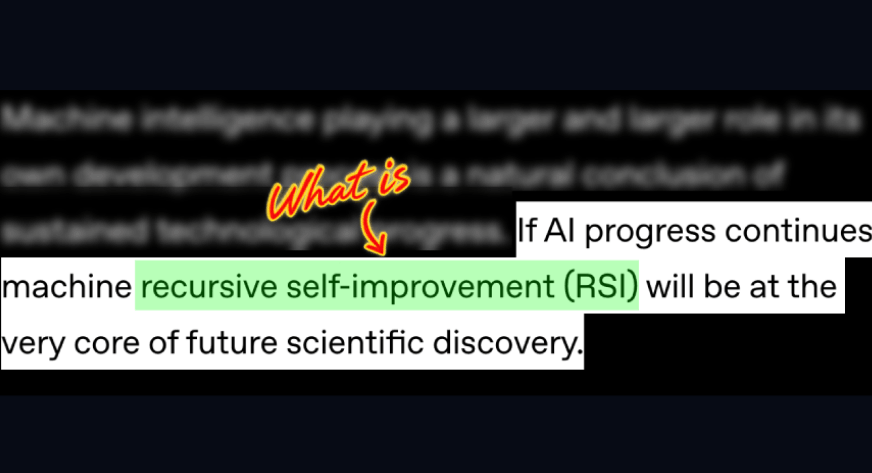
The phrase "the last AI built by humans" has a cinematic weight to it, but it also carries a very specific, practical challenge. When Sam Altman, Dario Amodei, and Elon Musk all point to Recursive Self-Improvement (RSI) as the next phase of large language models, they are not pitching a faster chat assistant. They are describing a system that can write its own upgrades, test them, and deploy them without a human in the loop. The research paper that outlines this method, paired with those public endorsements, tells us that this is no longer a fringe thought experiment. It is the direction of travel.
For our readers, the immediate reaction might be a mix of excitement and the familiar fatigue that comes with AI news cycles. But this story deserves more than a headline glance. What RSI actually means for you, the person working with spreadsheets, data pipelines, and daily deliverables, is that the tools you use will stop waiting for you to ask for an improvement. Today, you prompt a model and it answers. Tomorrow, the model might notice that your monthly reconciliation process is inefficient, rewrite its own logic to fix it, and present you with a better version of itself. That is the practical promise, and the practical pressure, of recursive self-improvement. It shifts the burden from you learning a new interface to the software learning its own job.
Here is our honest take: we are not afraid of the concept, but we are deeply skeptical of any conversation that treats this as a foregone conclusion. The gap between a research paper outlining a method and a production-ready system that can safely modify its own code is enormous. The real question is not whether AI can write better code than a human, it already can in many cases. The question is whether it can understand the consequences of its own changes well enough to avoid breaking the very systems it is meant to improve. That is a quality assurance problem on a scale we have never managed, and it will not be solved by a clever algorithm alone.
What we would tell a reader who asks us about RSI is this: pay attention to the word "recursive." It means the system is looking at itself, and that is the hardest thing for any technology to do reliably. The concrete point to watch is not the next model release, but the first time a developer publicly acknowledges that an AI suggested a change to its own architecture that no human had considered. That moment, when a machine's self-modification outpaces our ability to fully predict its behavior, is when the conversation shifts from performance to governance. Until then, treat the hype with the same healthy respect you would give any powerful tool: explore it, but keep your hand on the manual override. The last AI built by humans might be coming, but we have not yet proven we can build the first one that understands itself.