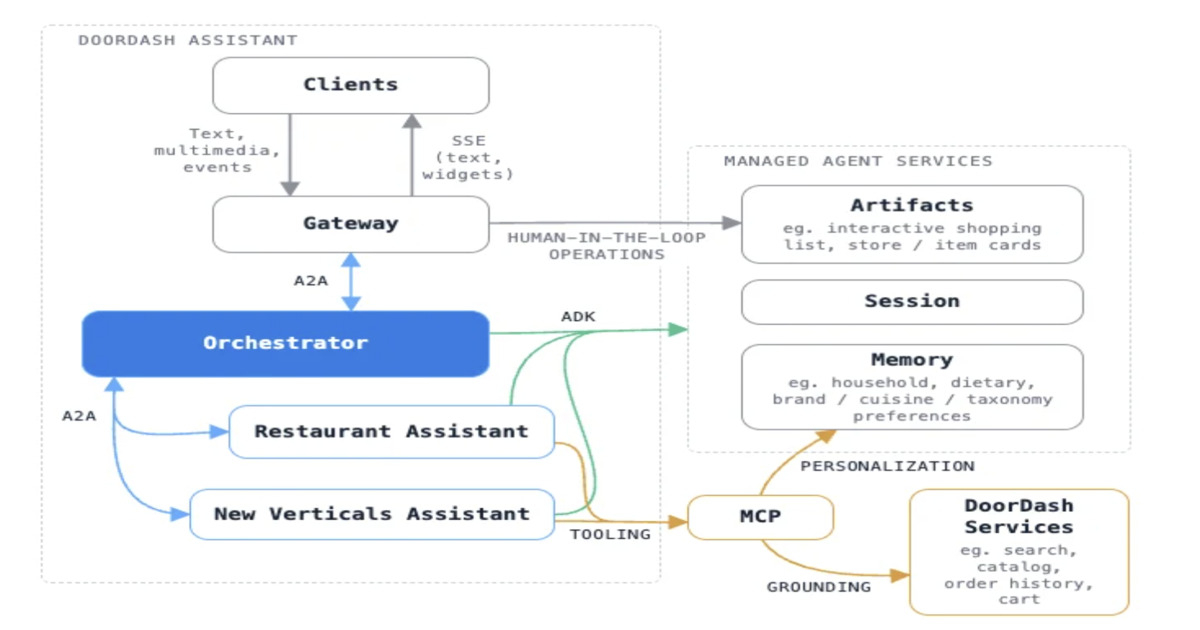
The details behind Ask DoorDash read like a quiet rebuttal to every half-baked chatbot that has tried to pass as a shopping assistant. While many teams bolt a large language model onto a search bar and call it a day, DoorDash chose a different path. They paired the LLM with specialized AI agents, MCP-based tooling, and an intelligence layer that carries persistent consumer memory and live backend data. The results are not abstract. Checkout conversion is up 24%, baskets are 17% larger, and intent accuracy improves when sessions are memory-backed. That is not hype. That is architecture doing its job.
What impresses us most is the deliberate separation of concerns. The LLM is not the brain. It is the interpreter, the conversational glue that translates a fuzzy request like "I need something for a rainy Friday dinner" into a structured set of actions. The specialized agents handle the grunt work, pulling inventory, checking delivery windows, and validating options against live systems. The memory layer is the quiet differentiator. It remembers that you are allergic to peanuts, that you preferred the local Thai spot last month, and that you usually order before 7 PM. This is not a parlor trick. It is the difference between a search engine and a personal shopper. For our readers, the takeaway is direct: the next wave of productivity tools will not win on model size. They will win on how well they orchestrate context, tooling, and memory into a single, coherent experience. If you are building an AI assistant, stop asking which model to use. Start asking what systems it needs to talk to and what it should remember. DoorDash just showed you the blueprint.
That said, we would caution against reading this as a victory for pure automation. The persistent memory feature is powerful, but it carries an implicit contract with the user. They are trading their preferences and history for convenience. DoorDash is smart to lean into that trade, but the moment a user feels the memory is being used against them, or that the assistant is guessing too hard, trust erodes quickly. The 24% conversion lift is real, but it is also a fragile metric. It holds when the assistant feels helpful, not intrusive. For anyone evaluating this approach, we would say this: watch how the system handles ambiguity and errors. A memory-backed assistant that confidently suggests a dish you rejected three times is worse than one that asks for clarification. The architecture is sound, but the judgment is still the hard part.
The open question that keeps us thinking is how this scales beyond food delivery. If DoorDash can apply this same layered intelligence to groceries, retail, or even local services, the implications stretch far beyond a single app. The LLM becomes a universal front end for a complex, real-time system. That is a future we can get behind. But we are also watching for the flip side: when memory becomes a liability, and when the intelligence layer starts making decisions the user never explicitly requested. The specific detail to watch is how DoorDash handles memory deletion and user control. If they get that right, they set a standard others will follow. If they fumble it, the 24% lift will not matter, because the trust that made it possible will be gone.