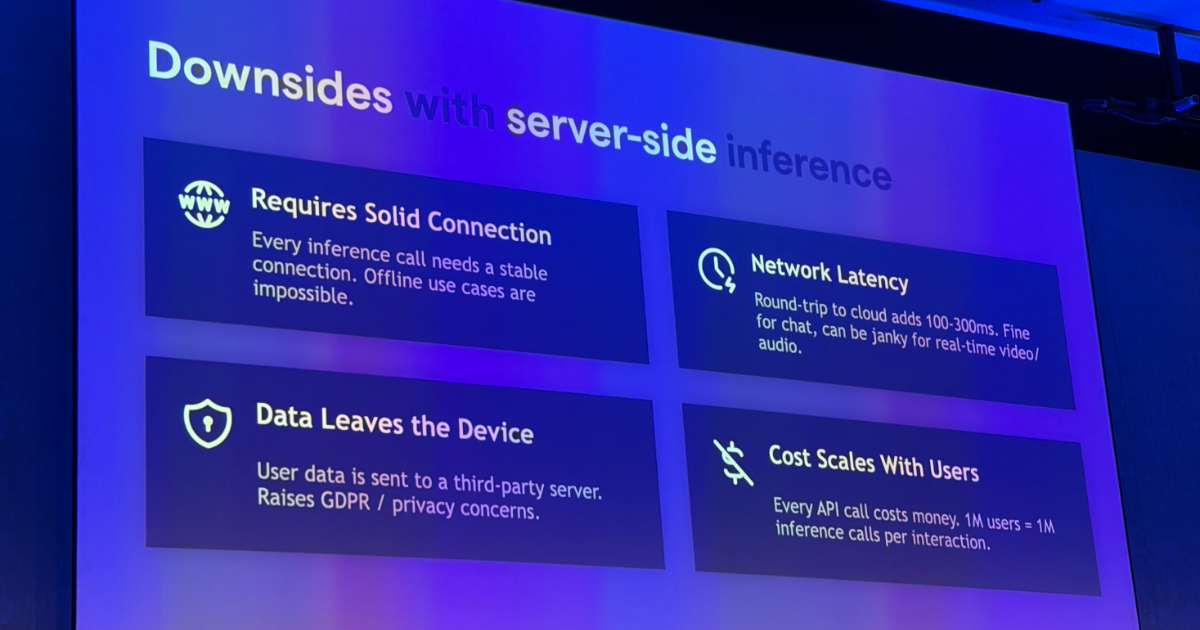
We believe the case for browser-based AI processing is stronger than many developers realize, and James Hall's presentation at QCon London 2026 makes that clear. Running AI workloads locally, directly in the browser, isn't just a technical curiosity. It addresses two of the most persistent frustrations with cloud-dependent AI: latency and privacy. When your data never leaves the device, you eliminate round trips to a server. That means faster responses and a simpler path to compliance with data protection requirements.
Hall's focus on technologies like Transformers.js and WebGPU gives us a concrete sense of what's possible right now. Transformers.js brings Hugging Face models to the browser with minimal overhead. WebGPU unlocks GPU acceleration, making inference speeds that were unthinkable a few years ago. The practical applications he demonstrated, real-time translation, document summarization, image classification, aren't parlor tricks. They represent genuine productivity gains for users who need immediate, private insights without uploading sensitive data to a third party.
What matters most, however, is Hall's emphasis on appropriate use cases. Browser-based AI is not a universal replacement for cloud infrastructure. If you need a large language model with hundreds of billions of parameters, the browser isn't your answer. But for tasks that fit within the memory and compute constraints of a modern device, local processing offers a compelling trade-off. The evaluation principles he outlined, measure latency, validate model accuracy against your specific data, test across target browsers, are exactly the kind of grounded advice that separates a useful implementation from a proof-of-concept that never ships.
For our readers, the takeaway is practical. Start by identifying a task in your current workflow that requires a small model and a fast response. Run it locally with Transformers.js and compare the user experience against a cloud endpoint. The difference in perceived speed and the elimination of network failures will almost certainly justify the effort. That is the point: browser-based AI is ready for real work, not just demonstrations. The technology is mature enough to adopt today, and the benefits, privacy, speed, cost, are too concrete to ignore.