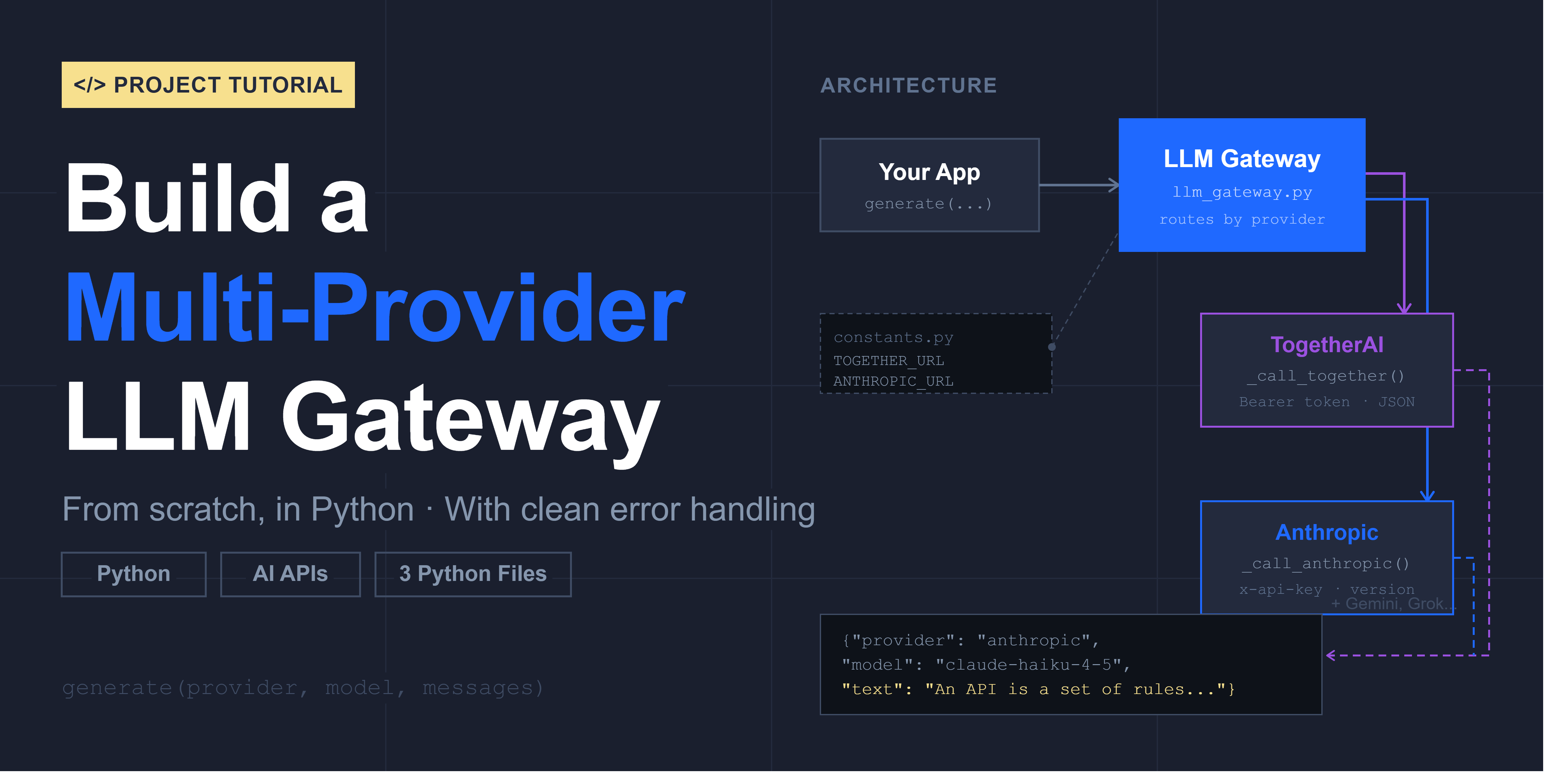
The rise of Large Language Models (LLMs) has undeniably sparked a gold rush of innovation, but a crucial challenge often overlooked is the inherent vendor lock-in that comes with tightly integrating with a specific provider's API. The tutorial on building a Multi-Provider LLM Gateway directly addresses this, offering a pragmatic solution to a growing pain point. We've seen similar trends emerge in other areas of development; for example, GitLab 19.0 Embeds Agentic AI in Secrets, Merge Requests, and Supply Chain Security GitLab 19.0 Embeds Agentic AI in Secrets, Merge Requests, and Supply Chain Security demonstrates the increasing sophistication of AI integration, yet the underlying infrastructure needs to be adaptable. Similarly, Azure Functions Ships Serverless Agents Runtime at Build 2026 Azure Functions Ships Serverless Agents Runtime at Build 2026 highlights the shift towards agentic architectures, all emphasizing the need for flexible and modular systems. A well-designed gateway effectively decouples your application logic from the nuances of individual LLM providers’ SDKs, authentication methods, and response formats, affording invaluable flexibility.
The inherent beauty of this approach lies in its future-proofing. Today, you might be leveraging OpenAI’s GPT models; tomorrow, you might find a superior offering from Anthropic or Cohere. Without a gateway, switching requires a potentially disruptive and costly rewrite. A gateway acts as an abstraction layer, allowing you to seamlessly swap providers with minimal impact on your core application. This isn't just about cost savings down the line, though that’s certainly a factor; it's about maintaining agility and responsiveness to the rapidly evolving AI landscape. The tutorial’s focus on a practical, buildable solution is particularly valuable. It moves beyond theoretical discussions of vendor lock-in and provides a concrete roadmap for developers to mitigate this risk. The inclusion of a video demonstration further enhances the tutorial’s accessibility, lowering the barrier to entry for those eager to implement this pattern.
The broader significance of this development extends beyond individual applications. It speaks to a maturing understanding of how we build AI-powered systems. Early adopters often rushed to integrate with the “shiny new thing,” prioritizing immediate functionality over long-term maintainability. The gateway pattern represents a shift towards more thoughtful, architecturally sound design. It acknowledges that the AI provider space is dynamic and that building for longevity requires decoupling and abstraction. This move parallels the evolution of web development, where frameworks and APIs emerged to standardize interactions and reduce vendor dependence. The .NET 11 Preview 5: Brings File-Based App Improvements, New C# Features, and a Blazor Validation Wave .NET 11 Preview 5: Brings File-Based App Improvements, New C# Features, and a Blazor Validation Wave demonstrates Microsoft's continued investment in developer tools and frameworks, reinforcing the need for adaptable and modular architectures.
Looking ahead, the widespread adoption of LLM gateways will likely fuel the emergence of specialized gateway services, offering managed infrastructure, advanced routing capabilities, and even automated provider selection based on factors like cost, latency, and model performance. We anticipate that the complexity of managing multiple LLM integrations will necessitate a more standardized and streamlined approach. The question now becomes: will organizations proactively adopt gateway patterns to future-proof their AI investments, or will they continue to gamble on vendor loyalty in a space defined by constant innovation? The answer will shape the long-term architecture of countless AI-powered applications.