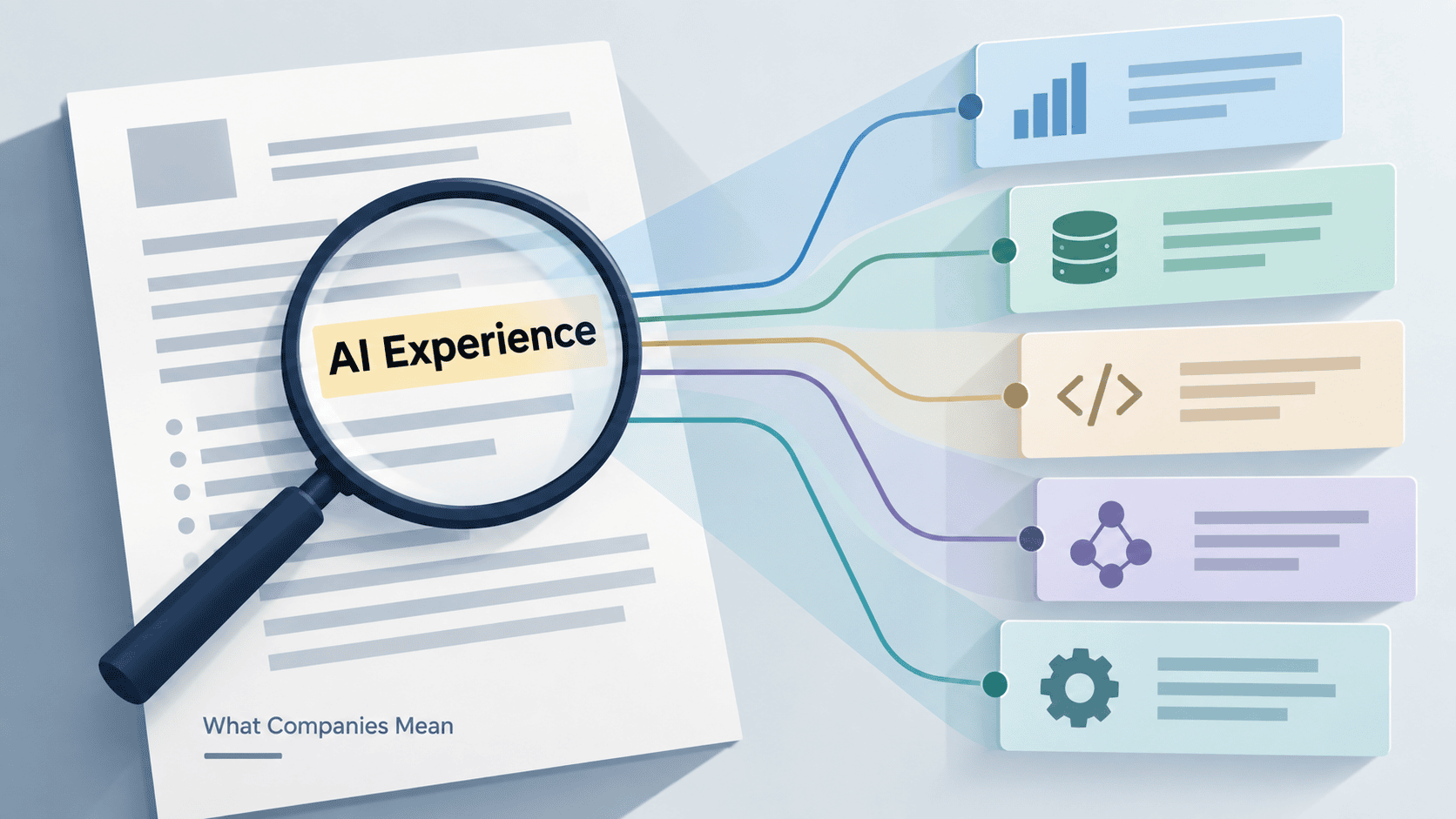
Every time a job posting asks for "AI experience," the actual requirement is far more specific, and far more human, than the buzzword suggests. Employers are not hunting for people who can recite transformer architecture from memory. They want candidates who know when to hand a task to a model, how to evaluate its output, and what to do when it fails. That distinction matters because it reframes AI literacy as a practical skill, not an academic credential, and it should change how professionals prepare for the roles they want.
Consider what typical "AI experience" demands in practice. An employer who lists the requirement for a marketing analyst is not expecting that person to fine-tune a large language model; they want someone who can write a prompt that consistently returns clean, structured data from a customer feedback tool. A project manager in the same situation needs to know how to estimate the time a model-based workflow saves versus a manual one, and where the failure points are likely to hide. These are judgment calls rooted in domain expertise, not machine learning PhDs. The skills that actually matter, prompt evaluation, output verification, fallback planning, overlap heavily with the logic people already use in Simplify complex conditional logic to calculate damage buffs with precision. That spreadsheet puzzle looks like a game mechanic, but the thought process behind it, layering conditions, testing edge cases, chaining rules, is identical to what an effective AI user does every day.
This is also why the resurgence of symbolic AI structures, explored in Symbolic AI resurfaces as researchers solve its core challenges, is directly relevant. If employers are already struggling to define what "AI experience" means in a world dominated by neural networks, the return of symbolic methods will complicate the picture further. A job posting that asks for "AI experience" next year might require fluency with both a large language model and a rule-based reasoning engine. The professional who understands the difference between a probabilistic and a deterministic system will be the one who can slot into any stack, not just the one that is fashionable today.
The concrete takeaway is straightforward: stop treating "AI experience" as a certification target and start treating it as a mental tool kit. If you can audit a model's output the way you audit a spreadsheet formula, checking assumptions, testing boundaries, catching drift, you already have the core competence most employers actually need. The question worth watching is whether job descriptions will ever catch up to this reality, or whether professionals will have to keep decoding the gap between what the listing says and what the role requires. That gap is the real skill to cultivate.