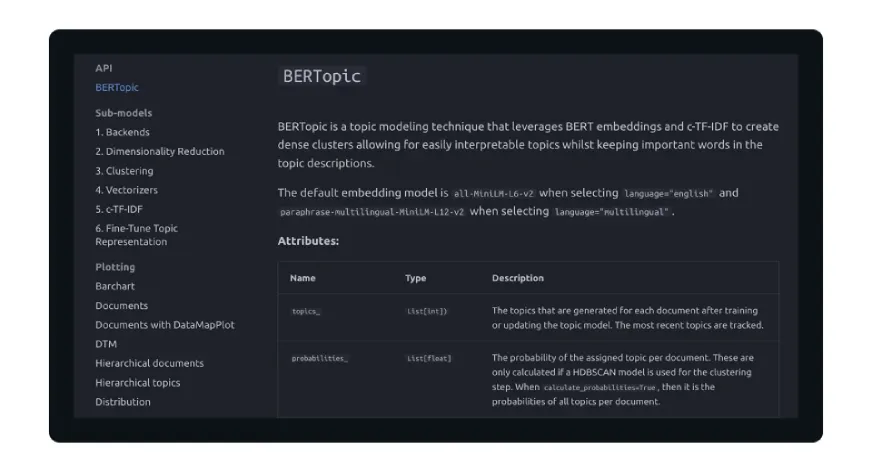
The traditional approach to topic modeling has always felt like a shortcut that costs more than it saves. Latent Dirichlet Allocation, for all its historical utility, treats every document as a random pile of words, ignoring the order, the nuance, and the relationships that actually carry meaning. BERTopic does not make that trade-off, and that distinction matters for anyone who has ever stared at a cluster of supposedly related documents and wondered why the connection felt so thin. This is not about chasing novelty for its own sake; it is about recognizing that context is not a luxury in data analysis, it is the entire point.
For practitioners, the practical shift is immediate. Instead of relying on frequency-based signals that flatten language into interchangeable tokens, BERTopic uses transformer embeddings to preserve semantic relationships. That means a document about "bank" appearing next to "river" is treated differently than one about "bank" appearing next to "loan." The clustering step then groups documents by meaning rather than surface-level word overlap, and the c-TF-IDF step extracts the terms that genuinely define each topic. The result is a set of themes that reflects how people actually write and speak, not how a bag-of-words model wishes they did.
What this means for you is straightforward: less time second-guessing whether your topics are real, and more time acting on what the data actually says. If your work involves analyzing customer feedback, research papers, or internal reports, the ability to move beyond keyword matching changes how you ask questions. You are no longer limited to "what words appear together," but can ask "what ideas are being expressed across different phrasings." That is not a minor upgrade; it is a different lens for seeing the structure in your documents.
The takeaway here is not that BERTopic is the only tool worth using, but that the underlying principle deserves your attention. If your current approach to topic modeling leaves you feeling like you are missing the deeper story, that is not a failure of effort, it is a limitation of method. BERTopic demonstrates that context-aware analysis is accessible, not reserved for researchers with deep learning expertise. The question is whether you are ready to move past word counts and into meaning.