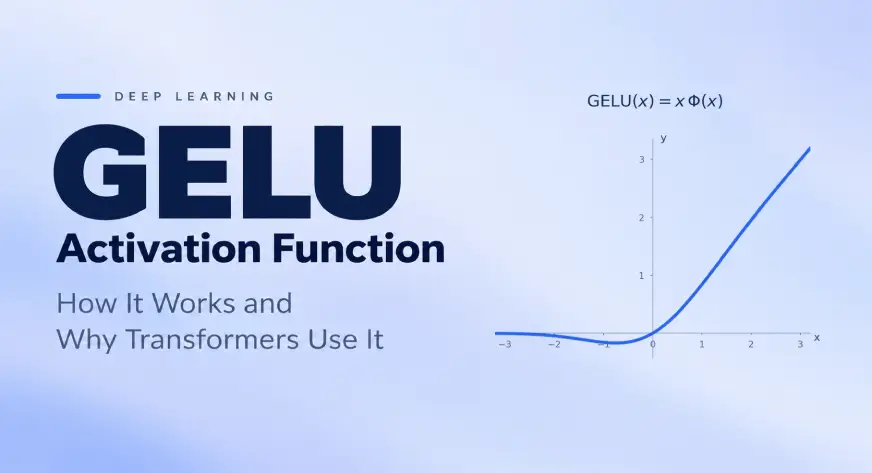
The choice between GELU and ReLU isn't just a technical footnote, it reveals something fundamental about how modern AI learns, and it matters for anyone building with these models. For years, ReLU was the default activation function because it was simple: negative inputs become zero, positive inputs pass through unchanged. But that hard cutoff discards information that might be useful. GELU takes a different approach, weighting inputs by their value rather than zeroing them out entirely. This is why Transformer models like BERT rely on it, and understanding the difference helps explain why your AI agents sometimes surprise you with their capabilities, or their limitations.
The practical consequence is that GELU allows neural networks to preserve subtle signals that ReLU would destroy. When a ReLU neuron receives a slightly negative signal, it treats that input as irrelevant. GELU, by contrast, asks a probabilistic question: how likely is this input to be valuable? It then passes through a proportion of that information, letting the model retain nuance. This matters most in tasks where context is everything, like language understanding, where a single word's meaning depends on the entire sentence. Transformers, which process sequences of words in parallel, benefit enormously from this smoother gating mechanism. If you've ever wondered why Boost Your AI Agent's Performance Without Changing the Model is possible, part of the answer lies in how the underlying architecture handles information flow. A better activation function means the model can extract more signal from the same data.
This shift also connects to a deeper lesson about progress in AI. The move from ReLU to GELU wasn't a breakthrough in theory, it was a practical refinement that unlocked better performance. That pattern repeats across the field. Consider how Reconsidering the real legacy of Minsky and Papert's perceptron critique shows that even famous critiques often miss the incremental nature of real progress. The perceptron's limitations were real, but they didn't cause an AI winter; they just meant researchers needed better tools. GELU is that kind of tool: not a revolution, but a smarter way to handle an old problem. It reminds us that the most impactful innovations are often the ones that make existing systems work more naturally, not the ones that promise to start from scratch.
Here is the specific takeaway: if you are fine-tuning a Transformer model or building an AI agent, pay attention to activation functions. They are not interchangeable plumbing. GELU's probabilistic gating gives models a richer representation of their inputs, which translates directly into better handling of ambiguous or context-dependent tasks. That is why BERT works the way it does, and why the next generation of models will likely continue refining this approach rather than reverting to simpler alternatives. The question worth watching is whether we can design activation functions that learn their own gating strategies dynamically, or whether GELU's fixed formula represents the practical ceiling for this technique.