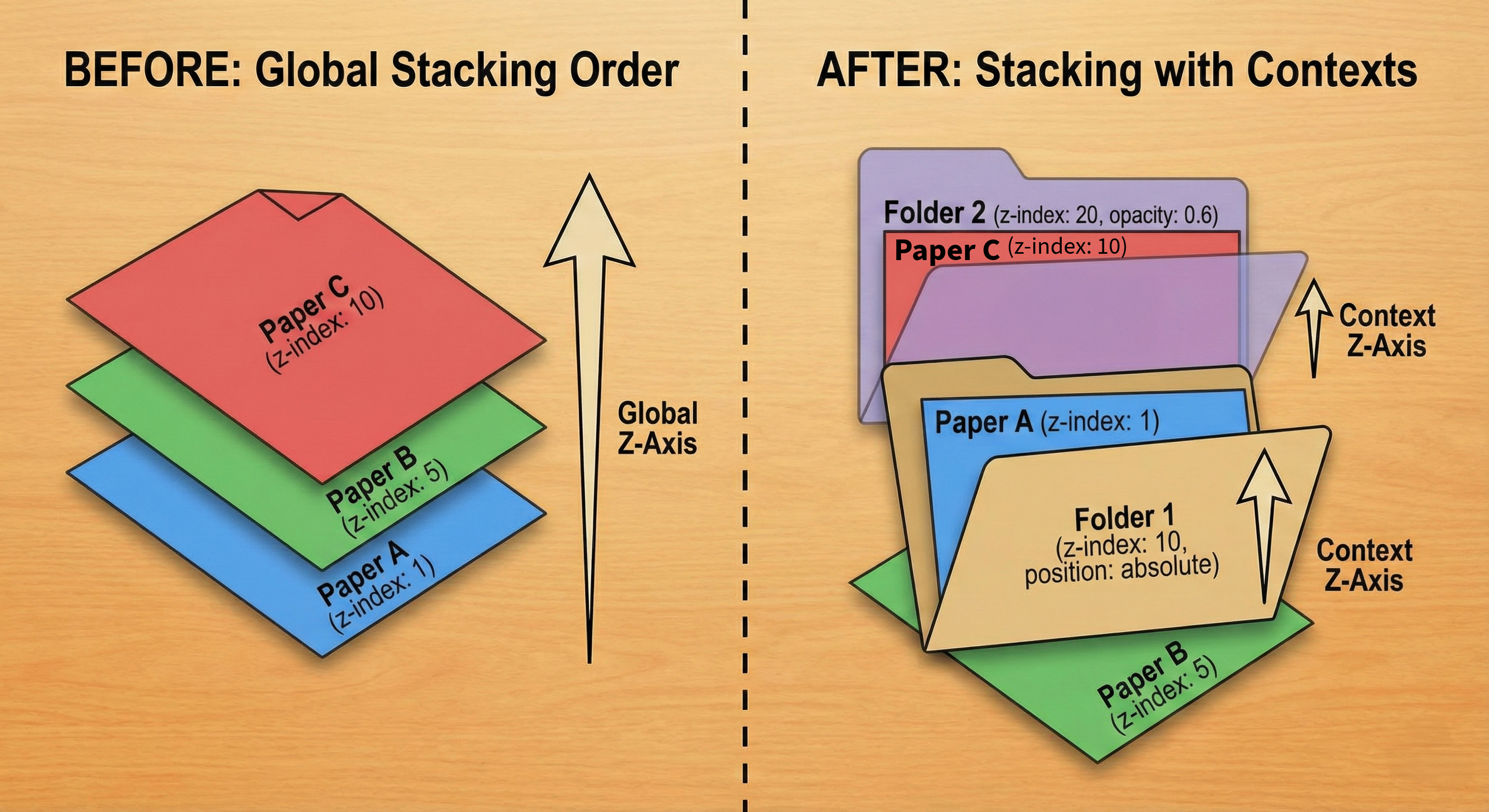
The CSS stacking context is one of the most quietly disruptive concepts in web development, and it deserves far more respect than it gets. Our view is straightforward: if you have ever reached for a z-index of 99999 only to watch your element stay stubbornly buried, you are not failing CSS, CSS is failing to explain itself. The real problem is not that stacking contexts are hard; it is that they are invisible until they break, and by then, most developers are already reaching for brute-force solutions that only compound the confusion.
What this means in practice is that mastery of stacking contexts is not about memorizing a list of properties. It is about understanding that every time you apply `position: relative`, `opacity` below 1, `transform`, or even `will-change`, you are quietly creating a new stacking context behind the scenes. Each new context resets the z-index battlefield. An element inside that context can never sit above an element in a parent context, regardless of how high you crank its z-index. That is why `99999` fails: it is not competing against other z-index values; it is trapped inside a local scope that cannot escape. The confusion is entirely predictable, and entirely avoidable, once you recognize that stacking contexts are hierarchical, not global.
For developers, the practical takeaway is this: stop treating z-index as a global priority queue. Instead, audit your CSS for properties that spawn new contexts. Every `position: absolute` inside a `position: relative` container, every `transform: translateZ(0)` added for GPU acceleration, every `filter` or `clip-path`, each one is a potential trap. The moment you understand that a stacking context is like a room inside a house, and that no matter how tall you stand on a chair inside that room you still cannot see over the roof, the mystery dissolves. You stop fighting the browser and start designing with its rules.
The solution is not to abandon z-index. It is to map your stacking contexts deliberately. Keep them shallow. Document which elements create them. And when something refuses to sit on top, do not escalate the number, look for the context that is containing it. That single shift in thinking turns a frustrating debugging loop into a clear, repeatable process. That is the kind of practical insight that separates confident CSS work from the endless cycle of trial and error.