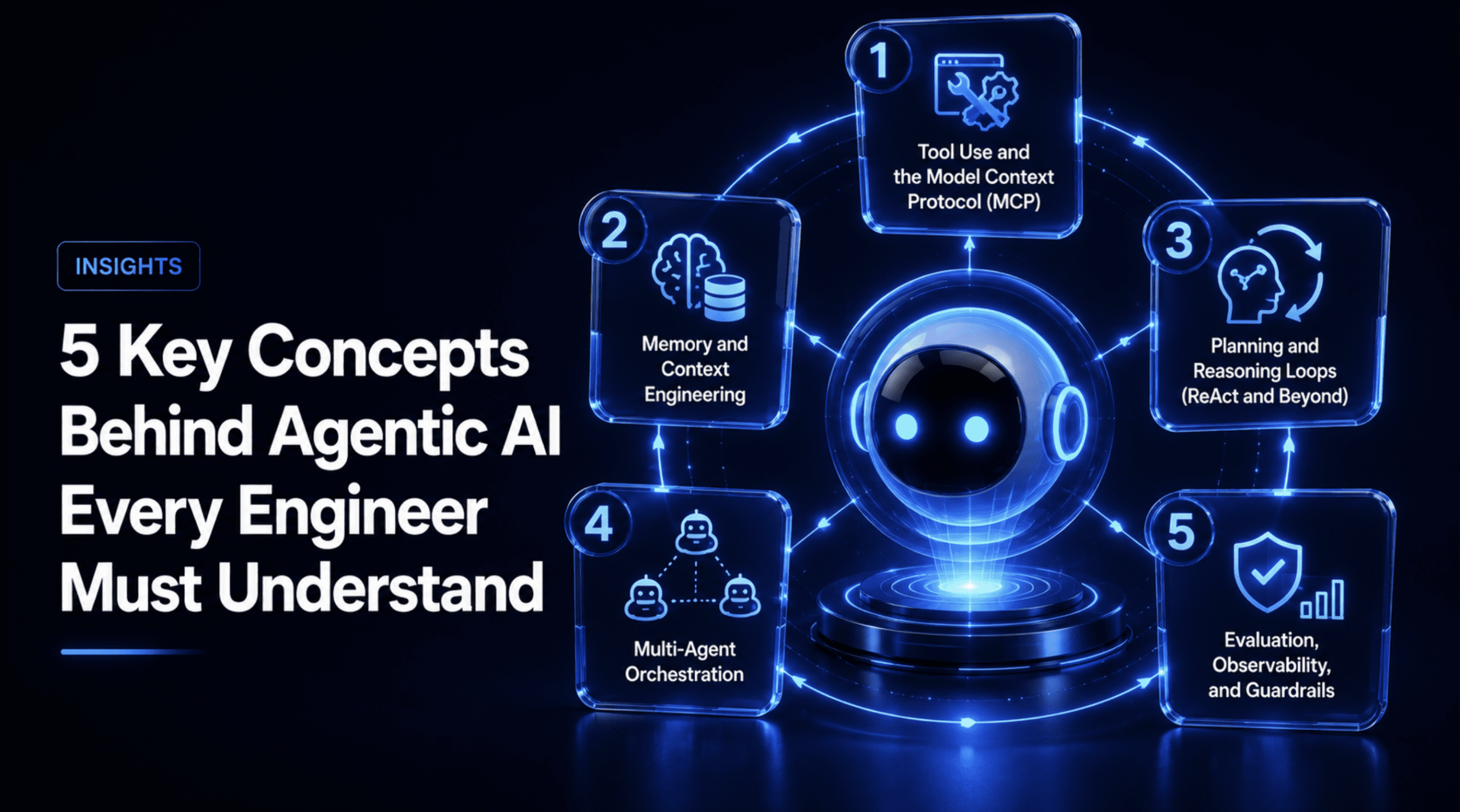
There is a quiet confidence in an article that promises to explain the five ideas behind agentic AI and then actually delivers on that promise. No hype, no jargon masquerading as insight. Just a clear-eyed look at what holds these systems together. That matters, because the conversation around agentic AI has drifted into the abstract. We hear about autonomy and task completion, but the mechanical reality of how an agent decides, acts, and corrects itself is where the real value lives. For engineers, this is not a trend piece. It is a working document. The five concepts outlined are not optional features. They are the load-bearing walls of any system that claims to be truly agentic. Ignore them and you are not building an agent. You are building a script with good intentions.
What we appreciate most about the framing is that it does not treat agentic AI as a magic trick. It treats it as an engineering discipline. That is the right posture. Too many teams jump straight to the exciting parts, the language model calls and the tool integrations, without thinking about the underlying loop that makes an agent trustworthy. This forces a different question. Not "what can the model do?" but "how does the system know what to do next, and how does it recover when it is wrong?" That second part is where most implementations fall apart. An agent that cannot gracefully handle failure is not intelligent. It is just persistent. For our readers, this is the difference between a demo and a deployment. We would tell anyone diving into this space to read the piece twice. Once for comprehension, once to audit your own architecture against it.
The practical takeaway here is not that you need to master every concept overnight. It is that you need to start with a clear definition of what an "agent" means in your context. If you cannot explain the feedback loop, the memory mechanism, or the decision boundary to a colleague over coffee, the system will not survive contact with real users. We have seen too many projects die not from a lack of model capability, but from a failure to design for the messy, iterative nature of real tasks. This emphasis on these five concepts is a corrective to that. It gives you a checklist before you write a single line of code. That is rare and valuable. We would add one caveat: the concepts are necessary, but they are not sufficient. The culture of your team, the willingness to test in production, and the patience to observe failure modes are just as important. The technology does not work in a vacuum.
The specific detail worth watching is how these concepts hold up as models become more capable. The current frameworks assume a certain level of unpredictability. What happens when the model's confidence is high but its reasoning is flawed? This gives you a foundation, but it also leaves the door open for the next generation of challenges. That is the honest place to stand. If you are an engineer reading this, do not just absorb the five ideas. Stress test them against your own use cases. Build a small prototype that forces a mistake. Watch how the system handles it. That experiment will teach you more than any blog post. The real takeaway is simple: agentic AI is not a product you buy. It is a system you engineer. And the engineering starts with understanding what holds it together. Not what makes it flashy. What makes it work. That is the only question worth answering.