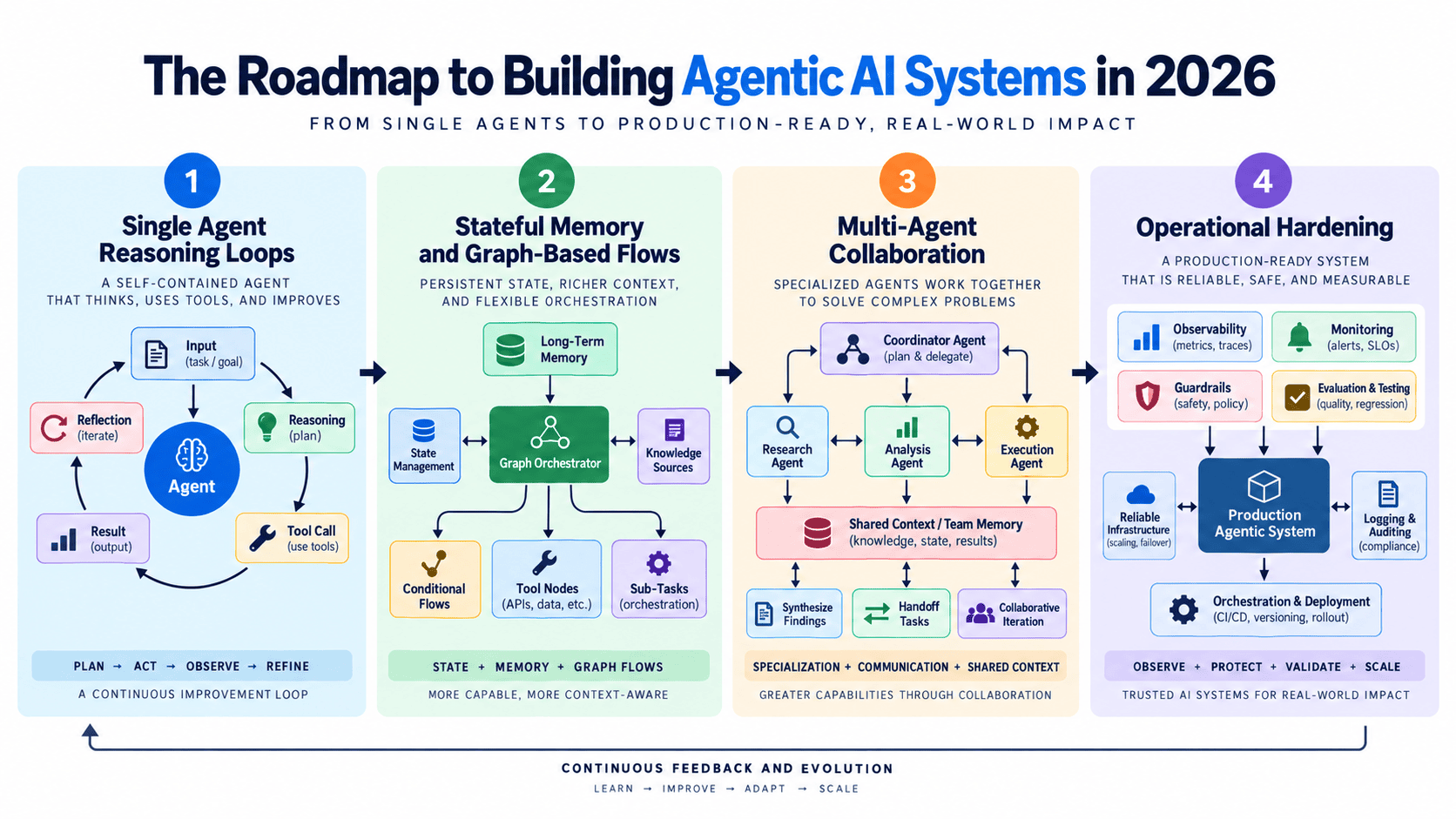
The roadmap from single cognitive loops to multi-agent swarms is the most practical guide to agentic AI we have seen this year, and it deserves your attention not because it is flashy but because it shows how to start small and scale deliberately. The four-level framework, beginning with a single cognitive loop, adding stateful memory, coordinating multiple agents, and finally implementing production observability, mirrors how smart teams actually build complex systems: one working piece at a time. This is the opposite of the hype-driven approach that promises swarms of autonomous agents on day one, and that honesty is why the roadmap matters.
For anyone who has tried to deploy AI in a real spreadsheet or data pipeline, the value of starting with a single cognitive loop cannot be overstated. A loop that observes a data change, makes a decision, and executes an action is the atomic unit of agentic behavior. Without it, multi-agent swarms are just expensive chaos. The roadmap's emphasis on stateful memory is equally grounded: an agent that forgets what it just did is not an agent, it is a broken script. This pairs naturally with the models featured in Ten Hugging Face Models Reshaping How Data Works in 2026, many of which are designed for retrieval and memory-augmented tasks. The practical takeaway is that you should not attempt a multi-agent system until your single agent can reliably finish a task and remember its context.
The transition to multi-agent swarms is where most teams get lost, and the roadmap wisely treats observability and monitoring as a level of its own, not an afterthought. If you build a swarm of agents that each run cognitive loops and share memory, you have introduced coordination problems that do not exist in single-agent systems. Who decides which agent handles which task? How do you trace a failure back to a specific loop? Production observability is the answer, and it is the difference between a demo and a deployment. Discover how AI infrastructure growth opens new paths at Disrupt 2026 will explore exactly this kind of infrastructure challenge, and the roadmap's fourth level gives you the vocabulary to ask the right questions before you attend.
The most specific takeaway from this roadmap is a hard rule: start with level one, and do not attempt level three until level two is stable and observable. The teams that rush to swarms without stateful memory and production monitoring will spend more time debugging than building. Four days remain to claim $100 off Disrupt 2026 passes, and if you bring this framework with you, you will spend your time there learning from teams that built it right instead of listening to pitches for systems that do not yet work.