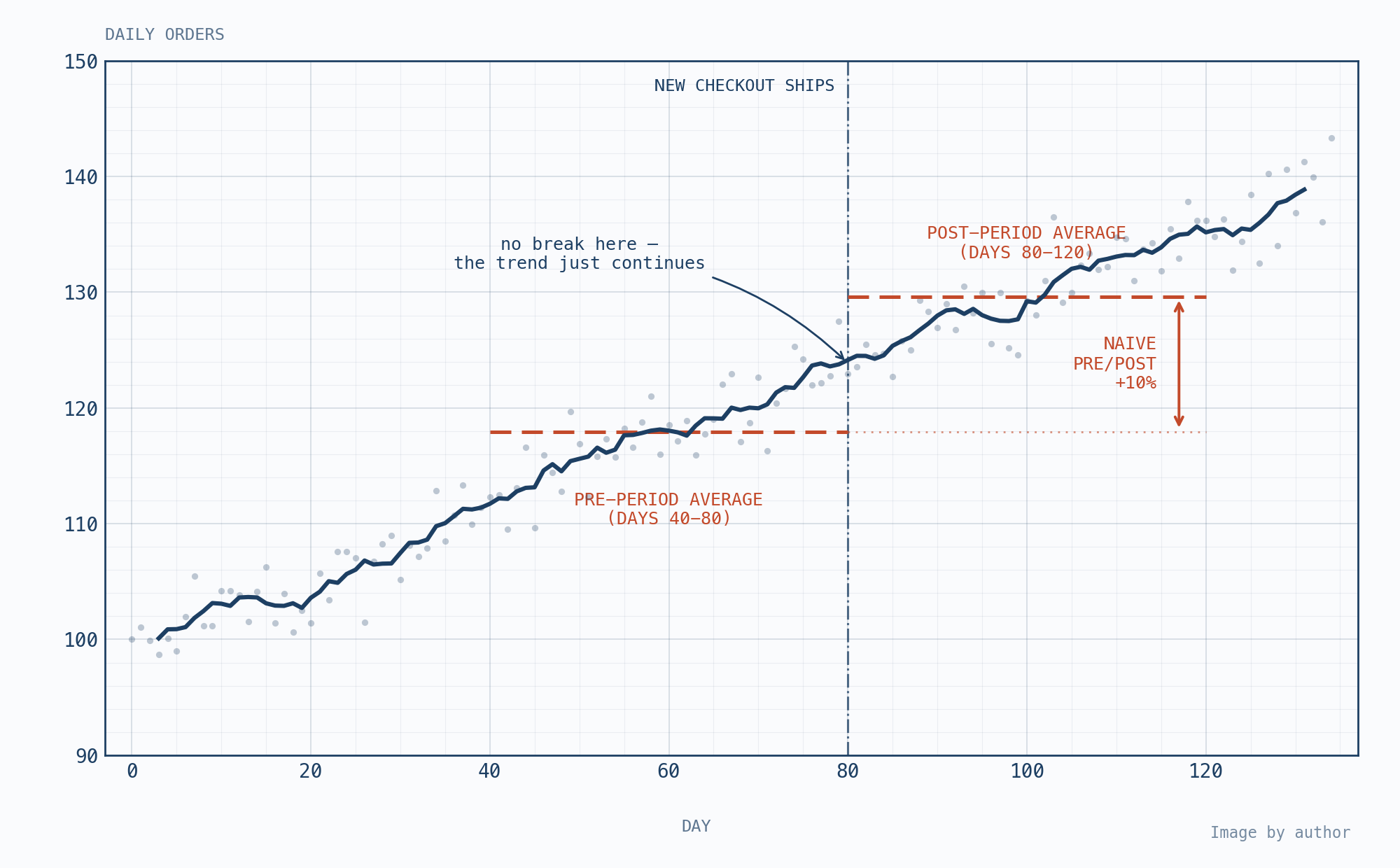
The gap between running a statistical test and shipping a product that people actually use is where most data tools go to die. The story of building a multi-agent system for Interrupted Time Series Analysis is ultimately a story about that gap. It is not a story about a clever algorithm winning the day. It is a story about the unglamorous work of turning a counterfactual question, one that asks what would have happened without the intervention, into something a non-specialist can trust and operate. For anyone who has struggled to explain why a simple before-and-after chart is misleading, this is a familiar pain point.
What makes this approach worth attention is the implicit argument it makes about the future of data work. The system is not just automating a regression; it is decomposing a complex analytical task into discrete agents that can handle data validation, model selection, and interpretation. This mirrors a broader shift we are seeing across the field, where the focus moves from writing code to orchestrating intelligence. It is the same logic that drives the push toward Unlock LLM Training: A Practical Guide to Distributed Algorithms, where the challenge is less about the model itself and more about how to coordinate the infrastructure around it. Similarly, understanding how Exploring Paragraph Structure: How LLMs Navigate Token Space works is less about linguistics and more about the geometry of information. In both cases, the hard problem is the orchestration, not the raw computation.
Our take is that this is the right problem to be solving, but it demands a specific kind of discipline. The temptation with multi-agent systems is to build a Rube Goldberg machine of prompts and hope it works. The author avoids that trap by grounding the system in the statistical rigor of ITSA, ensuring that each agent has a clear role and a verifiable output. This is a lesson that extends beyond this specific use case. The practical takeaway for our readers is straightforward: if you are building an AI product, start with the analytical framework, not the latest model. The AI is only as useful as the structure it operates within. We would tell anyone asking us about this that the real innovation is not the agents themselves, but the decision to treat the analytical method as the product spec.
The specific consequence to watch is how this pattern generalizes. If a multi-agent system can make counterfactual analysis accessible, then the same architecture can be applied to other complex statistical methods, such as synthetic control or difference-in-differences. The question is not whether this works, but whether the broader data community is ready to embrace the shift from building tools that require a PhD to understand, to building systems that encode that expertise into a form that anyone can query. That is the transformation worth exploring, and it will happen one agent at a time.