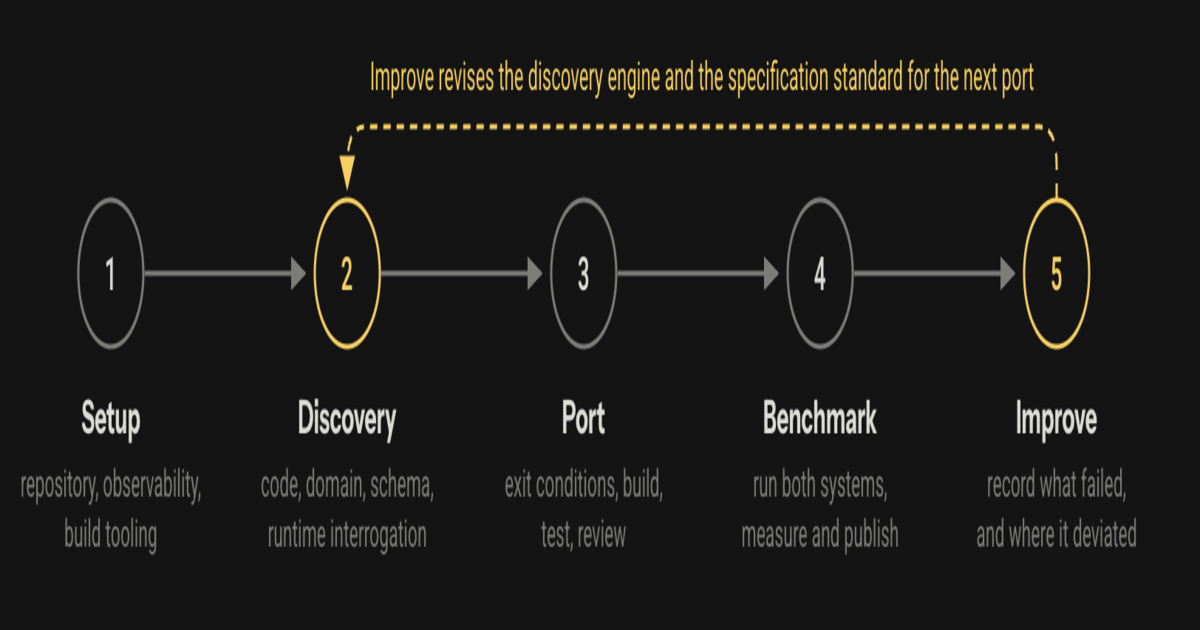
Spec design is not a footnote in AI-assisted software porting; it is the primary lever, and the results from Akka's experiment across 65 open-source projects make that unmistakably clear. By systematically varying specification structure, context, model selection, automated validation, and delivery guardrails, the team found substantial variation in time, token use, code size, test parity, and performance depending on how the input was framed. This is the kind of empirical grounding the field has needed. Too often we treat AI models as black boxes that either work or don't, when the real variable is the quality of the instructions we give them. For anyone building tools that rely on AI to transform legacy code, the lesson is direct: the spec is not just documentation; it is the single most influential design decision in the pipeline.
The findings resonate with parallel work in the AI reliability space. A recent piece on How language models learn to copy context with hash tables shows that even low-level architectural tricks like learned hash tables can dramatically improve how models handle context, reinforcing the idea that the structure of what we feed a model matters as much as the model itself. Similarly, research covered in AI Agents Shrink the Window for Open Source Vulnerability Fixes demonstrates that well-scoped prompts and guardrails can turn AI agents into effective patching tools, not just code generators. Akka's experiment extends that thinking from security patches to full software porting, and the pattern holds: when you tighten the spec, you tighten the outcome.
What makes Akka's work actionable is its granularity. They did not just confirm that better specs help; they measured exactly where the gains appear, and where they vanish. Some models handled ambiguous specs with surprisingly low token waste, while others ballooned in cost and output size when context was poorly bounded. Automated validation caught regressions that would have passed manual review, but only when the spec included explicit test parity requirements. The implication for teams adopting AI-assisted porting is that you cannot delegate spec design to intuition. You need to treat it as an engineering artifact, subject to iteration and measurement, just like the code itself.
The open question that lingers is how far this can scale. Akka's 65 projects represent a controlled, measurable slice of the problem, but real-world enterprise codebases are messier, older, and full of undocumented assumptions. The DoorDash GenAI platform for 5,000 users suggests that large-scale deployment is possible when you invest in guardrails and feedback loops, but it also shows how much organizational effort that requires. For now, the most concrete takeaway is this: if you are porting software with AI, spend your first hour on the spec, not the model. The model is a commodity; the spec is your advantage.