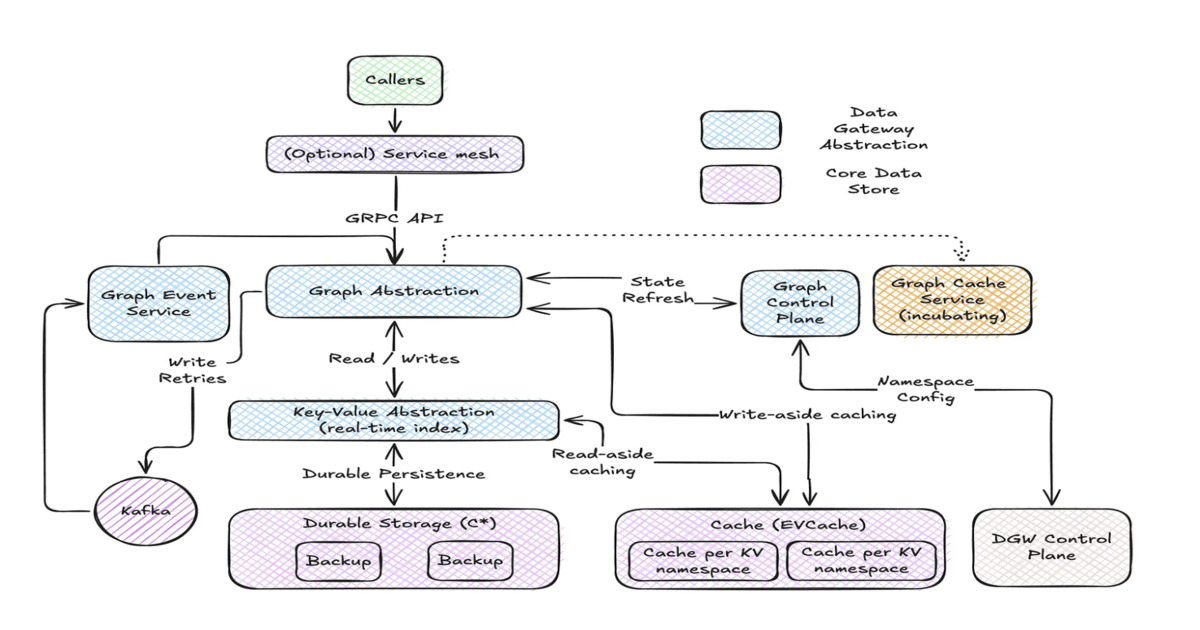
Managing 650 terabytes of graph data in milliseconds is the kind of engineering benchmark that sounds like a boast until you read how Netflix actually achieved it. Our take is straightforward: this is the most practical demonstration we have seen of graph databases scaling to meet production-grade demands without sacrificing speed. The Netflix Graph Abstraction platform is not a lab experiment or a theoretical architecture paper, it is a live system serving everything from social graphs for Netflix Gaming to operational topology graphs, and it does so with global availability maintained through asynchronous replication. For anyone who has wrestled with graph databases that promise scale but deliver latency, this is the proof point you have been waiting for.
What matters here is not the 650 TB number, though it is impressive. What matters is that Netflix designed for traversal and caching from the start, not as an afterthought. The engineers built a platform that treats graph data as something to be queried in real time, not batch-processed overnight. That design philosophy has direct implications for any team managing complex relationships in data, whether you are tracking dependencies in a microservice architecture, mapping user interactions, or modeling supply chains. The lesson is that graph abstraction layers, when built with caching and traversal as first-class concerns, can deliver the responsiveness that application developers expect from key-value stores or relational databases. Netflix has shown that the bottleneck was never the graph model itself; it was the absence of infrastructure designed to handle it at scale.
We also note the choice of asynchronous replication for global availability. This is a deliberate trade-off that prioritizes write throughput and geographic distribution over strong consistency. For use cases like social graphs and topology maps, that is the right call. Users do not need every node to reflect the latest edge the instant it is created, they need the graph to be available and fast when they query it. Netflix's architecture validates that eventual consistency, when paired with intelligent caching, is not a compromise but an optimization. Other teams facing similar scaling challenges should study this decision closely: it is the difference between a system that works under load and one that breaks.
The practical takeaway for our readers is this: if you have avoided graph databases because of performance fears, Netflix's Graph Abstraction should change your calculus. The platform proves that graph data can be managed at hyperscale with millisecond latency when the engineering is focused on caching, traversal design, and replication strategy. You do not need to be Netflix to apply these principles. Start by examining how your own data relationships are modeled, then consider whether a graph abstraction layer could simplify your queries and improve response times. The architecture exists. The results are public. The question now is whether you will explore what it can do for your workflows.