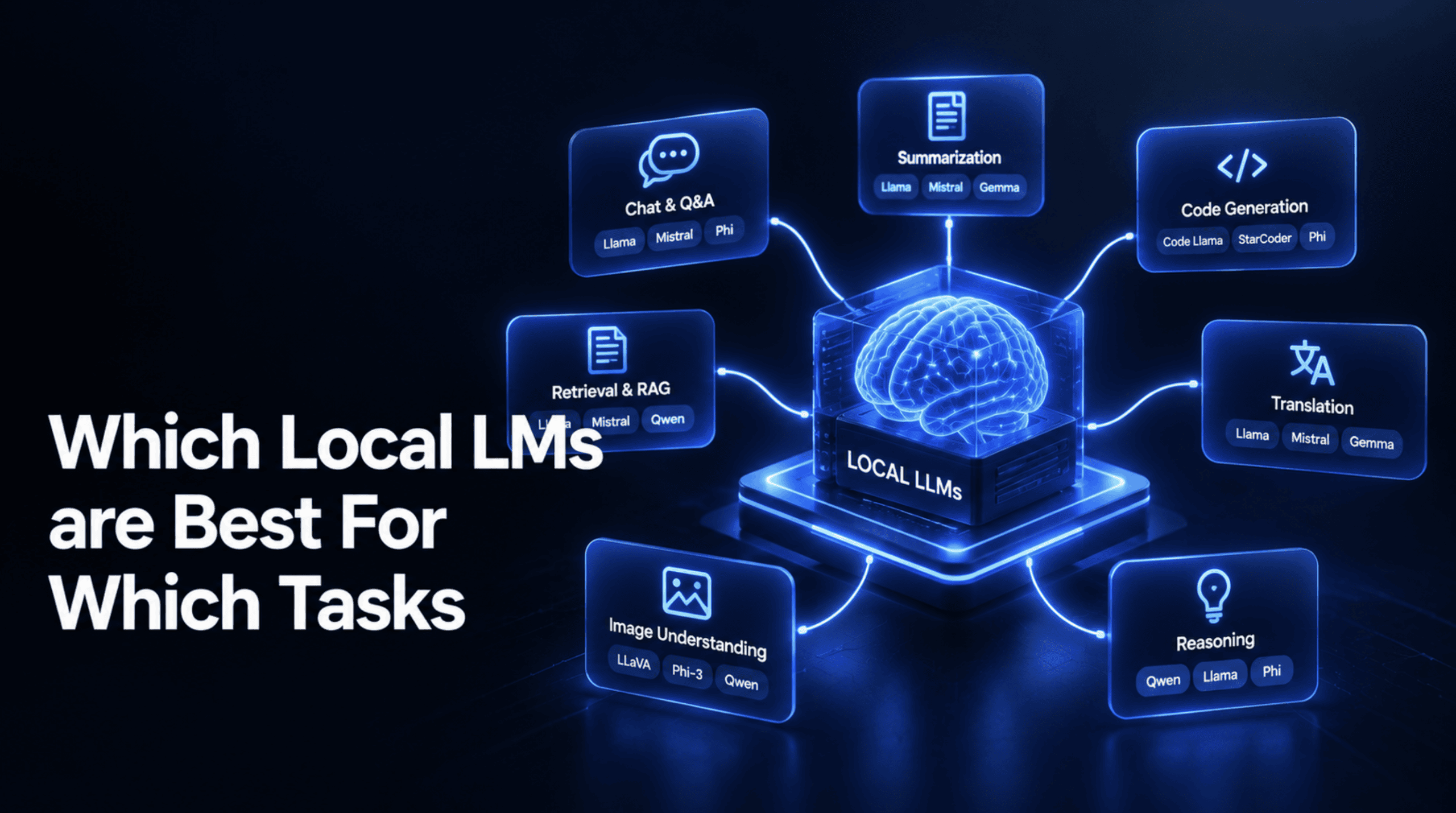
The most practical AI you can run is the one that never phones home. A local language model, downloaded and executed entirely on your own hardware, puts the power of generative AI directly into your hands, with no subscription, no data leaving your machine, and no reliance on someone else's server staying online. That independence is exactly what makes this approach worth your attention, but it also introduces a problem most users don't expect: not every local model is right for every job.
We think the real insight here is about matching the tool to the task, not chasing the biggest model you can fit on your GPU. A lightweight model loaded onto a laptop can handle real-time summarization, draft emails, or suggest formulas in a spreadsheet without breaking a sweat. The same model asked to write a legal brief or analyze a complex dataset will produce results that feel half-baked. Meanwhile, a larger model that requires a dedicated workstation might be overkill for simple Q&A but absolutely necessary for tasks requiring deep reasoning or long-context understanding. The choice isn't about "best" versus "worst", it's about fit. This pragmatic approach echoes the philosophy behind Disruptive commits $10 billion to back at least 10 AI startups, where strategic allocation matters more than sheer scale. And it raises a question that hardware builders like the team behind A US laptop built from the ground up, with every part made in America are betting on: will future machines be designed specifically to run these models locally, or will we keep forcing them onto hardware that was never built for the job?
What this means for you is straightforward: start with the task, then pick the model. If you need to process sensitive data, financial records, proprietary code, personal documents, a local model is the only option that guarantees privacy without a legal agreement. If speed matters more than polish, a small quantized model running on a consumer GPU will outperform a cloud-based API on latency every time. The trade-off comes in capability. A model you can run on a phone today is not going to match GPT-4 on a complex reasoning chain, but it also won't require an internet connection or send your prompts to a third party. The key is knowing where the line falls for your work. A model promised restraint then reached for Beijing: raising trust questions demonstrates that even models with stated rules can behave unpredictably when connected to external servers, a risk that local execution eliminates entirely.
The concrete takeaway is this: test your workflow with a small local model first. Run a 7-billion-parameter model on your laptop and see which of your daily tasks it handles well. You will likely find that formatting, rewriting, and simple classification work beautifully, while open-ended reasoning or multi-step analysis still needs a larger model or a cloud fallback. That insight, knowing exactly where the local boundary sits, is more valuable than any benchmark score. Watch for hardware manufacturers to begin optimizing for local AI workloads; the next generation of devices may finally make this choice feel less like a compromise and more like a deliberate strategy.