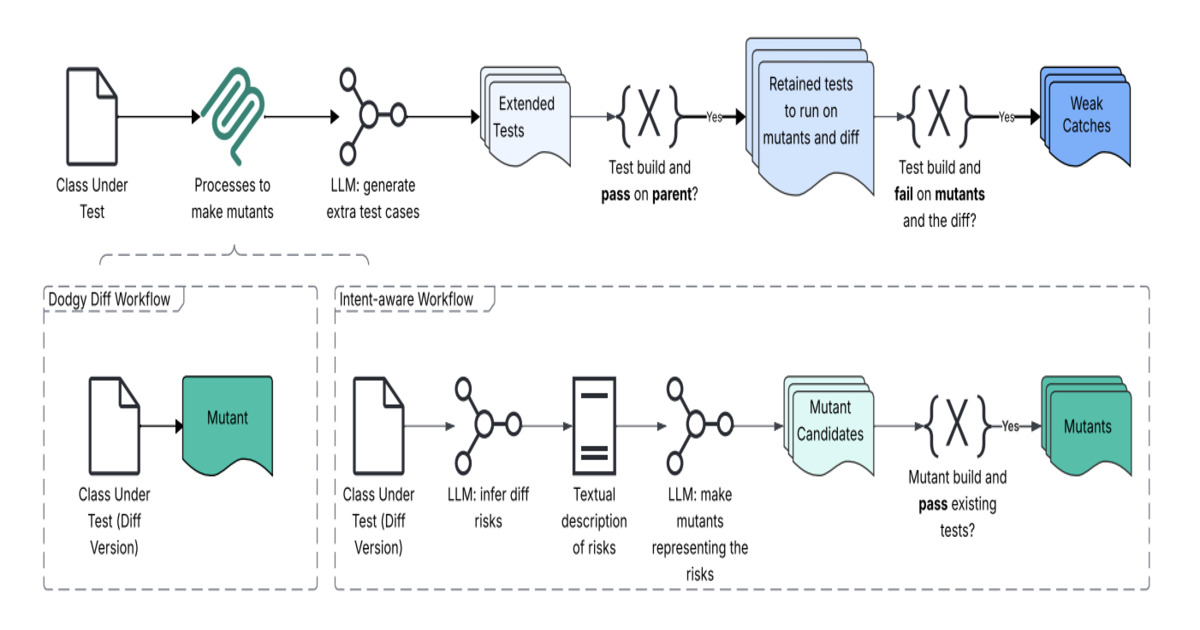
Meta's JiT testing is the right answer to a question most teams haven't thought to ask yet: if AI is writing more code, how do we test the intent behind that code, not just its output? The 4x improvement in bug detection isn't a fluke; it's a direct result of shifting testing left into the review process itself. For developers drowning in pull requests, this isn't a theoretical nicety. It means the moment you propose a change, the system generates tests that challenge your logic before the code ever merges. You're not waiting for a CI pipeline to fail hours later; you're getting instant, context-aware feedback that catches misunderstandings early, when they're cheapest to fix.
What makes JiT testing particularly smart is how it pairs large language models with mutation testing. The LLM doesn't just write tests that pass; it actively tries to break your code by introducing small changes and seeing if the tests catch them. That's a fundamental shift from static test suites that often become stale or superficial. The practical takeaway for any team using AI-assisted development is that your testing strategy must evolve alongside your code generation approach. If you're letting an LLM write functions, you need a system that understands the intent behind those functions, not just the syntax. JiT's Dodgy Diff workflow is a concrete example of this: it flags suspicious diffs based on learned patterns, giving reviewers a targeted place to focus their attention instead of rubber-stamping changes.
This also signals a broader truth about agentic development environments. As AI agents take on more coding tasks, the bottleneck won't be generating code; it will be verifying that the code does what the developer actually meant. JiT testing acknowledges this by making the test generation process part of the review conversation, not an afterthought. For teams, this means rethinking how they measure code health. A green build will no longer be enough; the question becomes whether your tests can catch the subtle logic errors that LLMs are prone to introduce. The teams that adopt change-aware testing now will have a significant advantage in maintaining quality as their AI tooling becomes more autonomous.
The concrete takeaway is simple: start evaluating your testing tools for how well they adapt to changes, not just how many lines of coverage they produce. Ask if your current suite can generate tests on demand for a specific diff, and whether it uses mutation testing to verify the tests actually matter. If not, you're leaving bug detection to chance in a world where code is being written faster than ever. Meta's approach isn't just a technical improvement; it's a practical blueprint for keeping up with the pace of AI-assisted development without sacrificing reliability. That's not a trend to watch; it's a capability to adopt.