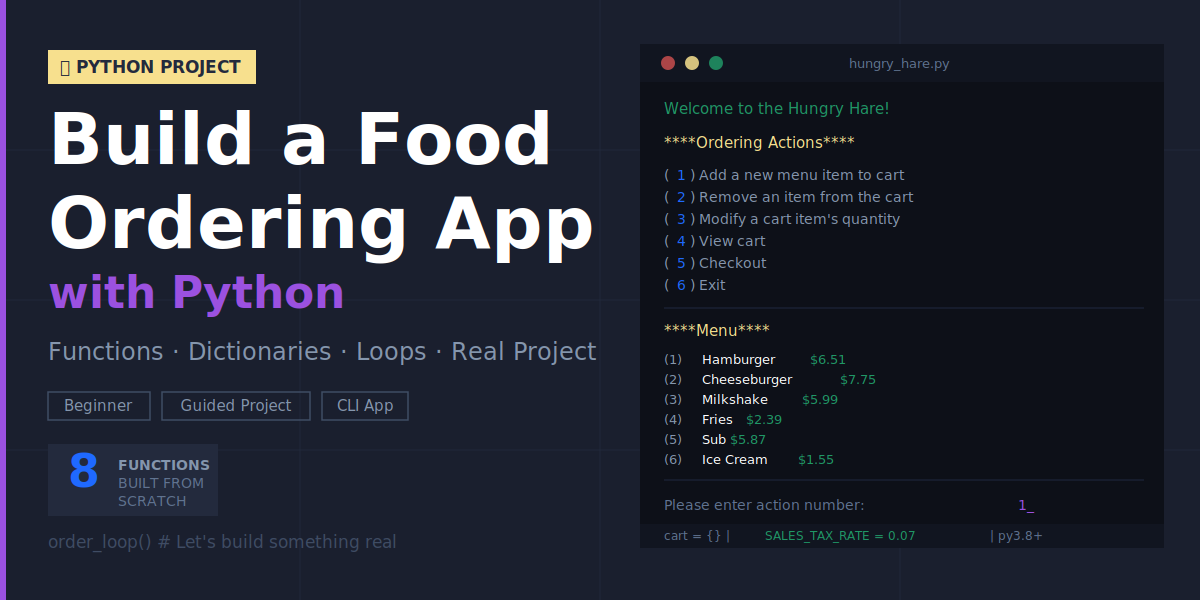
The allure of learning to code often begins with the promise of building something tangible, and this "Project Tutorial: Build a Food Ordering App with Python" article speaks directly to that desire. While isolated syntax exercises are undeniably valuable for grasping the fundamentals, they frequently leave learners feeling disconnected from the practical application of their newfound skills. As the tutorial rightly points out, true understanding blossoms when those individual components – dictionaries, loops, functions – coalesce into a functional application. This approach mirrors the broader shift we’re seeing in education, moving away from rote memorization towards project-based learning that fosters deeper comprehension and problem-solving abilities. It’s a welcome validation of the hands-on learning philosophy that’s gaining traction across various tech disciplines. For those just starting their data journey, understanding how to apply core concepts is paramount, and this tutorial offers a clear, accessible pathway. It’s particularly relevant given the ongoing demand for skilled data professionals; equipping individuals with the ability to build real-world applications is a powerful step toward closing that skills gap, as further explored in [Best Data Analytics Courses in 2026].
The choice of a food ordering app as the project is particularly astute. It’s a familiar concept that most users can readily understand, providing a valuable cognitive anchor. The complexity can be scaled to suit different skill levels, allowing beginners to focus on the core logic while more experienced learners can explore additional features like user authentication, payment integration, or database management. This accessibility is key to encouraging broader participation in the coding community. We see a similar emphasis on user understanding and accessibility within UX research, where ensuring cognitive inclusion is crucial for building truly intuitive and effective interfaces, as discussed in [The Benefits Of Cognitive Inclusion In UX Research]. The iterative nature of building such an application – debugging, refining, and adding new functionality – mirrors the real-world development process, providing invaluable experience that textbooks simply cannot replicate. It’s not just about mastering the language; it’s about embracing the process of creation and problem-solving that defines a developer's role.
Beyond the immediate benefits for individual learners, this tutorial highlights a broader trend: the democratization of software development. Python, with its relatively gentle learning curve and extensive libraries, continues to be a powerful enabler for individuals who may not have formal computer science training. The availability of such accessible tutorials empowers citizen developers – individuals who build applications to solve problems within their own organizations or communities – accelerating innovation and driving efficiency. This echoes the rapid evolution within broader technology ecosystems, as evidenced by the ongoing news and developments within platforms like Java, as covered in [Java News Roundup: JDK 27 in Rampdown, JDK 28 Expert Group, GlassFish, Infinispan, Kotlin]. The ability to rapidly prototype and deploy solutions, even with limited coding experience, is transforming how businesses operate and how individuals engage with technology.
Ultimately, the success of this tutorial hinges on its ability to inspire action and empower users to embark on their own coding journeys. By focusing on a practical, relatable project, it removes a significant barrier to entry and demonstrates the tangible rewards of learning to code. The future of software development will undoubtedly be shaped by individuals who can combine technical skills with a deep understanding of user needs, and this tutorial provides a valuable stepping stone toward that future. It begs the question: what other common, everyday applications can serve as compelling project-based learning opportunities to further democratize access to coding skills?