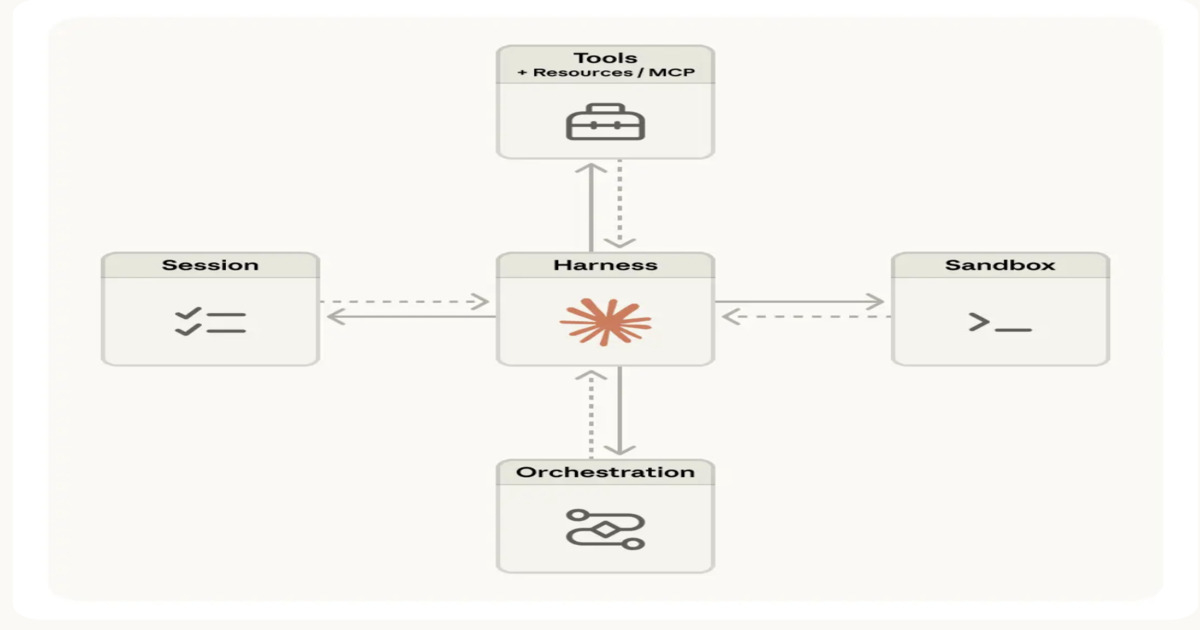
The most interesting thing about Anthropic's Managed Agents isn't the AI itself, it's the quiet admission that agent logic was never the hard part. For anyone who has tried to build a real workflow on top of a large language model, the pain point has always been the runtime: keeping a session alive, retrying a failed tool call, managing credentials without leaking them into a prompt. Anthropic's move to separate that operational layer from the agent's decision-making is a pragmatic acknowledgment that the industry has been asking developers to reinvent the same infrastructure over and over. By handling orchestration, sandboxing, and state management as a managed service, they are effectively saying that the value should live in the workflow design, not in the plumbing.
What this means for you is more time spent on the logic that actually differentiates your work, and less time debugging the boring but brittle parts of execution. Long-running, multi-step tasks have always been the Achilles' heel of agentic systems, a single timeout or a transient API error could kill an entire sequence. Managed Agents addresses that directly with error recovery and session continuity, so a workflow can pause, resume, and adapt without you having to build a custom state machine. For teams evaluating whether to adopt AI agents in production, this removes a significant chunk of the operational risk. You are no longer betting on your ability to build a robust execution environment; you are betting on your ability to describe a process clearly.
That said, this is not a silver bullet, and it is worth being clear-eyed about what Anthropic is offering. They are not making agents smarter; they are making them more reliable. The meta-harness architecture is a sensible solution to a real problem, but it still assumes you know how to break a task into discrete, well-defined steps. If your use case is vague or requires constant human judgment, a managed runtime will not fix that. The tooling is a complement to good design, not a substitute for it. The practical takeaway is that the barrier to entry for production-grade agents has just lowered, but the ceiling for quality remains entirely on your side of the equation.
For readers who have been holding off on agent-based workflows because the operational overhead felt prohibitive, this is the signal to revisit your assumptions. Start with a single, narrow task that benefits from external tools and long-running execution, and let the managed layer absorb the friction. The technology is no longer the constraint; your imagination for what a reliable, autonomous process looks like in your domain is. That is a trade worth making.