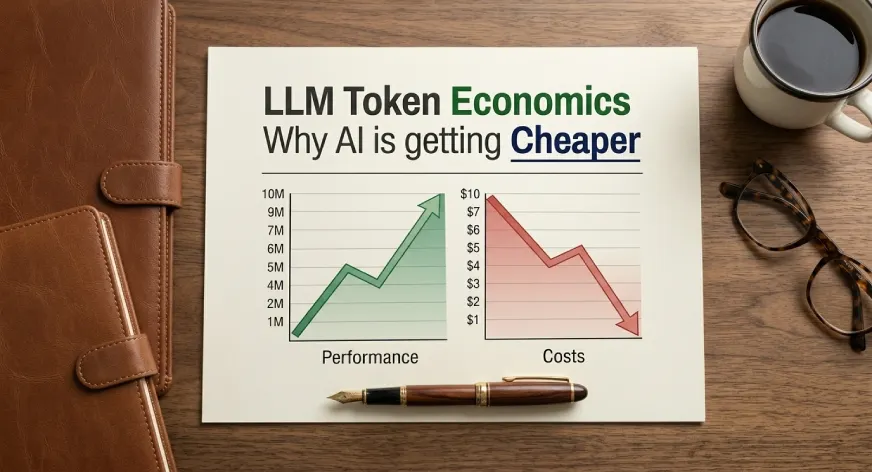
A year or two ago, asking an advanced AI model a question felt like a small financial decision. You paused, weighed the cost, and decided whether the answer was worth the price. Today, the same interaction barely registers. That shift is not a vague byproduct of progress. It is the result of specific, observable forces in how AI systems are built and priced, and understanding those forces matters more than the warm feeling of things getting cheaper.
The math behind the price drop is not magic, and it is not a loss leader. It is the economics of tokens, the fundamental unit of input and output that every model uses. When you pay for AI, you are not paying for a vague concept of intelligence. You are paying for computation, for the cost of generating each token, and for the infrastructure that serves it. What changed is that the cost per token has fallen, and it has fallen because the underlying systems have become more efficient at producing the same result. That is not a marketing claim. It is the reason your monthly bill did not explode even as your usage did.
For you, the practical implication is straightforward. The barrier between you and a useful answer has dropped from a conscious decision to a reflexive action. You no longer ask, "Is this worth the cost?" You ask, "What else can I try?" That is the real transformation. It changes how you work, how you experiment, and how you approach problems. When a tool is nearly free, you use it differently. You iterate more, you test more, and you fail more cheaply. The cost of being wrong has fallen, and that is what unlocks better outcomes.
But here is the point that matters: this trend is not a one-time correction. It is a trajectory. The forces that drove the cost down are still in motion, and they are tied to how the technology is designed, not just how it is marketed. The practical takeaway is not to wait for another price drop. It is to recognize that the economics have already crossed a threshold. If you are still treating AI as an occasional expense, you are already behind the curve. The question is not whether the cost will keep falling. It is whether you will adjust your behavior to match the reality of a tool that is cheap enough to use without thinking. That adjustment is the competitive edge now.