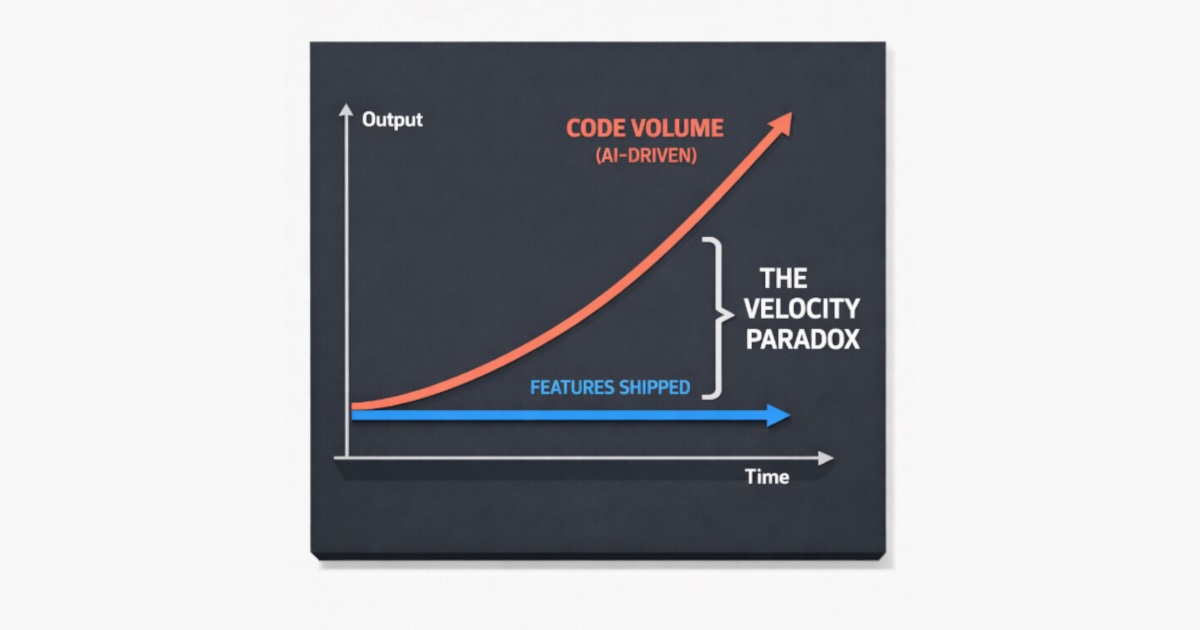
Agoda's observation that AI coding tools have not meaningfully accelerated project delivery should not surprise anyone who has watched software teams closely. The bottleneck was never keystrokes. It was always the human work of deciding what to build and confirming that what was built is correct. Coding, for all its visibility, is a downstream task. Speed there does little good when upstream decisions still depend on judgment, context, and conversation.
This matters for every team that has invested heavily in AI-assisted development expecting a direct line to faster releases. The real constraint is specification, translating messy business needs into precise, testable requirements, and verification, ensuring the output matches intent. These are not tasks that benefit from faster code generation. They demand the kind of human reasoning that AI tools currently cannot replicate: understanding trade-offs, resolving ambiguity, and validating outcomes against real-world constraints. Agoda's post makes the point plainly: if you speed up the part of the workflow that was already fast, the overall system does not get faster. It just exposes the next choke point.
For teams evaluating their own toolchains, the practical implication is clear. Investing in coding assistants without also investing in better specification practices and verification workflows is like widening a highway only to find the bottleneck is at the on-ramp. The gains will be real at the individual level but invisible at the project level. That mismatch can even be misleading, teams may see developers shipping more code and assume progress, while the project itself stalls on decisions that no tool has addressed.
What is needed is not a different AI tool. It is a different understanding of where work actually happens. Teams that treat specification as a first-class engineering activity, structured, reviewable, and owned, will see the leverage they hoped for from AI. Teams that treat verification as a collaborative checkpoint rather than an afterthought will find that speed elsewhere finally matters. The lesson from Agoda is not that AI coding tools are overrated. It is that the problem they solve was never the real problem.