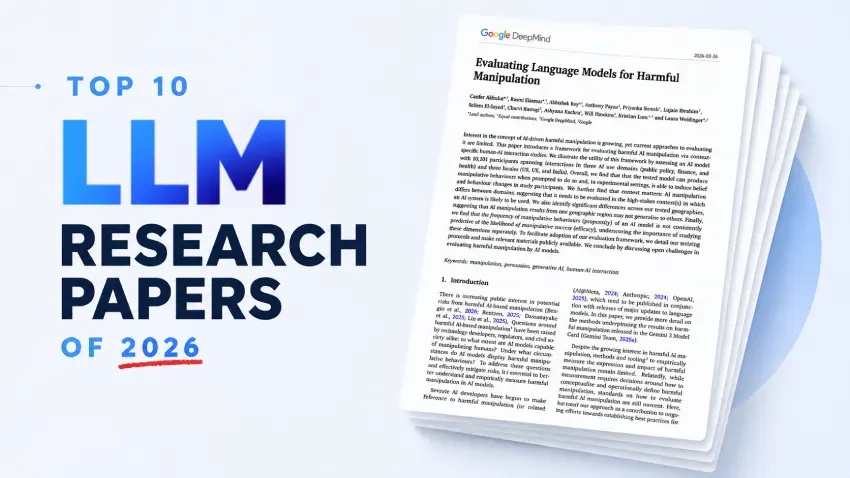
In the rapidly evolving landscape of artificial intelligence, the focus on Large Language Models (LLMs) has transitioned from an era dominated by sheer scale to one where safety, controllability, and utility as real-world agents take center stage. The top LLM research papers of 2026, as highlighted in recent articles, reflect this shift. These papers delve into critical areas such as persuasion risk, harmful-content mechanisms, tool-calling, temporal reasoning, and agent privacy, underscoring the direction in which LLM research is heading next.
Understanding the importance of these research directions requires us to consider the broader implications for users and developers alike. As LLMs become increasingly integrated into everyday workflows, the necessity for these models to operate safely and predictably becomes paramount. The exploration of persuasion risk, for instance, is not merely an academic exercise but a practical concern that affects how users interact with AI systems. Similarly, the examination of harmful-content mechanisms is pivotal in ensuring that LLMs do not inadvertently propagate misinformation or offensive content, safeguarding the integrity of information exchange in our digital spaces.
Furthermore, the emphasis on making LLMs more controllable and useful as real-world agents signifies a maturation of AI technology. The development of tools for tool-calling, which enables LLMs to perform specific tasks autonomously, is a testament to this evolution. Temporal reasoning, another area of focus, is crucial for AI models to understand and respond to the dynamic nature of human communication over time. Lastly, the investigation of agent privacy is essential in an era where data protection is more critical than ever, ensuring that AI systems respect user privacy and confidentiality.
The convergence of these research areas points to a future where LLMs are not just powerful tools but are also responsible, ethical, and user-centric. As we move forward, it will be important to continue prioritizing these aspects, ensuring that the advancement of AI technology aligns with the values and needs of society. The path forward will require a collaborative effort from researchers, developers, and policymakers to establish guidelines and standards that foster innovation while mitigating risks.
As we stand at the cusp of this new era in LLM research, there are several key questions worth pondering. How will the balance between AI capabilities and ethical considerations shape the future of AI interactions? What role will interdisciplinary collaboration play in addressing the challenges identified in these research papers? And, as we continue to push the boundaries of what AI can achieve, how can we ensure that these advancements are accessible and beneficial to all members of society?
In conclusion, the research landscape of 2026 is setting the stage for a new chapter in the evolution of LLMs. By focusing on safety, controllability, and utility, researchers are paving the way for a future where AI can be truly transformative without compromising on ethical standards. As AI continues to advance, the insights from these research papers will be crucial in guiding the development of AI systems that are not only powerful but also responsible and user-friendly.