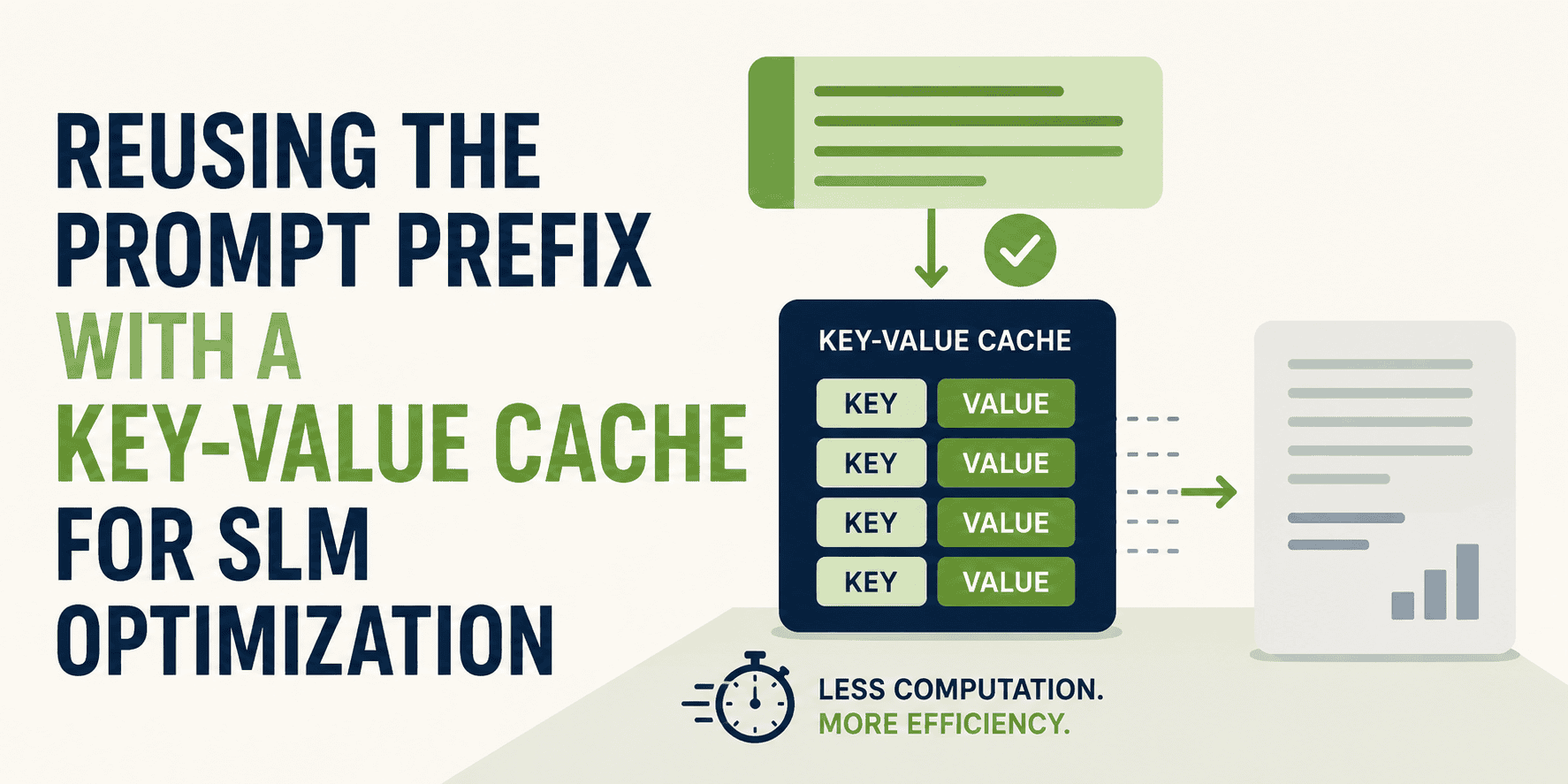
The second article in our series on small language model optimization is about prompt prefix caching, and it gets to the heart of what separates a demo from a deployment. We have spent years watching teams build impressive proofs of concept, only to stall when the bill for inference arrives. If you are feeling constrained by the cost and latency of running SLMs at scale, this technique is not a footnote; it is the main event. The idea is elegantly simple: reuse the key-value cache for the static parts of your prompt instead of recalculating them on every single request. That is not a minor efficiency gain. That is the difference between a system that feels responsive and one that feels like a chore.
For our readers, this changes the calculus of what is possible. When you are building a tool that relies on a long, detailed system prompt, the prefix is often the heaviest part of the computation. Without caching, every user interaction burns through tokens just to re-establish context. With prefix caching, you are effectively paying for that expensive first step once, then letting every subsequent request ride on the coattails of that initial work. This means you can afford to make your prompts richer, more instructive, and more specific, because the cost of that complexity is amortized. We would tell any reader who asks: if you are not looking at your cache hit rate, you are leaving real performance on the table. It is the most accessible optimization in the SLM toolkit, and it does not require a PhD in machine learning to implement.
What we find most compelling is the ripple effect this has on user experience. Latency is not just a technical metric; it is the feeling of a tool being responsive or sluggish. When you eliminate the redundant work of re-processing a static prefix, you are not just saving money. You are making the AI feel more immediate, more intuitive, and less like a server that is thinking too hard. That aligns directly with the human-centered approach we champion. It is not about the underlying architecture; it is about the person on the other side of the screen who just wants an answer without watching a spinner. The practical takeaway here is straightforward: start auditing your prompts today to identify which parts are truly static. That is your low-hanging fruit. The specific detail we will be watching for is how the community handles cache invalidation, because as your prompts evolve, managing that lifecycle cleanly will be the next real test of this technique's maturity.