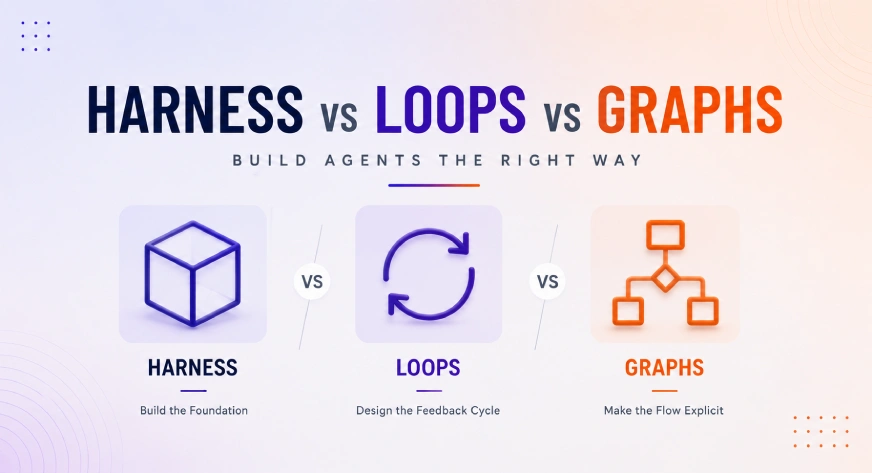
The central observation lands with the weight of a quiet confession: we keep blaming the loop when the harness is what's holding us back. That distinction is not a matter of semantics, and it's not a niche engineering debate. It's the difference between polishing a wheel that's attached to a car with no steering column and wondering why you keep ending up in a ditch. The colleague asking for "improved loop engineering" is reaching for a tool that can't solve the problem, because the loop is just the repetition of a pattern. The harness is what defines the pattern's boundaries, its inputs, and its consequences. If the harness is fragile, no amount of loop iteration will save you. The same applies to the graph with 40 nodes: it looks impressive on a whiteboard, but if you haven't watched the agent perform a single task end to end, you're designing a map of a territory you've never visited.
The practical takeaway for anyone building agents is uncomfortable but clarifying. You don't need more complexity in your loop, and you probably don't need a grander graph. You need to pull the harness out of the drawer and inspect it under a bright light. What happens when the agent receives an ambiguous instruction? What does it do when a tool returns an unexpected format? How does it recover from a failed step, or does it just spin? These are harness questions, not loop questions. The loop will happily run forever inside a broken harness, producing the same flawed outputs with increasing confidence. That's not a technical quirk; it's a design flaw. The reason this confusion persists is that loops and graphs are easier to talk about. They're visual. You can draw them. But the harness is where your agent's personality lives, and personality is harder to diagram. It's also where your failures live, and those are harder to look at.
If a reader came to us asking where to start, we'd say this: before you add another node to the graph or tweak the loop's iteration logic, run one task through your agent and watch it. Not the happy path, but the messy middle. See where it hesitates, where it invents a fact, where it gets stuck on a formatting issue. That single observation will teach you more about your harness than any design review. The confusion is correctly called out, but we'd go one step further. The confusion isn't just about terminology. It's about where we direct our attention. We're drawn to the parts of the system that are dynamic and algorithmic, because they feel like real engineering. The harness, by contrast, feels like plumbing. But in our experience, the plumbing is where the system either becomes trustworthy or becomes a demo. A specific signal to watch for is whether your agent's behavior changes when the input order changes, even slightly. If it does, your harness is imposing a hidden dependency that no loop will ever resolve. That's the detail we'd keep an eye on.