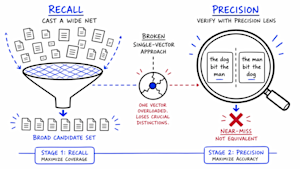
The recent research from Redis sheds light on a critical, yet often overlooked, challenge in fine-tuning Retrieval-Augmented Generation (RAG) embedding models. The findings indicate that efforts to enhance precision can inadvertently compromise retrieval quality, resulting in significant accuracy drops—up to 40% in some cases. This issue is especially pertinent for enterprise teams relying on agentic AI pipelines, where the integrity of retrieval directly influences the entire reasoning process. Such revelations align with ongoing discussions about the evolving landscape of enterprise RAG, as highlighted in pieces like The retrieval rebuild: Why hybrid retrieval intent tripled as enterprise RAG programs hit the scale wall.
The heart of the matter lies in the nuanced balance between precision and generalization. When teams train models for compositional sensitivity—the ability to discern subtle differences in sentence meaning—they may inadvertently hinder the broader retrieval capabilities that underpin effective AI-driven applications. This regression can easily go unnoticed, as traditional metrics focus on the task at hand, failing to scrutinize the model’s performance across diverse topics and contexts. As Srijith Rajamohan, an AI Research Leader at Redis, articulates, there’s a misconception that high semantic similarity guarantees accurate intent. This misunderstanding can lead to a cascade of errors in decision-making processes, particularly in sensitive environments where precision is paramount.
The research highlights a crucial architectural consideration: the need for a two-stage retrieval process. By separating the recall and precision tasks, teams can enhance retrieval quality without sacrificing the foundational benefits of embedding models. This approach not only emphasizes the importance of context but also provides a more robust framework for addressing structural mismatches that standard models often overlook. As organizations strive to optimize their AI pipelines, understanding this distinction becomes vital. The implications extend beyond mere technical adjustments; they challenge existing assumptions about model readiness and effectiveness, urging teams to rigorously evaluate their metrics and operational outcomes.
Looking ahead, the research underscores an urgent need for enterprise teams to rethink their approaches to embedding models and retrieval systems. The two-stage architecture proposed offers a promising pathway, but it also introduces complexities related to latency and implementation. As businesses navigate these changes, the question remains: How will they balance the pursuit of precision with the operational demands of their applications? The evolving nature of data management and AI integration will continue to present both challenges and opportunities for innovation. As we observe these developments, it’s vital for teams to remain vigilant, adaptable, and proactive in their pursuit of reliable, effective AI solutions that truly empower their workflows.