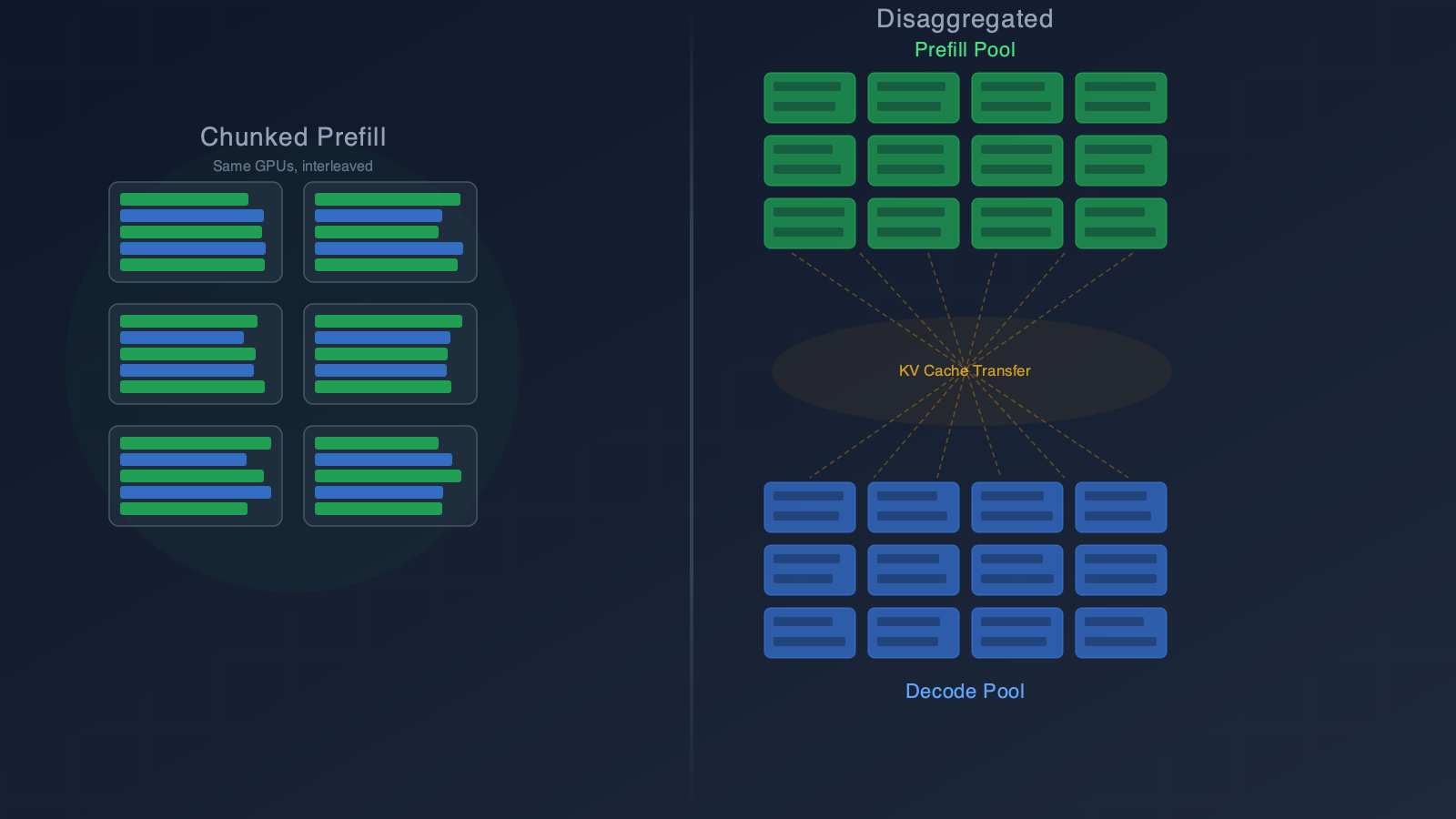
There is a moment in every scaling conversation where the math stops being academic. "Disaggregation Is a Thousand-GPU Problem" makes that moment concrete by asking a deceptively simple question: when does splitting prefill from decode actually pay for itself? The answer is not a sales pitch. It is a threshold. Three conditions have to hold before that split makes sense, and below that threshold, chunked prefill is the more honest default. This is the kind of thinking we need more of, because it replaces hype with a cost model.
Our take is straightforward: most teams do not have a thousand GPUs, and they should stop acting like they do. Disaggregation only becomes worthwhile when the scale of inference traffic justifies the added complexity of running two separate systems. That is not a minor footnote. It is a reminder that architectural decisions are not statements of ambition. They are resource allocations. If you are running a handful of nodes, you are not failing to disaggregate. You are making the rational choice to keep prefill and decode together, because the overhead of splitting them would outweigh the latency gains. Chunked prefill is the practical middle path, and we agree. It is a way to get some of the benefits of separation without pretending you are operating at hyperscale. For most teams, that is not a compromise. It is the right tool.
What does this mean for you in practical terms? If you are building an AI-native spreadsheet or any data application that leans on large language models, your instinct might be to chase the latest inference architecture because it sounds more advanced. This is a useful corrective. Before you invest engineering hours into a disaggregated setup, ask whether your request volume and token lengths actually cross the threshold described. If they do not, chunked prefill is not a fallback. It is the smarter engineering decision. We would tell a reader who asked us directly: do not adopt a pattern because it is fashionable. Adopt it because your metrics justify it. And if you are still early, spend your effort on observability and load shaping rather than premature infrastructure splits. Explore the full reasoning behind the threshold, and look at related discussions on inference optimization strategies and practical LLM serving trade-offs to see how others have navigated this same fork.
The most useful takeaway here is not the threshold itself but the discipline it represents. The authors are not saying disaggregation is wrong. They are saying it is conditional. That is a more mature position than the one that treats every new technique as a universal upgrade. The open question to watch is how fast the cost curves shift. If GPU memory and interconnect prices continue to fall, the thousand-GPU bar may drop, and disaggregation could become viable for smaller deployments sooner than expected. That is the detail to monitor. For now, the honest answer is that patience is a feature, not a bug. Choose chunked prefill, measure the outcomes, and revisit the split when your scale starts to hurt. That is how you build systems that last.