Every website is at its best the day it ships. The final branch merges, the site goes live exactly as designed, and it is briefly perfect. It will never be this good again. That is not pessimism; that is physics. The market moves, the messaging shifts, a competitor launches something, and the careful thing you built slowly stops matching the company it represents. A year later, it is a period piece. Not broken, just behind. Every team knows this decay, and almost everyone treats it as an acceptable cost of doing business. Pierre Burgy and the team at Fimo decided to treat it as a design problem instead.
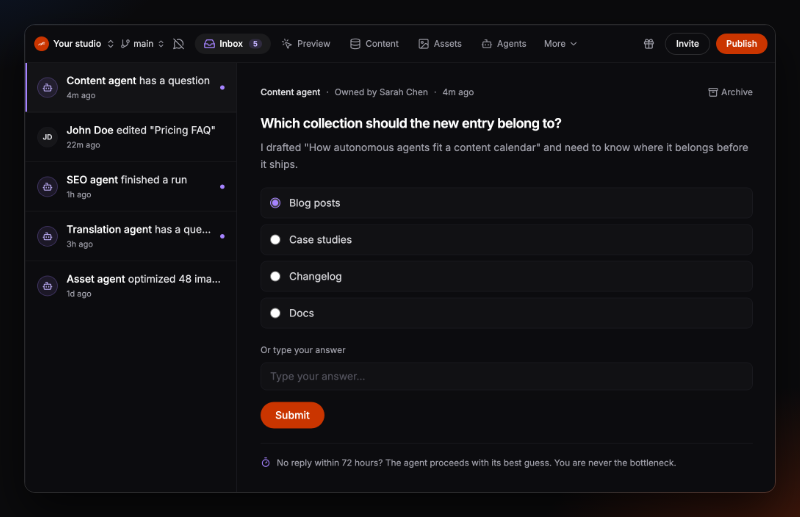
The insight here is not that change is hard. We have all read that. The deeper problem is that most teams optimize for the launch moment, not for the lifespan of the site. You hire a copywriter, you brief an agency, you ship a beautiful narrative. Then the quarter ends, priorities shift, and the site becomes a static artifact in a dynamic world. This is where the conversation gets interesting. Burgy is not arguing that you should write more content or run more tests. He is arguing for autonomy: agents that continuously optimize the site after launch, not as a novelty, but as the default operating model. That is a different kind of ambition. It is not about building a better website. It is about building a website that builds itself.
That ambition connects to a broader shift we have been watching across the stack. Scale Your SaaS Edge with Modular Cloudflare Workers shows how teams are moving away from monolithic deployables toward smaller, more adaptable units. Twenty Years of jQuery: How a Little Library Rewired Web Development reminds us that the tools we take for granted were once scrappy solutions to immediate friction. The through line is not technology. It is the decision to stop treating the web as a series of completed artifacts and start treating it as a living system. A website that can change itself is the logical endpoint of that philosophy. The question is whether the industry is ready to trust the outcome.
Here is our honest take: the hard part is not the technology. The hard part is letting go of control. We have spent two decades building workflows designed to prevent bad changes from shipping. That instinct is correct. But it has also created a culture where the default answer to "should we update this?" is "not right now." Autonomous agents do not have that hesitation, and that is exactly the point. They also do not have the context, the judgment, or the taste that a human editor brings to a nuanced product narrative. So the real design problem is not how to build the agent. It is how to define the boundary between what should be automated and what should remain a human decision. That boundary is not a technical specification. It is a product decision, and it will be different for every team.
What we would tell a reader who asks us about this: do not wait for the perfect autonomous platform. Start with a single page, a single conversion path, and a clear set of outcomes. Let the agent optimize the headline, the layout, the call to action. Watch what it does, and then decide what it is not allowed to touch. That is the practical next step, and it is one you can take this week. The specific detail to watch is the feedback loop. If the agent only optimizes for clicks, you will get clicks. If it optimizes for trust, you will get something more durable. That distinction, not the automation itself, is where the value lives.