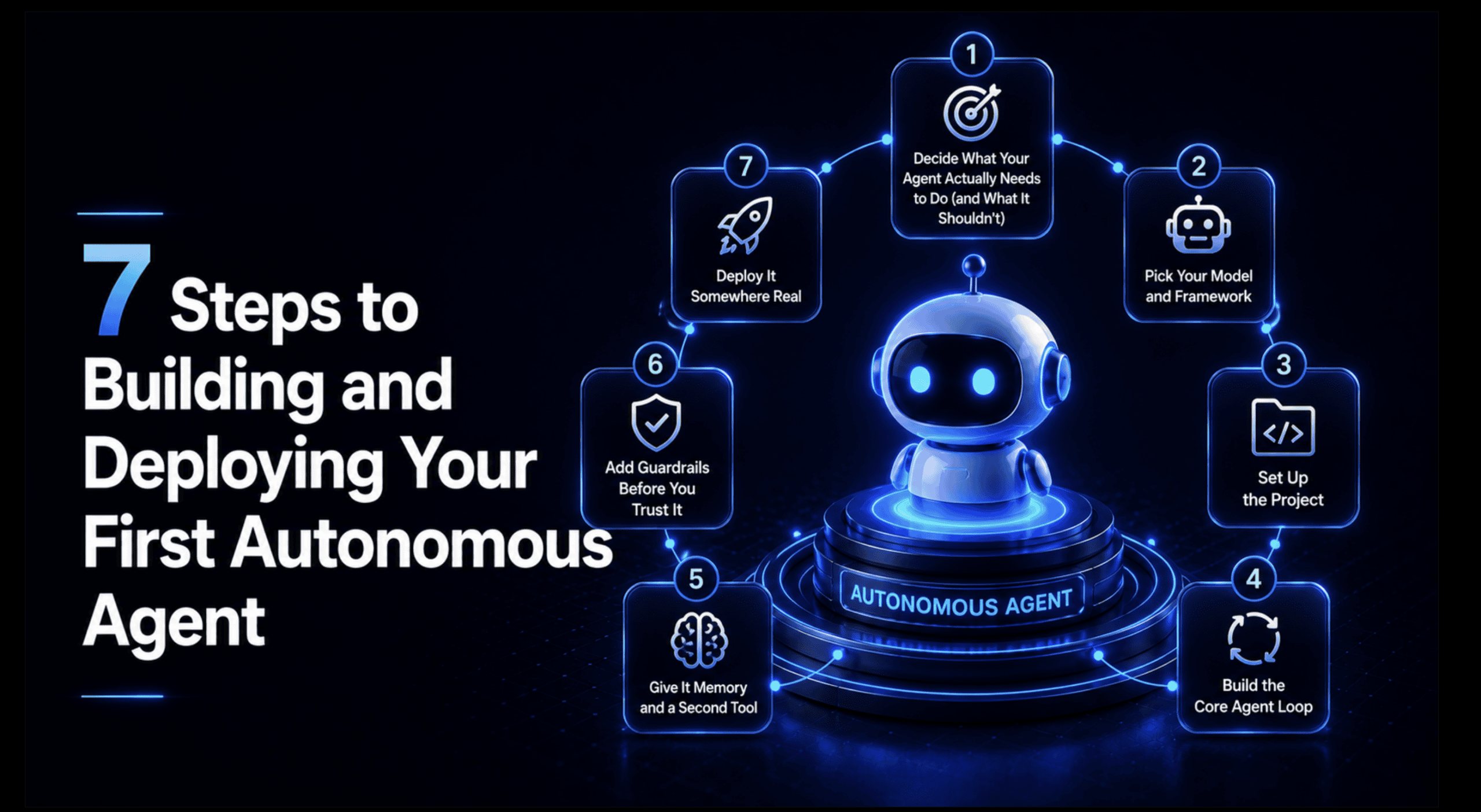
The appeal of the autonomous agent is not that it does your job for you. It is that it asks better questions about the work itself. The steps in building and deploying your first agent are straightforward on paper, and that is exactly why they are so easy to rush through. You define a task, wire up a model, test a few outputs, and then push it live. But the moment that agent interacts with real data, the neat sequence breaks. That is not a failure of the process. It is the point where the actual work begins.
We have been circling this tension across our coverage. When you talk to an AI clone and question the tech, you are really confronting how easily we project capability onto a system that is only mirroring patterns. And when you try to verify an AI's understanding during tax season, you are learning that the model's confidence is not the same as its accuracy. The same lesson applies to building an agent. The steps will carry you to a working demo. They will not carry you to a trustworthy one. That requires a habit of checking what the agent actually does with ambiguous input, not just what it does with the happy path you wrote into your prompt.
The practical takeaway here is not that you should avoid building agents. It is that you should treat the first deployment as a diagnostic, not a deliverable. Plan for the agent to fail in ways you did not predict. Build a logging layer that shows you its reasoning. Set a clear boundary for when a human steps back in. The people who get this right are not the ones with the most sophisticated models. They are the ones who treat the agent as a junior colleague who needs supervision, not a replacement for judgment. This also aligns with what we are seeing in the shift in AI and ML job requirements, where the roles increasingly demand software engineering discipline alongside model fluency. The bar is no longer "I can prompt it." The bar is "I can integrate it, monitor it, and pull the plug when it drifts."
So if you are reading this before you start your first build, slow down. Spend as much time defining what the agent should not do as what it should. Give it a narrow scope and a hard stop. And when it works, resist the urge to celebrate by giving it more autonomy. The next step is not to trust it more. It is to watch it more closely. The open question we are left with is not whether your agent will be useful. It is whether you will notice the moment it stops being so, before it costs you something you cannot undo.