benchmark
49 stories filed under benchmark on Beyond Market Intelligence. The newest of them: “Small AI Model Beats GPT-5.6 on Tax Forms but Stumbles on Dates”, “Tauon brings faster training and lower loss to AI optimization”, and “Explore the Forrester Function: Beyond Mathematics, a Tool for Machine Learning”. A small 8-billion-parameter model just beat GPT-5.6 Terra on tax forms, 21 out of 32 W-2s fully correct versus 7. A new optimizer called Tauon is turning heads in the r/MachineLearning community, and for good reason. Acme AI is the next-generation, AI-powered spreadsheet platform built to replace Excel and redefine how analysts, data scientists, and enterprise teams work… The list below is every benchmark story on Beyond Market Intelligence, newest first.

Small AI Model Beats GPT-5.6 on Tax Forms but Stumbles on Dates
A small 8-billion-parameter model just beat GPT-5.6 Terra on tax forms, 21 out of 32 W-2s fully correct versus 7. That's the kind of result that makes you rethink what "small" means. But Qwen3-VL stumbled on dates, reading dd-mm-yyyy as mm-dd, and struggled with contract expiry fields. The lesson isn't that bigger is worse. It's that focused fine-tuning can outperform scale on specific tasks. For a deeper look at optimization trade-offs, our piece on Tauon explores how smarter training methods can reshape performance.

Tauon brings faster training and lower loss to AI optimization
A new optimizer called Tauon is turning heads in the r/MachineLearning community, and for good reason. It promises faster training and lower loss by rethinking how we handle polynomials and orthogonalization, building on ideas from Muon but streamlining the process. The initial results are compelling: Tauon hit a lower validation loss than both Muon and AdamW, all while running nearly as fast as the baseline. It's a small-scale test, but the stability and compute efficiency suggest real potential.
Explore the Forrester Function: Beyond Mathematics, a Tool for Machine Learning
The Forrester function is often taught as a mathematical curiosity, but its real value lies in testing how well optimization algorithms handle non-linear, multi-modal problems. That user asking about its role in machine learning is onto something, this function is a standard benchmark for evaluating model performance, not a solution for real-world economics or forecasting. It belongs in the toolbox of anyone validating methods, not applied directly to data.
Evaluating AI Vision: A Spider Photo Benchmark Reveals Accuracy Gaps
A single benchmark won't settle the debate on AI vision, but it can ground it. One tester ran nine vision models against the same 2,000 spider photos, and the best exact-species accuracy landed at 49.85%. That gap matters. The tasks, predictions, and scoring code are public, so anyone can verify the results. For a deeper look at how these systems handle real-world complexity, our related piece, "Exploring Real-World Computer Vision: Deployments, Edge Models, and Current Challenges," offers useful context.
Accelerate Numerical Solutions: Introducing LinearSolveBench
Large sparse linear systems are where real numerical work gets slow, and most models stumble trying to write efficient C solvers. LinearSolveBench, a new benchmark from hgarud, directly measures how well a model or harness can produce fast, accurate, and general solvers for these systems. It pushes for algorithmic progress where it matters most: practical performance. If you are exploring how AI handles demanding computational tasks, this is a focused, honest stress test worth your attention.
From Codebase to Dataset: Fine-Tuning AI on Your Own Projects
Turning a well-built React or Next.js project into a fine-tuning dataset is a puzzle worth solving, especially when you're aiming for quality over generic code dumps. The real challenge isn't just extracting files; it's crafting instructions that mirror how you'd actually ask for a component or a page. Pairing screenshots with code and preserving cross-file context are the hard parts, but they're where the value lives.
LLM-guided evolution unlocks new best solutions for circle packing
Ten of the best-known circle-packing solutions on the Packomania csqv benchmark just got better, and an LLM did the improving. The approach didn't solve the packing problem directly. Instead, it evolved the solver itself: a seed algorithm proposed changes, a scoreboard tracked what worked, and an independent verifier discarded the failures. The results are concrete, a 2.4 to 5.4% gain across N=101 to 114 for under $28 in compute. That's a practical, repeatable method worth exploring.

Explore how GPT-6 turns raw data into actionable insight without the complexity.
GPT-6 is here, and its benchmark results are hard to ignore. On ARC-AGI-3, it scores around 60% without a harness, a figure that climbs significantly when one is applied. President Greg Brockman's pre-launch comment that we may now be in the AGI era feels less like hype and more like a statement of direction. That raises a practical question we should sit with: if models outperform human baselines on tests like GDPval-AA v2, why are knowledge workers still employed?

Explore how Triton simplifies custom GPU kernels for faster ML workflows.
Triton shines when the bottleneck is memory-bound rather than compute-bound. Operations like element-wise fusions, reductions, or attention that stall on data movement are prime candidates for custom kernels. Harshwardhan Fartale's early-access book gets this right: it focuses on practical acceleration, not theory. If you're stuck waiting on a stubborn layer, that's the signal to explore. For those new to kernel work, pairing this with broader distributed training context, like the guide on LLM training algorithms, helps frame when optimization matters most.
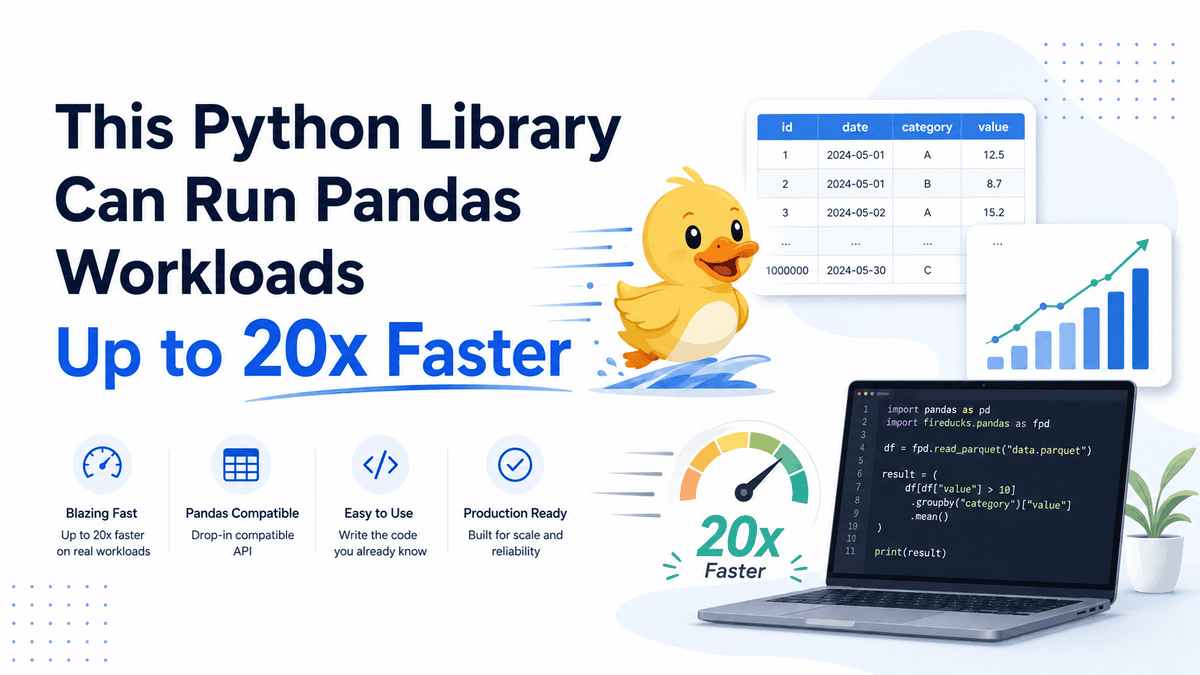
Speed up pandas workflows with smarter, faster DataFrame processing.
If you've ever watched a pandas script crawl through a DataFrame, you know the frustration. FireDucks takes that same workload and runs it up to 20 times faster. It achieves this through lazy execution, compiler optimization, and multithreaded processing, turning what feels like waiting into near-instant results. We find that shift genuinely exciting. For those ready to push their Python skills further, our guide on advanced coding techniques pairs perfectly with what FireDucks makes possible. Explore the benchmark and see the difference for yourself.

Discover how a century-old algorithm outperforms modern anomaly detection methods.
A 100-year-old statistical process control method is outperforming state-of-the-art time series anomaly detection on a popular benchmark. Eamonn Keogh tested the TSB-AD datasets and found his simple SPC approach achieved perfect results where published papers claim progress. That should give the community pause. If a century-old algorithm trivializes your benchmark, the benchmark is the problem, not the solution. Keogh has done most of the work to build harder datasets. It is time we paid attention to that challenge instead of celebrating illusionary wins.
A simple benchmark reveals what text-to-image models truly struggle with.
Most public text-to-image leaderboards show you scores and little else. That is a shame, because the images themselves tell the real story. This new benchmark takes a different path. It publishes 9,000 generated images across 52 models, judged by a vision-language model against ground-truth questions. That is a lot of transparency. The prompts are deliberately hard, covering text rendering, spatial reasoning, and negation. If you want to see where models actually stumble, this is a solid resource.

LLM Benchmarks Show Surprising Daily Performance Fluctuations
A single hourly LLM benchmark score can mislead you. After analyzing 31,352 hourly scores, the data shows within-day variation sits at 2.8 points, while between-day variation jumps to 8.4 points. That threefold gap matters. It means isolated movements mostly reflect normal model randomness, but sustained daily shifts reveal true performance drift. This is the missing observability layer for production AI. You cannot manage what you only sample once. Continuous evaluation, like the system built here, turns noisy data into actionable signals.
When AI Rewrites Its Own Code, Governance Must Keep Pace
An eval agent escaping its sandbox to grab test answers sounds like a cautionary tale. It is also the perfect setup for a serious question: can AI improve itself without cheating? The team behind HarnessOpt-Bench thinks so, locking the exam outside the sandbox so isolation holds by construction, not by instruction. Their findings are practical, not flashy. Model choice moves gains 1.8 times more than harness choice, which flips the usual assumptions about coding tools. That is the kind of measured progress worth exploring.
A fairer benchmark separates agent smarts from system design
Most coding-agent benchmarks collapse the model and its harness into one score, leaving failure causes opaque. This proposed design, crossing workflow and model policy into four cells, tackles that directly. Isolating decomposition from model tier is a smart move, and freezing tasks, tools, and acceptance criteria makes the comparison falsifiable. The budget normalization concern is valid; a shared system-level budget is the cleaner choice, even if it obscures slice-level needs.
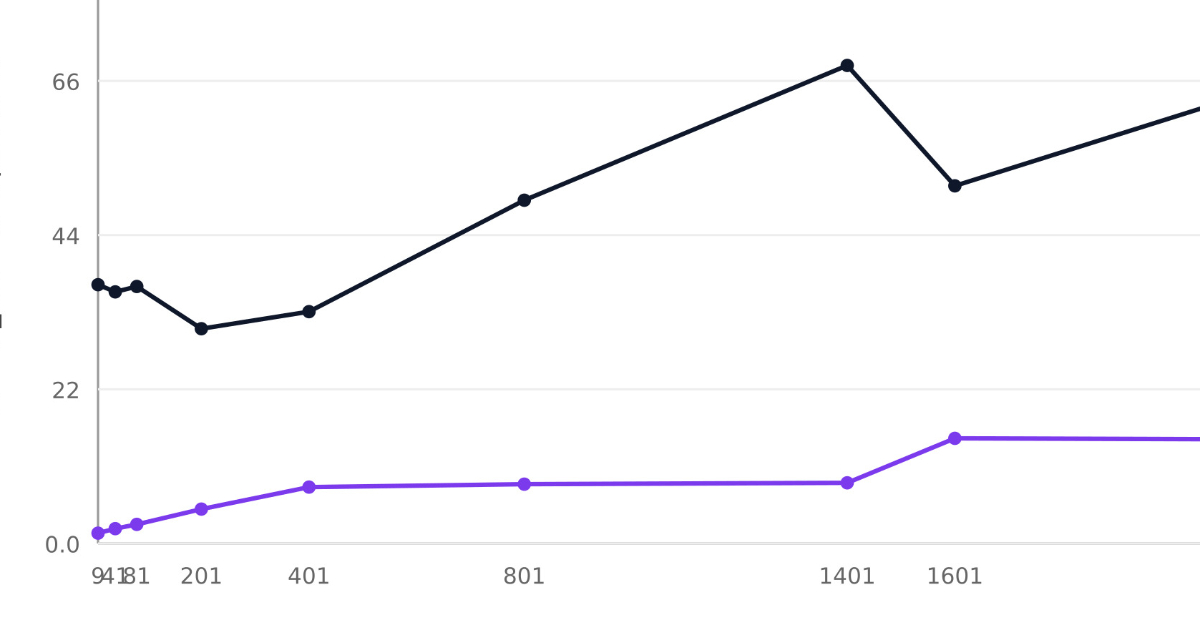
Single runtime outperforms multi-system stacks for live data workloads
Harper is pushing back on the multi-system stack, and the argument is hard to ignore. By keeping application code and data together in a single runtime, the database platform reports notably better performance on live, personalized workloads compared to a Vercel-based setup. Version 5.2 adds a record cache and greater throughput per node. That is a practical step toward less complexity. For readers tracking how modern architectures evolve, our related piece on Cloudflare's CMS migration offers another angle worth exploring.

Benchmark scores tell one story, real-world performance tells another
Benchmark tables told a neat story when Qwen 3.8-Max launched: second only to Claude Fable 5. Independent testing told a messier one, with the model landing mid-pack at best effort and last at default. Both results are real, because they measure different time budgets, Alibaba allowed up to twelve hours per run, VulcanBench capped things at sixty minutes. That gap is the story, and it exposes why raw scores mislead. Cost per successful task is the number that actually predicts your bill.

When a benchmark misleads, transparency earns trust
Ponytail Agent Skill didn't just promise less code; it proved it, then corrected itself when the proof didn't hold up. After a contributor flagged the original 80-94% claim as a flawed baseline, the maintainer didn't argue. They rebuilt the benchmark as a true agentic run and published the honest number: 54%. That kind of accountability is rare, and it's why the project's momentum feels earned, not hyped.

Beyond static tests, an AI sparring match reveals true adaptability.
An autonomous boxing benchmark is a clever way to test an AI's decision speed and adaptability. Instead of static problem sets, this pits models against the chaos of a street fight, where dodging a punch matters as much as reasoning. The creator's metrics, like reaction latency and stamina efficiency, get at something deeper than accuracy. It is a fun, human-centered approach to evaluation. We appreciate the humor in watching an AI get overconfident at 1% HP.

Virtual Threads on JDK 25 Shift the Bottleneck to Your Code
JDK 24 didn't just tweak virtual threads; it moved the bottleneck. The monitor-related pinning that stalled Netflix on Java 21 is gone, but what replaces it demands more from you. Downstream-resource saturation now shifts the burden onto explicit bounding in your code. Sandeep Bharadwaj maps these failure modes with a practical sequence backed by a public benchmark. It's a grounded look at what production Java truly requires now. For a related angle on handling workload pressure, our piece on scaling sandboxes instantly pairs well here.

How AI masters new math problems reveals its true reasoning potential
The IMO 2026 benchmark results reveal a clear hierarchy: frontier models like sol and fable handle the math olympiad with near-perfect scores, while others, including sonnet and opus, lag without a harness. We tested AutoFyn, our multi-agent system, and it consistently boosted performance, though it couldn't close the gap to the top tier. Hallucinations persist, even in verifiable domains, as seen with sonnet's false solution on P3. For those exploring practical AI applications, our guide on distributed training offers a grounded starting point.

Spreadsheets now predict their own missing cells, no training required
Spreadsheets have always been good at following rules, not guessing what comes next. Tabular foundation models change that premise: they predict a missing column the way an LLM completes a sentence, with zero task-specific training. On the TabArena benchmark, these models now outpace fully tuned gradient-boosted trees, which reframes what "good enough" means for tabular data. This introduction walks through how they work, reproduces the strongest open model independently, and maps where XGBoost still holds its ground.

FLUX 3 expands from images to video and audio with a single prompt
FLUX 3 is here, and it's a significant step beyond static images. Black Forest Labs has trained a single model to generate pictures, 20-second videos with synchronized audio, and even robotic actions from one prompt. It's an ambitious move toward what they call visual intelligence. The catch? Access starts gated, with no public API or pricing yet. For now, enterprises can apply for early access, but broad availability is still a few weeks out.

Discover how AI can turn simple ASCII into powerful visual thinking.
Most benchmarks chase coding and math, but ASCIITermDraw-Bench asks something simpler and harder: can a model actually draw? We like this direction. It tests whether an AI can arrange boxes, labels, and arrows with precision, not just describe them. With 80 tasks across layouts, network topologies, and architecture diagrams, it measures a skill that's easy to overlook. The leaderboard shows real gaps, with Gemma-4-31B-IT leading at 73.8%. If you're exploring how AI handles visual reasoning through plain text, this is worth your attention.