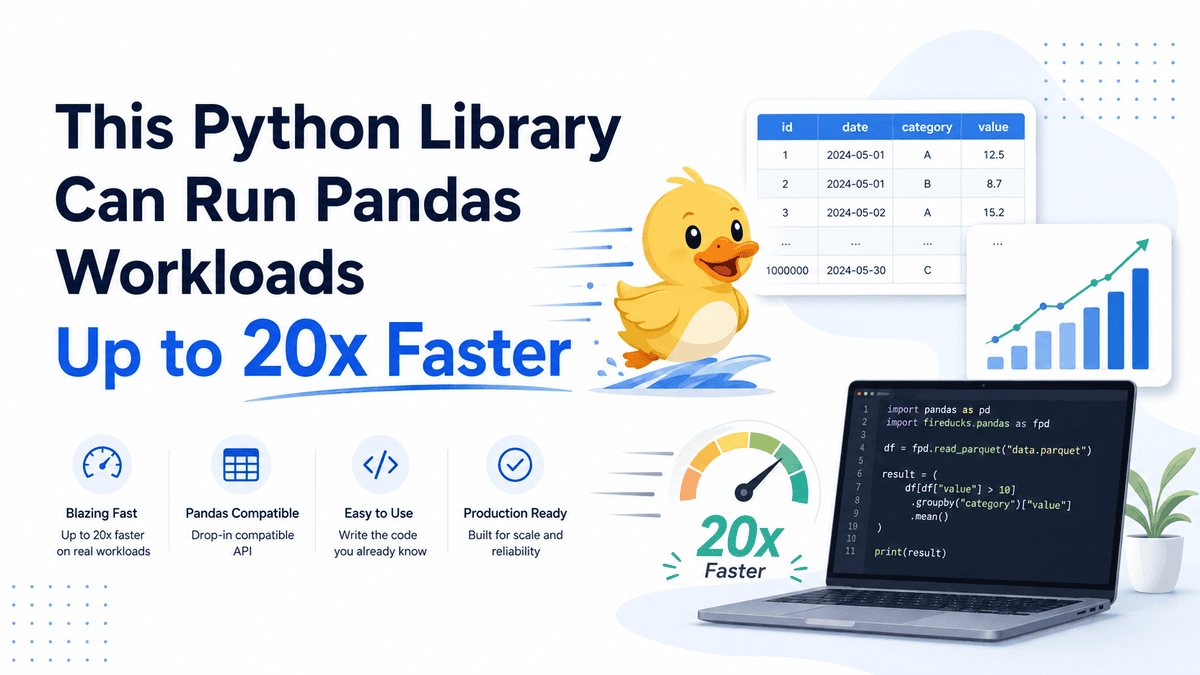
Every time a headline promises a 20x speedup for pandas, it deserves a skeptical look. Pandas is the workhorse of data work, but it has never been known for raw performance. So when we read about FireDucks achieving that kind of gain through lazy execution, compiler optimization, and multithreaded processing, our first instinct is to ask what the catch is. In this case, the catch is not a trick. It is a different way of thinking about how work gets done. For readers who have spent years wrestling with slow DataFrames, this is not just a performance note. It is an invitation to question whether the tools you use daily are actually serving you or just familiar enough to feel irreplaceable. That same tension shows up in Unlock Python's Potential: Advanced Techniques for Smarter Coding, where the point is that leveling up rarely means new syntax. It means understanding what the language already promised you.
The practical implication here is direct. If FireDucks can deliver on its benchmark claims, it changes the economics of your time. You do not have to rewrite your entire codebase. You do not have to learn a new paradigm. You swap in a library that thinks ahead, defers what does not need to happen yet, and runs more of your workload in parallel. That is the kind of win that does not show up in a feature list. It shows up in the time between hitting run and getting your results back. For data scientists and engineers who spend their days iterating on analysis, that time is not neutral. It is the difference between testing one hypothesis and testing ten. It is the difference between keeping a train of thought and losing it to a loading spinner. This is why we keep coming back to tools that respect your attention, and it is worth comparing that experience to what you get from Jev vs LLMs: Evaluating AI for Practical Decision-Making, where the real value is in practical, measurable outcomes rather than hype.
Our take on this is straightforward. You should not switch your entire stack because a benchmark looks good. But you should run your own test. Take your messiest, slowest DataFrame operation and try it with FireDucks. If it gives you a fraction of that 20x, you have just bought yourself a serious amount of cognitive bandwidth. What matters most is not the library itself but what it represents. The era of accepting sluggish data tools as a fact of life is ending. We are moving toward a world where performance is a feature you can choose, not a constraint you endure. For anyone who has ever shared a real project and asked for feedback, as described in Share Real-World Data Science Projects: A Path to Interview Prep, the lesson is the same. The tools you pick shape the questions you can ask. So ask yourself this: how much faster could you work if your data did not get in the way? That is the question FireDucks forces you to confront, and it is worth taking seriously.