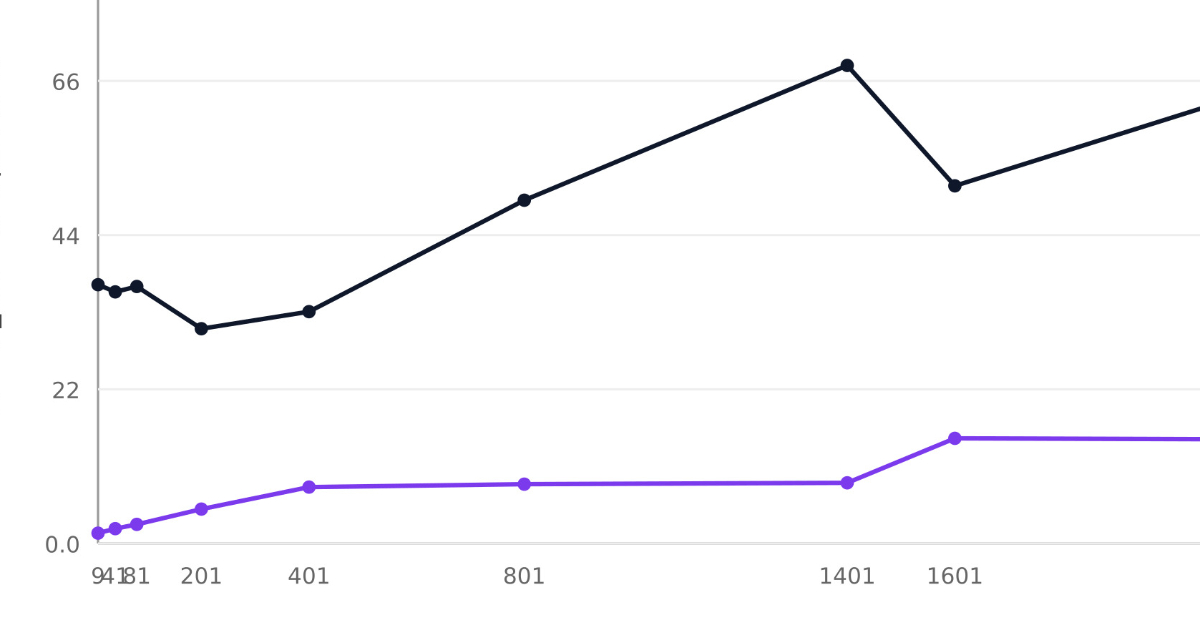
The database platform Harper is making a deliberate argument against the multi-system stack, and its latest benchmark is worth your attention. The company's stance is simple: keeping application code and data together in a single runtime outperforms the fragmented approach that has become standard practice. Harper's testing against a Vercel-based stack showed significantly better performance on live, personalized-data workloads. That is a bold claim, but more importantly, it points to a real pain point. Developers are tired of stitching together separate services for compute, storage, and caching, only to watch latency climb as every API call hops between systems. Harper's position is that this complexity is not a law of nature; it is a design choice, and one that can be challenged.
This is not about dismissing the tools you already use. It is about questioning whether the default architecture of the past decade still serves you. The related conversation around Exploring the Forrester Function reminds us that even mathematical models are being repurposed for machine learning workflows, which demand low-latency, data-dense operations. Similarly, Cloudflare’s blog migration to EmDash shows that even established players are moving away from heavyweight CMS platforms toward lighter, faster alternatives. The pattern is consistent: speed and simplicity are winning. Harper's benchmark is another data point in that same shift. When you pair that with the growing complexity of navigating AI/ML job requirements, where engineers are expected to master an ever-widening toolchain, the appeal of collapsing the stack becomes even clearer. Fewer moving parts means fewer things to break, and fewer skills to juggle.
What does this mean for you in practical terms? If you are running a Vercel-based stack today, Harper's numbers suggest you might be leaving performance on the table, especially when your workloads are personalized and data-heavy. The release of version 5.2, with its new record cache and more throughput per node, is not just a minor update. It is a direct response to the bottleneck that most teams hit when they separate their app logic from their database. The record cache alone could be a meaningful win for read-heavy applications, reducing the distance between the user and the data they need. Our take is this: do not adopt Harper's architecture because it is trendy. Adopt it because you have measured the cost of your current stack and found it lacking. The benchmark is a starting point, not a conclusion. Run your own tests, but go in with the understanding that the multi-system stack is a default, not a requirement.
The open question is whether the industry is ready to embrace this level of consolidation. We have spent years being told that microservices and serverless functions are the only way forward. Harper is making the case that the pendulum has swung too far. The specific detail to watch is how the record cache performs under concurrent load, and whether Harper can maintain its throughput advantage as your data scales. That will be the real test. If the numbers hold, this could be the push that makes developers rethink the cost of every network round trip. If they do not, it will be another benchmark that fades into the noise. Either way, the conversation has started.