decision making
decision making at Beyond Market Intelligence is a file of 27 stories. The newest of them: “Reimagining the workplace where AI handles tasks so people can lead”, “How to Spot the 4 Case Study Types in Data Science Interviews”, and “Make Smarter AI Agents That Know When to Escalate and When to Act”. Amjad Masad sees a future where AI agents handle the daily grind so people can focus on real decisions. Case study rounds used to mean marketplace experimentation. Acme AI is the next-generation, AI-powered spreadsheet platform built to replace Excel and redefine how analysts, data scientists, and enterprise teams work… The list below is every decision making story on Beyond Market Intelligence, newest first.

Reimagining the workplace where AI handles tasks so people can lead
Amjad Masad sees a future where AI agents handle the daily grind so people can focus on real decisions. He calls them "self-driving companies." It is a compelling vision, one that reframes productivity not as doing more tasks, but as leading with purpose. If the idea of automation freeing human potential resonates, read how Waymo brings self-driving tests to Toronto streets this year for a real-world look at AI taking the wheel.

How to Spot the 4 Case Study Types in Data Science Interviews
Case study rounds used to mean marketplace experimentation. After 80+ interviews across 16 companies, the picture is broader. You might face a launch evaluation, a root cause analysis, an opportunity sizing decision, or a targeting problem built on heterogeneous treatment effects. Spotting which of the four you are facing matters because each demands a distinct approach. The included maps break down the opening, the test, and the trap.
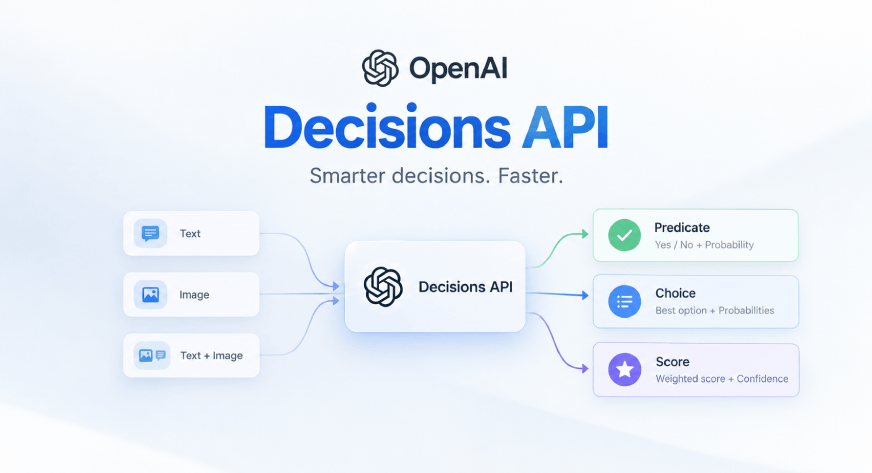
Make Smarter AI Agents That Know When to Escalate and When to Act
A false positive triggers an unnecessary escalation; a false negative lets a genuine issue slip through. That's the high-stakes calculus every decision-making AI agent must master. The new OpenAI Decisions API gives developers a structured way to handle exactly that, knowing when to act and when to hand off. It moves beyond simple classification into practical, context-aware judgment.
Teaching AI to Learn From Screen Video and Improve Over Time
You've built the control loop, programmatic inputs, screen capture as visual feedback. The missing piece is an AI that actually *watches* the screen before deciding what to do next. Frustratingly, most models treat visual data as optional. What you need is a system with persistent memory that learns from every interaction, not one that forgets what it saw moments ago. For a deeper look at managing memory efficiently, our piece on adaptive hierarchical routing explores how structured recall can preserve context without drowning in data.
Rethinking Your PhD Path When Conference Papers Stall
A fourth-year PhD stalled on top ML conference publications faces a question that deserves a practical answer, not a platitude. The pressure to optimize for prestigious venues is real, but so is the value of building engineering skills that translate beyond academia. Pivot if the work feels meaningful, not as a retreat. Explore what empowers your long-term goals. For more on how AI tools are reshaping professional paths, see our coverage of Hermes Agent's recent funding.

Cloudflare Clef gives AI agents a sharper decision-making model
Cloudflare's Clef takes a different path for AI agents: instead of generating open-ended text, it picks between predefined options. That's a sharper fit for decision-making tasks where precision matters more than prose. The 9B and 27B open-weight models, along with a platform for task-specific tuning, give developers room to adapt. It's a practical step forward, not a flashy one. For more on how AI models are being tested in the wild, our piece on Cloudflare's firewall stress-tests pairs nicely with this.

Explore how machines learn through multi-armed bandit simulations in Python
Reinforcement learning often feels abstract until you watch an agent learn in real time. Multi-armed bandit simulations in Python make that process tangible, showing how machines balance exploration and exploitation through trial and error. The approach is accessible enough for beginners yet powerful enough to reveal core AI principles. If you are ready to move beyond static datasets, this hands-on exploration will transform how you think about autonomous decision-making.

Grant Your LLM Safe Autonomy in 9 Practical Steps
Giving an LLM permission to act sounds like a leap of faith. This guide doesn't ask you to take that leap blindly, it breaks the process into nine practical steps. The author builds a control plane for AI agents, walking through how to grant safe autonomy without losing oversight. It's the kind of grounded, actionable thinking that makes complex systems feel manageable.

Jev vs LLMs: Evaluating AI for Practical Decision-Making
Spreadsheets have long forced a choice between speed and judgment. In a new test, TypeSafe AI's Jev tackled 3,080 classification tasks, and the results are worth your attention. The comparison focuses on accuracy, latency, calibration, and confidence, asking whether a dedicated tool can serve as a practical decision layer where LLMs might falter. It is a grounded, useful evaluation. For those exploring how AI systems handle reasoning under pressure, this pairs well with our guide to distributed training algorithms.

Jev: AI That Decides, Not Just Writes
Most spreadsheet users know the pain of writing formulas; Jev skips the typing and moves straight to the outcome. This AI doesn't just generate text for you to interpret; it makes the call, deciding what the next step should be based on your data. It's a direct answer to the question of what happens when the tool stops assisting and starts acting. For those interested in how far AI can go beyond simple generation, our piece on the Forrester function offers a deeper mathematical look.

Why Agentic AI Fraud Defies Traditional Explainability Tools
SHAP has long been the go-to tool for explaining fraud predictions, but autonomous agents break that framework. When an AI agent makes a series of decisions across multiple systems, a single feature-importance score can't capture the cascading logic. This gap matters because fraud detection is becoming more dynamic, not less. It's a problem worth confronting directly, and one that challenges how we define accountability in AI-driven security. If you're tracing how these systems learn, our guide to distributed training offers useful context.

See how forward-deployed engineering turns enterprise AI into lasting value.
Forward-deployed engineering is where enterprise AI actually learns. The pitch is familiar: an engineer on-site, a workflow encoded in weeks, a demo that works on real data. The real test comes later. Does the next deployment start with more product and fewer unknowns, or just another services team? We see FDE as a disciplined learning loop. Every engagement should leave behind reusable capability, not just a satisfied customer. That compounding is what separates a product that understands from a company that simply delivers.

Explore uncertainty to make smarter decisions with Bayesian neural networks
Point predictions give you an answer, but they don't tell you how much that answer is worth. That's the gap this guide steps into. It walks through Bayesian neural networks in a practical, grounded way, showing how uncertainty quantification turns a single guess into a range of possibilities you can actually act on. It's a thoughtful read for anyone tired of blind confidence in their models.

Focus human attention where it drives real data outcomes
Reviewing every AI action is a luxury most teams can't afford. In this piece, the author tackles a familiar bottleneck: how to keep humans in the loop without turning oversight into a full-time job. The answer isn't more checkpoints, it's routing attention to the moments that genuinely need it. We appreciate this practical take on balancing control with momentum. It pairs well with our guide on distributed training, where similar trade-offs between efficiency and oversight come into play.

AI handles the execution but human judgment still leads analytics.
Agentic AI is rewriting the analytics stack, shifting execution to intelligent agents that handle the heavy lifting. But as this technology takes over the mechanical work, one skill remains untouchable: the human judgment to ask the right questions. The distinction matters because agents can process data, yet they can't decide what truly matters. This division of labor isn't about replacing people; it's about freeing them to focus on insight and strategy.
Where Data Meets Design to Make Decisions That Stick
Most dashboards look beautiful and still fail the only test that matters: do they change what someone does next? Meriem Benhabiles argues that data visualisation only works when structured UX thinking shapes it, from the questions asked before opening a tool to the choices that help an insight land. That is a refreshingly practical stance. It pairs well with our coverage of how AI voice transparency and clean data practices shape user trust, so exploring those pieces deepens the picture.

What data scientists miss about rerankers and why it reshapes your RAG architecture
Ask a data scientist what a RAG reranker actually does under the hood, and you'll get a pause before an honest answer: it's not magic, it's a focused relevance filter. That honesty matters more than any architecture diagram, because it forces hard decisions about where your enterprise RAG pipeline spends its compute. We think that clarity is the real unlock. For teams already wrestling with distributed systems, this piece pairs well with our practical guide to distributed algorithms.
Demystifying BMVC's IJCV recommendation process for authors
The question of how BMVC's IJCV special issue recommendation actually works is one many authors quietly wonder about, and it's smart to ask before the dust settles. Based on past cycles, the decision typically hinges on a blend of review scores and the program chairs' judgment, often aligning with oral or highlight selections rather than a purely mechanical cutoff. You likely won't hear anything until a separate email arrives, so patience is key.

Let AI choose the right tool so you can focus on results.
Choosing an AI shouldn't feel like a research project. If you're stuck weighing options, stop overthinking and start with one clear action: define the single task you want to simplify, then test that first. The right tool reveals itself through use, not speculation. We've explored similar themes before, like in "Talking to My AI Clone Taught Me to Question the Tech," which shows why hands-on experience beats abstract debate. So pick a starting point, try it, and let the results guide your next move.

Designing the dispatcher that makes agentic RAG workflows smarter
The dispatcher in an agentic RAG system isn't just a router; it's the judgment call that decides when to loop back for another retrieval and when to trust what's already in context. This piece from our series on enterprise document intelligence finally puts the patterns together, and it's a refreshingly clear look at why that decision is the real engine of reliability. If you're still wrestling with when your workflow should stop, this is the guide you've been waiting for.

Diversify Your Budget Without Losing the Insights That Power It
A well-structured budget should never force you to choose between clarity and control. This piece tackles that exact tension, showing how you can diversify a budget while keeping the shadow prices that explain every decision. It's a practical approach for anyone tired of opaque spreadsheets that hide their own logic. We appreciate work that makes financial modeling more transparent, and this guide delivers exactly that. For readers exploring how data tools evolve, *Expanding Your Tech Fluency* offers a useful complement.
When to choose simple analysis over machine learning
Not every data question deserves a model, and that is the right instinct to start with. In our experience, the decision to reach for machine learning hinges on whether the problem truly needs pattern recognition at scale or if a transparent analytical approach solves it faster. We often ask: can a simple formula explain this clearly to a stakeholder? If yes, skip the complexity.
Explore how deeper math in operations research can reshape your data career
You're weighing a real fork in the road: stay deep in data science or branch into operations research. That's not just a title decision; it's about how you want to solve problems. OR is math-heavy, but not beyond what you've already got. Calcs 1-3, linear algebra, and stats are the foundation. You'll add optimization and probability, which are more applied than theoretical. Earning potential is comparable, so let the work itself guide you.
Solve Data Case Studies with a Clear Framework That Drives Real Business Impact
Data science case study interviews are not about reciting syntax. They test how you think through a problem, analyze data, and explain your reasoning in a way that solves a real business challenge. That's a skill worth building. This guide introduces a simple framework called SCOPE to help you approach almost any case with clarity and confidence. It's practical, not theoretical.