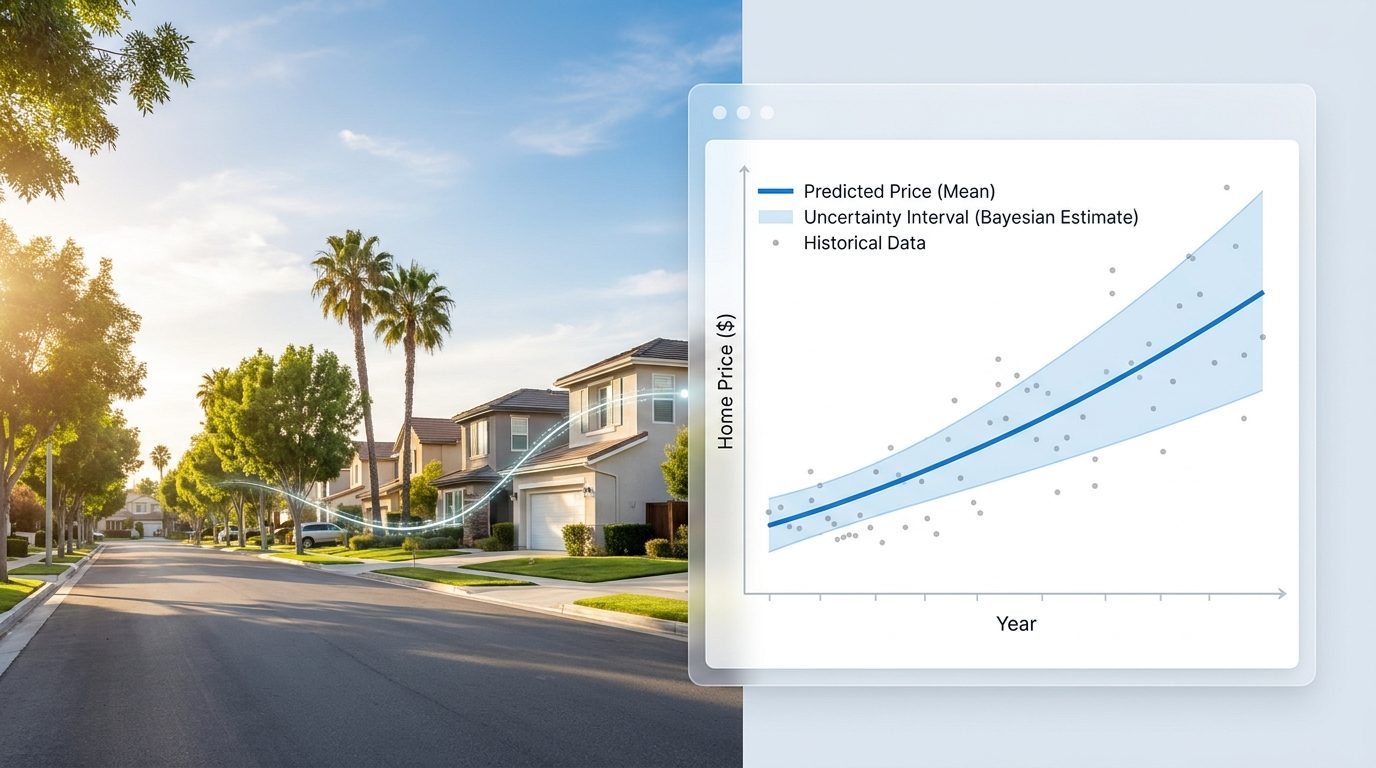
Spreadsheets taught us to trust the number in the cell. We build models, we hit enter, and we move on, rarely pausing to ask how confident we are in that output. Bayesian neural networks challenge that habit at their core. It argues for moving beyond point predictions toward uncertainty quantification, which is a fancy way of saying: the model should tell you when it doesn't know. For anyone who has ever presented a forecast to a stakeholder, that feels less like a technical upgrade and more like a survival mechanism. This framing is not a niche academic exercise but a practical tool for making better decisions, and that framing is exactly right.
We have spent years telling users to trust the output of their tools. But trust is not the same as certainty. A regression line drawn through historical data gives you a single answer; it does not give you the range of plausible realities that could unfold next quarter. Readers are pushed to embrace a more honest relationship with their models, one where ambiguity is surfaced rather than hidden. This connects directly to the broader challenge of working with large language models, where a single prompt can yield wildly different outputs depending on token probabilities. As we explored in Unlock LLM Training: A Practical Guide to Distributed Algorithms, understanding the mechanics under the hood is essential for responsible use. The same principle applies here: if you do not understand what your model is uncertain about, you are not using it; you are gambling.
The practical takeaway for our readers is not that you need to abandon your current stack and start coding variational inference tomorrow. It is that the questions you ask of your data should change. Instead of asking "What is the predicted revenue?" you start asking "What is the predicted revenue, and how wide is the range of outcomes that could produce this number?" That shift in questioning changes how you allocate resources, where you focus your attention, and when you decide to hold off on a decision. It also changes how you communicate with non-technical stakeholders. A point estimate invites false precision; a confidence interval invites a conversation. That is a meaningful distinction, and it is handled with a level of accessibility that we appreciate. It never talks down to the reader, but it also does not assume you have a PhD in probabilistic programming.
The broader implication here is that the future of data work is not about building smarter models; it is about building more honest ones. We are moving toward a world where tools like Exploring Paragraph Structure: How LLMs Navigate Token Space help us understand how models think, and Bayesian methods help us understand when they are guessing. Both are essential pieces of the puzzle. Bayesian neural networks are not presented as a silver bullet, and their maturity is not oversold. What it does is give you a reason to care. The next time you build a model, ask yourself one question: would you rather be right, or would you rather know when you are wrong? The answer should change everything.