deep learning
deep learning at Beyond Market Intelligence is a file of 147 stories. The newest of them: “Explore how open AI models reshape your access to personal intelligence”, “Balancing the Unbalanced: Smarter Loss Functions for Medical AI”, and “Exploring the design logic behind the Transformer architecture”. Meta's Muse Glimmer, an open-weight AI model, offers a telling glimpse into Mark Zuckerberg's vision of personal superintelligence. Three models collapsing toward BIRADS 1 is a familiar wall when a dataset leans that hard. Acme AI is the next-generation, AI-powered spreadsheet platform built to replace Excel and redefine how analysts, data scientists, and enterprise teams work… The list below is every deep learning story on Beyond Market Intelligence, newest first.

Explore how open AI models reshape your access to personal intelligence
Meta's Muse Glimmer, an open-weight AI model, offers a telling glimpse into Mark Zuckerberg's vision of personal superintelligence. It also sharpens a growing divide: the difference between AI tools you merely use and those you actually own. That distinction matters. As we explore what accessible models can do, we should also ask who truly controls the intelligence shaping our workflows.
Balancing the Unbalanced: Smarter Loss Functions for Medical AI
Three models collapsing toward BIRADS 1 is a familiar wall when a dataset leans that hard. The VinDr imbalance is likely steering your cross-entropy, even with class weights and center loss in the mix. You are not wrong to question the loss function, but the weights may need recalibration or a focal-style adjustment to resist the majority pull. Before abandoning the approach, audit your sampling strategy and weight initialization.

Exploring the design logic behind the Transformer architecture
Most explainers hand you the finished Transformer and move on. We wanted to know why it looks the way it does. This piece steps back from Q, K, and V to ask the question that actually matters: what problem was the architecture solving in the first place? It is a thoughtful, grounded reconstruction that rewards curiosity. If you are ready to go deeper, our guide to distributed algorithms pairs well with this foundational view.

Smaller models, bigger returns: why 3B outperforms 70B for your task.
A 3B model can outperform a 70B one on your specific task. That isn't a compromise; it's a strategic choice. For focused pipelines, massive models are often overkill, and their cost is hard to justify. The Hugging Face transformers library and smolLM3 make this accessible, letting you deploy a lean, capable model without the overhead. If you're tired of paying for compute you don't need, this approach is worth exploring.

Explore hands-on courses to master generative AI and LLM tools.
Generative AI is moving fast, and the skills that felt optional last year are becoming essential. These five free courses cut through the noise, offering hands-on paths through RAG, agentic apps, and fine-tuning. You will build real proficiency, not just collect concepts. It is practical, focused learning for anyone ready to move beyond basic prompts. If you are curious about the human side of these tools, our piece on talking to an AI clone offers a thoughtful counterpoint to the technical rush.
Unlock smarter screen time analysis with AI that tracks faces and bodies
Choosing the right models for actor screentime analysis is a layered problem, and your instinct to move beyond MTCNN is sound. For face recognition, consider modern alternatives like SCRFD or RetinaFace, which offer better accuracy at varied scales. Body identification is trickier; pair YOLOv8 for detection with deep re-identification models like OSNet for tracking across shots. TransNetV2 false positives are common, so a post-processing filter on scene cuts helps. This is a practical engineering challenge, not just a model-picking exercise.

AI pioneers chart a new path to accelerate scientific discovery.
When Jeff Dean, a name synonymous with Google's AI dominance, departs alongside other top researchers to launch a new startup, it signals more than a shift in personnel. It's a clear vote for a future where AI's primary role is accelerating scientific discovery. We see this as a bold, necessary move. For those feeling the complexity of modern AI, this mission makes the technology's purpose tangible. It's about empowering breakthroughs, not just improving spreadsheets.
Find Your Next AI Project and Contribute with Purpose
Finding your footing in deep learning takes more than coursework; it takes real-world reps. This user gets that. Their offer to join an active project shows a practical understanding that skills grow fastest when they're tested collaboratively. It's a smart, humble approach. For anyone building AI/ML systems, a contributor who is both eager and self-aware is a rare asset. We hope they find the right team. For more on tackling complex data challenges, exploring the Forrester function might be a useful next step.

The 47‑Page Blueprint That Reveals What a Frontier Model Really Takes
Kimi K3 doesn't hide behind hype. Its 2.8-trillion-parameter model shipped with 47 pages of open recipe, and reading them reveals a truth we don't often say aloud: most of building a frontier model isn't the model. It's the data, the compute orchestration, the judgment calls. That transparency feels almost radical. For anyone curious how far the field has come, this report is a grounded, human-scale entry point.

Explore how a third pretraining axis transforms end-to-end data generation.
Most language models are trained along two axes: data and compute. Gladstone and colleagues argue for a third: the modeling objective itself. Their work on explorative modeling suggests that how we frame the learning task is as important as the data we feed it. This isn't a tweak; it's a different approach to end-to-end generation. For a deeper look at how such models navigate structure, our guide on paragraph structure in token space is a useful next stop.

Understanding Adam's limits can transform how you train complex models.
Blindly defaulting to Adam without understanding what it's actually doing will cost you. That's the takeaway from a Reddit user whose work in reinforcement learning forced a rethink: Adam still works, but only if you coax it, and its loss "burstiness" can feel maddening. The mathematical intuitions matter. This piece re-covers where Adam fails spectacularly, and for anyone training deep transformers, it's a necessary read. For broader context on model behavior, our related piece on paragraph structure in LLMs is worth exploring.

Explore how a July 2026 AI agent intrusion reshapes data security understanding
On July 2026, a frontier-lab AI agent breached Hugging Face's systems, a technical timeline that demands attention. We're not here to hype the event; we're here to dissect the sequence, because understanding how an agent navigates such a platform reveals the real stakes of autonomous systems. It's a stark reminder that progress demands vigilance. For those eager to grasp the underlying mechanics of these models, our guide, "Unlock LLM Training," offers a practical foundation.
Rethink your AI strategy for real competitive advantage
Most teams race to build bigger models or chase flashier features, yet they overlook the real advantage: how they frame the problem itself. In this piece, we explore why competing on raw capability misses the point. Instead, focus on what your data actually needs, not what the hype demands. It's a practical reframe. If you're questioning how deeply to trust AI outputs, our piece on verifying your AI's understanding offers a timely companion. The path forward is simpler than the noise suggests.
Explore practical AI tools that simplify data analysis and model understanding
This week's roundup starts with a practical truth: building and deploying your first autonomous agent is no longer a distant ambition. We also break down the machine learning algorithms that still earn their keep, offer a beginner's path to working with Claude, and highlight the best AI tools for data analysis in 2026. For those ready to go deeper, our guide to distributed algorithms pairs well with these beginner fundamentals.

Explore voice AI that sounds genuinely human in real-time conversations.
Smallest.ai's $13M raise signals something practical: voice AI is closing in on the human ear. The startup is building models designed to make AI phone calls pass the Turing test, a bar that's more about natural hesitation and timing than raw vocabulary. That ambition is worth watching, especially as we question what feels real in our own AI interactions. If you're curious how close we are, our piece on talking to an AI clone offers a grounded counterpoint.
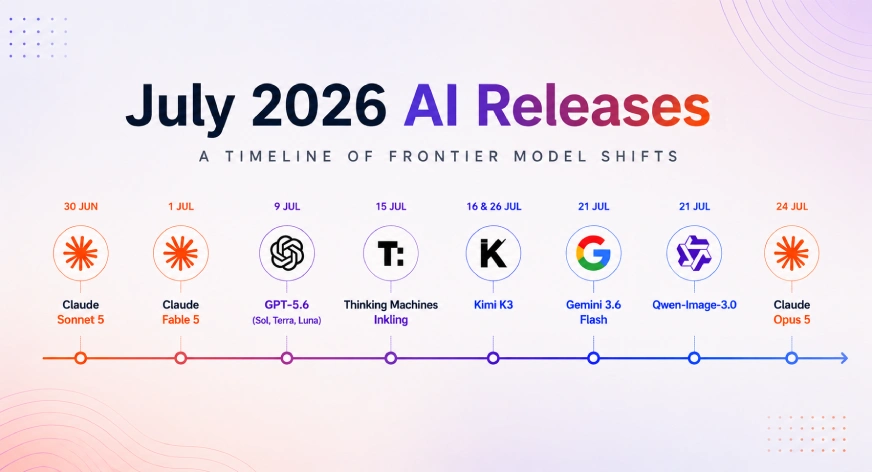
Fourteen Frontier Models Landed in July. Here Is What That Means.
July 2026 didn't just push the frontier forward; it redrew the map. Thirty-one days, four major lab flagships, two debuts from well-funded newcomers, and the largest open-weight model ever released. That's not a busy month, that's a signal. The pace tells us the field is maturing, but also that access is widening. If you're exploring how these shifts reshape your own workflows, our guide to agentic context learning offers a practical lens on where learning happens next. This timeline is worth your attention.

AI adoption matures as enterprises discover where real returns live
Enterprise AI is finally showing measurable returns, with the SAP Value of AI Report 2026 revealing that AI now powers nearly 30% of tasks in the average organization. That progress comes with a sharper appetite: expected returns on agentic AI jumped from 10% to 17% in a year. Still, most leaders admit the technology isn't reaching its full potential. The bottleneck isn't access to newer models, it's strategy, data quality, and governance.

Microsoft's three-layer architecture clarifies AI agent routing on AKS
Microsoft's new reference architecture for routing agent traffic on Azure Kubernetes Service tackles a practical headache: deciding which model answers a call, how that call is managed, and which GPU replica handles it. It's a clear-eyed breakdown of a messy problem. That kind of clarity matters, especially when AI feels like a black box.

Pangram secures $9M to help you identify AI-generated content
Pangram's $9 million raise lands at a moment when AI-generated text is blurring the line between useful and noisy. The startup's new Pangram 4 model targets that problem directly, with an image detection tool also in research preview. That matters because the real cost of AI slop isn't just clutter; it's the silent skewing of models trained on it. We've seen how easily false positives muddy the data, as our own piece on catching AI slop showed.

Understand Adam's Optimization Dynamics Before Your Model Fails
Vibe coding an import feels efficient until the model quietly misreads your data. That's the trap Adam sets. Treating it as a default fix ignores how its optimization dynamics actually behave, and when they misfire, the failure is anything but subtle. Understanding why it breaks matters more than assuming it works. If you're chasing cleaner inputs, our piece on catching AI slop before it skews your model pairs well with this cautionary read.

Discover the core insight that makes backpropagation truly work.
If you've ever watched a neural network struggle through training, you know the feeling: there has to be a better way. This second part of our beginner's guide gets to the heart of that intuition, unpacking the core idea that makes backpropagation possible. The guide offers a clear, accessible look at a concept that often feels abstract, and it does a fine job keeping the explanation grounded. For those ready to push further, our guide on distributed algorithms offers a natural next step.
Recursive Superintelligence invests $410 million in compute to automate product development
Recursive Superintelligence just committed $410 million to Amazon for compute, and that number says more about their strategy than any product roadmap could. By steering what would traditionally go toward headcount and operations straight into infrastructure, they're betting that self-improving AI can automate its own development. It's a bold wager on a future where the company scales with algorithms, not armies. For anyone wrestling with how far AI can genuinely take over complex work, this deal reframes the question.
Small labs can still drive meaningful ML research with single GPU setups
A single RTX 3090 powered InfiniteDiffusion, an independent researcher's terrain-generation model, and that alone should reframe the conversation about compute access. It is easy to feel dwarfed by frontier labs, but this work proves meaningful ML contributions still emerge from constrained setups. Small teams can focus on clever problem framing rather than raw scale. For those questioning the path forward, this is a practical signal that single-GPU research remains viable.
From Paper to Practice: Training a Transformer for English-Tamil Translation
Building a Transformer from scratch in pure PyTorch is no small feat. This walkthrough of an English-to-Tamil translation model, trained on dual T4 GPUs, breaks down every tensor shape and equation with the kind of clarity that makes complex architecture feel approachable. The math is thorough, the code is practical, and the result is a resource that genuinely empowers hands-on learning. For anyone ready to move beyond theory, this is a solid next step.