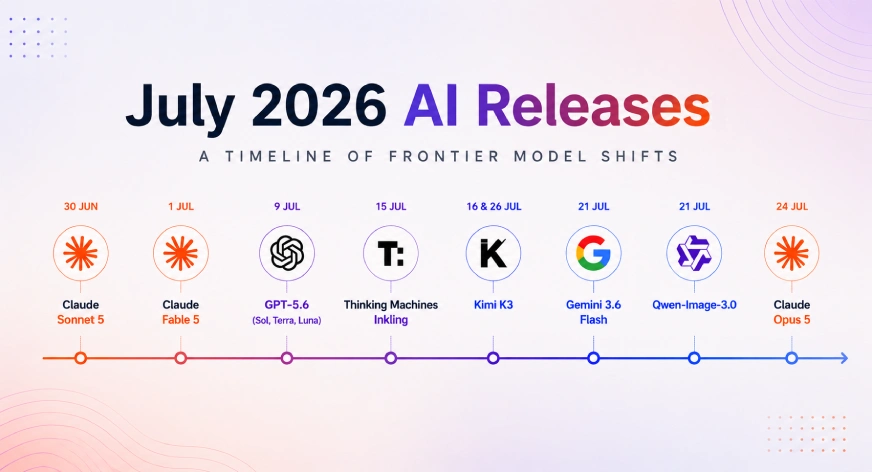
July 2026 was the month the frontier stopped being a spectator sport. Four major labs shipped flagship or near-flagship models, two well-funded newcomers delivered their debuts, and the largest open-weight model ever published hit download servers, all within thirty-one days. That kind of density is not a minor uptick in release cadence; it is a structural signal. The pace of frontier work has shifted from a race of incremental sprints to something closer to a continuous relay, where the baton changes hands so often that the concept of a "leader" becomes almost meaningless. For anyone who tracks this space, it is worth pausing to ask what that sustained pressure means for the tools you actually use, rather than just the headlines you skim.
This is precisely the moment to look past the benchmark table and consider the practical texture of the shift. When we explore how AI agents learn by editing context, not model weights, we are reminded that the frontier is not only about raw parameter counts or perplexity scores. It is about how easily these systems integrate into existing workflows without demanding a complete re-architecture of your data stack. The July releases span that gap in wildly different ways: some prioritize efficiency and latency for real-time interaction, others push the boundaries of long-context reasoning, and the open-weight release in particular invites a level of scrutiny and customization that closed systems cannot offer. That variety is the real story. For the user, the takeaway is not which model "wins" July, but that the cost of experimentation has dropped far enough that the question is no longer whether you can afford to test a frontier model, but which one you should test first.
There is also a human dimension to this density that is easy to overlook. When we talk to our AI clones and question the technology, we are reminded that every release is not just a technical artifact but a reflection of priorities, biases, and intended use cases. The newcomers shipping their first models are not just competing on capability; they are competing on vision, often targeting specific verticals or workflow pain points that the incumbents have left underserved. That is a healthy pressure valve. It forces the larger labs to consider usability and accessibility, not just raw intelligence, which is exactly the kind of practical guidance we see in distributed training guides that make these systems approachable. The real value of July 2026 is not the list of releases; it is the demonstration that the ecosystem has matured to the point where choice is a feature, not a burden.
Here is the concrete thing to watch. The open-weight release is the detail that will matter most in six months. Not because it will necessarily top every leaderboard, but because it invites a level of scrutiny, fine-tuning, and community-driven improvement that closed models cannot match. The question is not whether you should adopt it, but whether you can afford to ignore the lessons it will generate about what is actually working in this new wave. That is the takeaway worth quoting: in a month this crowded, the most durable signal is not who shipped the biggest model, but who shipped the one that others can build on. The frontier is no longer a destination. It is a moving target, and July proved that the only way to keep up is to stop watching and start building.