devops
Beyond Market Intelligence keeps devops in one place: 22 stories so far. The section currently leads with “Monitor Cypress Tests with Grafana: Persistent Observability for Your Data”, “Build Scalable Products with Less: Engineering Lessons from Startups”, and “Navigating AWS Complexity with Smarter Terraform Infrastructure Management”. Cypress test suites generate a steady stream of data, but most teams treat that information as a one-time signal rather than a persistent resource. Scaling a product doesn't have to mean scaling complexity. Acme AI is the next-generation, AI-powered spreadsheet platform built to replace Excel and redefine how analysts, data scientists, and enterprise teams work… The list below is every devops story on Beyond Market Intelligence, newest first.
Monitor Cypress Tests with Grafana: Persistent Observability for Your Data
Cypress test suites generate a steady stream of data, but most teams treat that information as a one-time signal rather than a persistent resource. Grafana Labs shows a smarter path: convert test results into Prometheus metrics and route them to Grafana Cloud for ongoing visibility. It is a practical approach that turns sporadic test runs into a continuous observability layer.

Build Scalable Products with Less: Engineering Lessons from Startups
Scaling a product doesn't have to mean scaling complexity. In his latest talk, David Gudeman draws on over a decade of startup experience to show how pairing GCP, Firebase, and Cloud Run can accelerate product-market fit without overwhelming your team. He gets practical fast: cut redundant frontend state, design event-driven backends, and keep DevOps lean while building for the long haul. It's a grounded playbook for teams who want to move smarter, not harder.

Navigating AWS Complexity with Smarter Terraform Infrastructure Management
The Terraform AWS Provider's v6.62.0 release lands as infrastructure grows more intricate, adding support for new capabilities while sharpening how Terraform reads existing resources. That dual focus, forward momentum and deeper comprehension, matters for teams juggling complexity. It is not about chasing novelty; it is about making the provider a more reliable partner in daily work. For a broader look at simplifying cloud workflows, our guide "Unlock ChatGPT for Work" pairs well with this momentum.

AI-Powered Engineering: How Platforms Can Adapt and Empower Developers
Platform teams are no longer just infrastructure keepers. They are the ones deciding how AI-assisted engineering actually takes shape. In this discussion, Stéphane Di Cesare, Davide de Paolis, Stephen Cihak, Camila Macedo, and Renato Losio get into the real trade-offs: where standardization helps, where it stifles, and how to build guardrails without strangling developer autonomy. It is a practical look at shifting workflows. For a deeper angle on how AI changes the skills we expect, check out "Navigating AI/ML Job Requirements."
Your AI Bot Just Fixed a Bug While You Were Asleep
A bug reproduced in staging, documented with screenshots, and assigned to the right engineer, all while you slept. That is the quiet power of Grok Bot, a tool that moves from suggestion to action. It closes the gap between what a spreadsheet can do and what you actually need it to do. For those exploring how AI can reshape daily workflows, this is a practical starting point. And if you are curious about the underlying mechanics, our guide to distributed algorithms offers a deeper look.

Azure Repos code reviews now billed per review with five-concurrency limit
Microsoft has opened GitHub Copilot code review for Azure Repos to all Azure DevOps customers, acknowledging that many teams aren't ready to leave for GitHub. That's a practical move, one that meets users where they are. Reviews bill per use through your linked Azure subscription, with costs showing up in Cost Management two days later. Budgets alert you but won't halt reviews, and concurrency caps at five per organization. It's a straightforward, usage-based approach.

Predict infrastructure failures before they disrupt your workflow.
Empirik has launched with $21M in funding, backed by Sequoia, to predict IT outages before they strike. The mission is straightforward: give infrastructure the same proactive intelligence that Cursor brought to software engineering. That comparison matters because it signals a shift from reacting to problems to preventing them. For teams tired of firefighting, this is a practical step toward calmer operations. And if you're curious how similar predictive logic plays out in other fields, our piece on adaptive recommendation systems offers a useful parallel.

From Configuration to Control Governing AI Infrastructure Safely
As coding agents take over the writing of infrastructure, HashiCorp argues the real challenge has shifted to verification and safe execution. HCP Terraform is stepping into that role, offering governance for AI-driven workflows. It is a smart move, acknowledging that generating configuration is no longer the bottleneck. The focus now is on control. For those exploring how AI agents handle tasks, our guide, "Unlock ChatGPT for Work," offers a practical starting point.

Rightsizing Developer Platforms to Reduce Cognitive Load and Accelerate Delivery
Platform engineering is rarely a one-size-fits-all equation. John Keates tackles the real friction behind modern developer platforms: the cognitive load that shift-left practices have quietly piled onto teams. He focuses on rightsizing, not just building more. It's a practical look at matching your platform to your culture, not the other way around. For those exploring how AI tools fit into everyday workflows, our guide to unlocking ChatGPT for work offers a useful starting point.

From Prompt to Production: How Roblox Scales Autonomous Code Safely
Andrew Swerdlow's take on scaling autonomous software development at Roblox cuts straight to what most engineering leaders are quietly wrestling with: moving from prompt to production without losing control. His focus on security sandboxes, mining code review exemplars for institutional knowledge, and rethinking productivity around feature velocity feels like a practical blueprint, not a fantasy. It's a grounded argument for trusting AI where it earns that trust.
Explore the 2026 cloud and DevOps trends shaping your data future
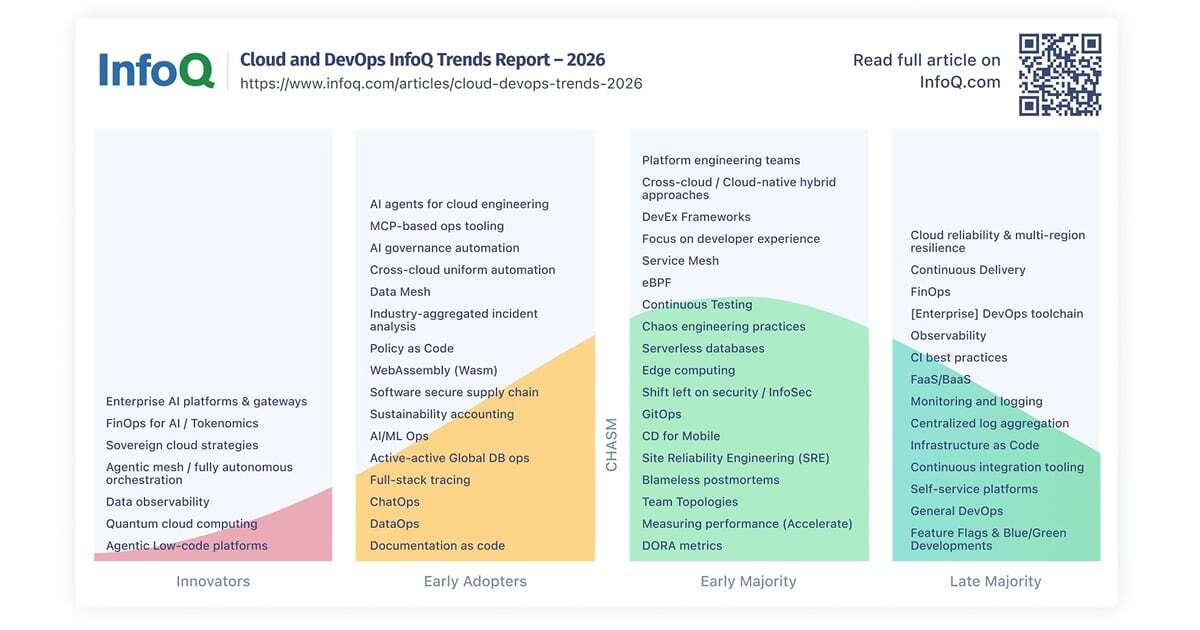
The cloud and DevOps landscape is shifting under our feet, and the InfoQ editorial team is here to map it out. In this podcast, Daniel Bryant, Matt Saunders, Shweta Vohra, Steef-Jan Wiggers, and Mark Silvester sit down to dissect the annual Trends Report for 2026. They get raw and honest about AI, resilience, platforms, FinOps, and sovereignty. If you're feeling constrained by traditional infrastructure thinking, this conversation empowers you to explore what is actually next.

How Pinterest Built Guardrails for Safer, Scalable AWS Infrastructure
Pinning down least-privilege access across sprawling AWS environments is a challenge, and Pinterest's new Resource Provisioner Pipeline tackles it head-on. Their Terraform execution engine enforces dual-control reviews, adding strict guardrails to GitHub Actions workflows. It's a practical, no-nonsense approach to infrastructure security that prioritizes safety without sacrificing speed. For teams wrestling with similar scale, this is a smart model worth examining. And if you're exploring how AI can streamline other workflows, our guide to unlocking ChatGPT for work offers a useful starting point.

Give AI agents a persistent workspace with Cloudflare's new open-source runtime.
Cloudflare's new open-source runtime, Cloudflare Computer, gives AI agents something closer to a real machine than the usual ephemeral containers. By leaning on Cloudflare isolates, it promises faster, cheaper, and more scalable execution for agentic workloads. That's a meaningful step beyond stateless setups, and it's worth exploring if you're building agents that need persistence. For more on how Cloudflare thinks about performance, their EmDash CMS migration offers a useful parallel. This runtime feels like a practical push toward agents that actually finish the job.

Your Team's Insight Still Guides the AI in Incident Response
AI is moving fast into incident response, summarizing channels, analyzing unfamiliar code, and even suggesting fixes. That's genuine progress. But Craig Risi's piece reminds us that the hardest calls still land on humans. The technology can point the way, yet judgment, context, and accountability remain ours to carry. That's not a limitation; it's the point. For a broader look at where this intelligence is headed, our piece on AI designing its own hardware offers a fitting follow-up.
Explore the 2026 culture and methods trends shaping collaborative work
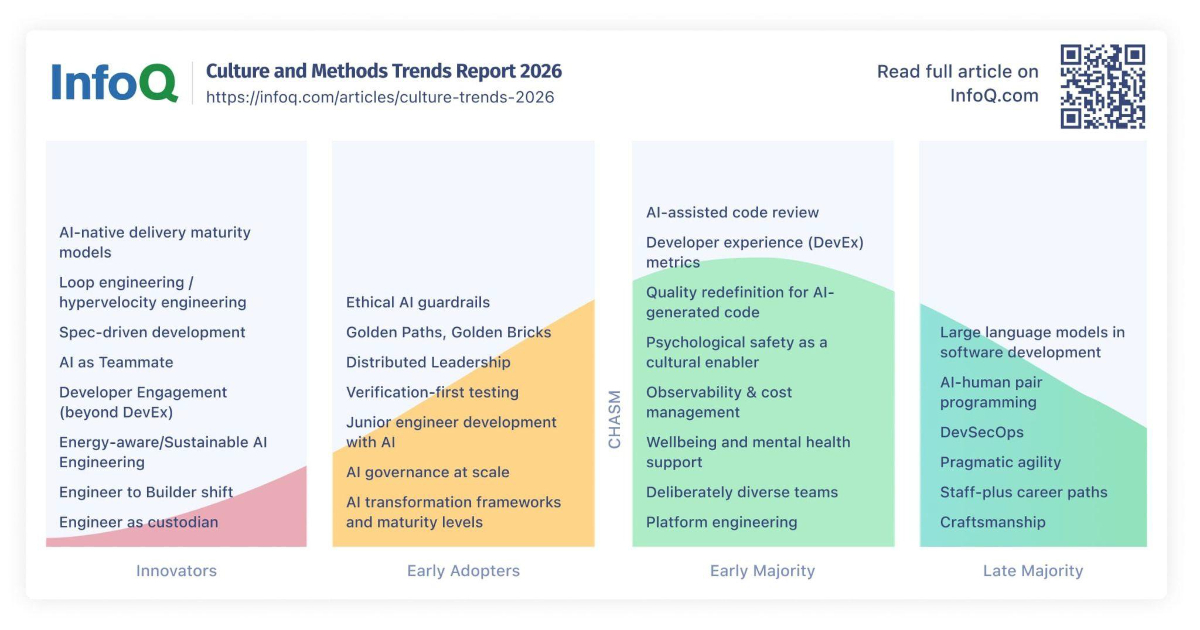
The InfoQ Culture and Methods editorial team has mapped where software delivery is heading in 2026, and the picture is less about tools and more about trust. The report digs into how teams are reshaping workflows around human outcomes, not just throughput. It's a grounded read, especially when so much tech commentary leans on hype. For practical context on how these cultural shifts play out in daily work, the related guide on unlocking ChatGPT for work offers a useful, hands-on starting point.

Explore how internal platforms reduce cognitive load for microservices teams.
Microservices deliver real value only when teams can sustain their pace, and Chris Richardson's presentation gets straight to that challenge. He pairs Team Topologies with internal platforms to cut through complexity, focusing on six concrete patterns, from security to deployment, that keep stream-aligned teams moving. The payoff is a clear strategy for shrinking cognitive load while sidestepping the usual platform traps. It's a practical, grounded take on acceleration. For more ways to simplify technical workflows, our guide, "Unlock ChatGPT for Work," offers a useful parallel.
How AI agents free engineers from busywork to focus on judgment
Instacart's CTO says AI made the company stop worrying about tech debt, and that's a bold bet worth examining. Anirban Kundu argues that machines should absorb repetitive engineering work, freeing humans to focus on judgment and intent. In 97% of cases, builders don't even read code anymore. That's a striking redefinition of the craft. For a deeper look at how teams are managing modern testing pipelines, our related article on monitoring Cypress tests with Grafana offers a practical counterpoint.

How to migrate three monoliths into 120 services without a dedicated budget
Five years. No dedicated migration budget. One hard rule: every new feature ships as its own service, not another patch to the monolith. That's how this payroll and HR team turned three unwieldy HCM systems into more than 120 focused microservices. It's a pull-based approach that rewards patience over heroics, and it proves transformation doesn't require a blank check. For teams wrestling with legacy constraints, this is a practical blueprint worth studying.
Mastering the Technical Interview for Live Streaming Deployments
Preparing for a live streaming deployment interview means more than rehearsing answers. You need to show how CI/CD pipelines, Kafka, and Kubernetes work together under real-time pressure. For an MLE role, focus on fault tolerance, scaling, and data consistency. Your friend should map out scenarios around message replay, pod autoscaling, and rolling updates. It's practical, not theoretical. For deeper grounding, our guide "Unlock LLM Training: A Practical Guide to Distributed Algorithms" offers a solid base on system coordination.

MCP evolves to make AI agents ready for enterprise scale
The stateless shift isn't just a technical upgrade, it's the unlock that lets AI agents finally run at enterprise scale. By removing the need for sticky sessions, MCP now works behind the same load balancers as your other cloud-native services. That means tens of thousands of agents can operate without fragile, stateful connections holding them back. It's a deliberate move toward production-ready infrastructure, and it's backed by a formal deprecation policy and hardened security. The path forward is clear.

Empathy and focus transform compliance from burden to shared success.
Forced workflows and thin documentation nearly derailed one platform team's roadmap. The lesson wasn't about tightening control; it was about loosening it. By simplifying governance and focusing on prevention over policing, they turned compliance into a shared habit rather than a hurdle. Empathy drove adoption, not mandates. This is a practical reminder that developer experience and regulatory needs can coexist. For more on easing technical friction, our guide on unlocking ChatGPT for work offers a similar shift toward accessible tooling.

Measure the carbon cost of your software delivery pipelines
Most software teams never see the environmental cost of hitting "deploy." GitLab is changing that by bringing carbon awareness directly into CI/CD pipelines. It's a practical step toward Green DevOps, giving engineering teams a clear measure of the emissions their delivery work generates. That visibility matters. You can't reduce what you don't track. For anyone exploring how AI and data tools shape modern workflows, our guide on monitoring Cypress tests with Grafana offers a similar hands-on approach to persistent observability.