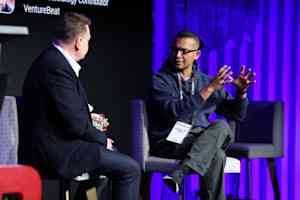
There is a quiet radicalism in what Instacart's CTO, Anirban Kundu, is proposing, and it has nothing to do with code generation. At VB Transform 2026, Kundu essentially argued that the entire concept of software maintenance, that slow, grinding accumulation of patches and workarounds we call tech debt, is becoming an artifact of a human-scale process. When 97% of your builders no longer read the code they create, the old rules of ownership and careful review stop applying. The remaining 3% of work, the legacy systems, the compliance checks, the latency-sensitive paths, are the only places where human judgment still has a meaningful seat at the table. This is not just an efficiency play; it is a redefinition of what an engineer actually does, moving from writing lines to navigating an AI system toward a desired intent.
This shift should make every team pause and ask a difficult question: what is the actual unit of work you are optimizing for? We have spent years monitoring our test suites and orchestrating autonomous agents to handle the grunt work, but Instacart is taking that logic to its conclusion. If an AI agent can generate and regenerate code weekly, then the codebase is no longer a precious asset to be protected; it is a disposable output, like object code was in the assembly era. The challenge is not in writing the code, but in defining the intent and building the evaluation frameworks to verify the AI's output. Kundu's team runs 7,000 automatic evals a month and fields 8,000 real-time developer queries with 99.9% accuracy, which suggests they are not just trusting the machine, they are building a rigorous system of oversight that is fundamentally different from a code review.
The more compelling lesson, however, is in how they are handling the messy, human side of failure. Their agentic SRE, trained on years of Instacart's own incident history rather than generic failure data, is a clear example of building scalable products with less because it embeds institutional memory directly into the system. When their internal tool Blueberry caught a database shard issue by correlating a Slack conversation with a feature-flag rollout that was too aggressive, it did not just find a bug; it demonstrated a form of pattern recognition that bypasses the "first brain" of human intuition. Kundu is right that human intuition holds us back, because we default to what we have seen before. The takeaway here is not that you should stop caring about tech debt, but that you should question whether the debt you are carrying is a function of your code or a function of your process. If you can drop and rebuild inactive systems, then the fear of legacy is a choice, not a constraint.
What we would tell a reader asking for advice is this: start building your evaluation and intent models now, before you let the agents loose. The practical consequence of Instacart's approach is that the bottleneck for engineering velocity shifts from writing code to defining problems clearly enough for an AI to solve them. The open question is whether your organization can develop the discipline to create those intent definitions with the same rigor it once applied to code reviews, and whether you can accept that the 3% of work requiring human hands will be the most strategic, and likely the most scarce, resource you have.