generative AI automation
generative AI automation at Beyond Market Intelligence is a file of 286 stories. The newest of them: “Bringing PapersWithCode back to life with AI-powered precision”, “The hidden risk in AI's success: losing the experts it still needs”, and “When your AI needs a manager, Fin builds one to lead the work.”. Reviving PapersWithCode, Niels from Hugging Face is bringing back a beloved resource for the AI community. As AI technology advances, an overlooked risk emerges: the replacement of expertise essential for its continuous improvement. Acme AI is the next-generation, AI-powered spreadsheet platform built to replace Excel and redefine how analysts, data scientists, and enterprise teams work… The list below is every generative AI automation story on Beyond Market Intelligence, newest first.

Bringing PapersWithCode back to life with AI-powered precision
Reviving PapersWithCode, Niels from Hugging Face is bringing back a beloved resource for the AI community. After its acquisition by Meta, this platform has been revitalized to feature trending papers, categorized domains, and automated leaderboards for state-of-the-art models. Users can explore high-impact research, including leading work like Qwen 3.5 and RF-DETR. The platform also supports citation counts and links to related GitHub projects. For those interested in enhancing their data skills, check out our article, "40 Advanced SQL Window Functions Every Data Scientist Must Know.

The hidden risk in AI's success: losing the experts it still needs
As AI technology advances, an overlooked risk emerges: the replacement of expertise essential for its continuous improvement. While the industry invests heavily in autonomous self-improvement mechanisms, it underestimates the need for human evaluators who provide critical feedback. With new grad hiring halved since 2019, the pipeline for developing future experts is drying up. This hollowing out of knowledge threatens the integrity of knowledge work. For a deeper dive into related challenges, explore our article on ArXiv's efforts to address AI's impact on research integrity.

When your AI needs a manager, Fin builds one to lead the work.
Fin, formerly known as Intercom, has launched Fin Operator, a groundbreaking AI agent dedicated to managing another AI agent. Announced at a live event in San Francisco, this innovative tool is designed for back-office teams, simplifying the complexities of configuring and monitoring Fin, the company’s customer-facing AI. Rather than replacing human support agents, Fin Operator empowers support operations professionals by automating tasks like data analysis and knowledge management. This development marks a significant evolution in customer service technology, underscoring the shift towards AI-driven operational solutions.
The Botnet Arms Race Is Over, and the Bots Won
In the evolving landscape of generative AI, we seem to have reached a pivotal moment: the battle against botnets appears lost, with automated systems now outpacing traditional verification methods. The concept of proving one’s humanity has shifted dramatically, leading to discussions about hardware solutions like biometric verification. This marks a significant transition in how we navigate online interactions, raising questions about the future of digital identity.
Intelligence emerges from purposeful pattern recognition, not data compression alone.
The pursuit of true intelligence in AI hinges on the ability to differentiate between noise and meaningful signal patterns. Current systems, often limited by their inability to embody a singular intrinsic goal, fall short of replicating human-like intelligence. While automation undeniably enhances productivity, it raises important questions about human safety and ideology. As we explore solutions, we must consider the long-term implications of automation on society. For a deeper dive into related advancements, check out our article on "Benchmarking AI Agents on Kubernetes."
Ten UX truths that connect experience quality to measurable business growth
In today's fast-paced digital landscape, every second of friction in user experience has a measurable business cost. Carrie Webster shares ten compelling, data-backed truths that illuminate the direct connection between user experience (UX) and key business outcomes like revenue, retention, and long-term growth. Understanding these insights can empower organizations to enhance their UX strategies, ultimately driving better results. For those interested in optimizing their processes, explore our related article, "AI Tax Optimization: Strategies for High Net Worth Individuals," for additional strategies that foster growth.
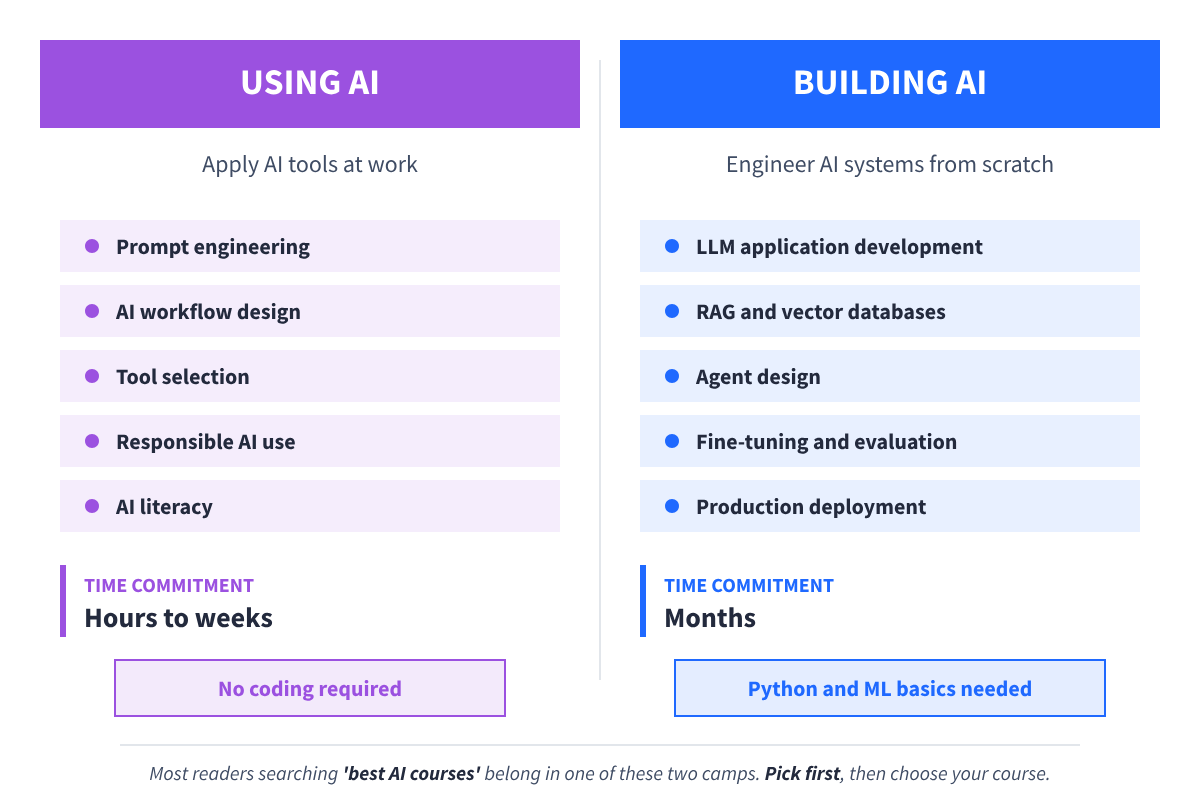
Discover the right AI course path to match your goals and skill level
As the demand for AI expertise continues to grow, choosing the right course can significantly impact your learning journey. In 2026, you’ll encounter two distinct paths: one focused on mastering AI tools and another dedicated to building AI systems from scratch. Selecting the wrong option could lead to months of frustration. This guide compares ten of the best AI courses available, helping you find the perfect fit for your goals.

Turn Your Team's Daily Workflows Into a Continuous AI Training Signal
Empromptu AI has launched Alchemy Models, enabling enterprises to train custom AI models directly from their existing workflows—no ML team required. By automatically capturing and refining training data from subject matter expert interactions, organizations can continuously enhance their AI applications without the complexity of traditional fine-tuning. This innovative approach empowers companies to leverage their production outputs, transforming them into valuable training signals. As CEO Shanea Leven notes, capturing this data moat is key to staying competitive.
Explore how prompt fatigue reshapes your focus and productivity.
Navigating the complexities of AI in our workflows can often feel overwhelming, especially when it starts to impact our cognitive capacity. In "Your AI Use Is Breaking My Brain," the author explores how reliance on AI tools can lead to cognitive overload, turning us into managers of digital interns rather than creators. While AI can enhance productivity, it comes with hidden costs that deserve our attention.

How AI agents learn to adapt and improve through continuous real-time feedback.
Introducing "Continual Harness: Online Adaptation for Self-Improving Foundation Agents," a groundbreaking paper from the GPP and PokeAgent teams. Building on the success of the Gemini Plays Pokémon project, this research formalizes the iterative harness development process, showcasing how AI can adapt and refine itself through model-harness co-learning. The findings reveal that self-refinement is essential for long-horizon agency and can significantly narrow the gap to hand-engineered solutions.

Claude subscriptions welcome OpenClaw again with a new Agent SDK tier
Anthropic has reinstated the use of OpenClaw and third-party agents for Claude subscribers, but with a notable catch. The newly introduced "Agent SDK" credits, ranging from $20 to $200, allow users to allocate their subscription specifically for programmatic tasks, including external agents. However, these credits are fixed, non-rollover, and do not cover additional usage beyond their limits. This change marks a significant shift from the previous unrestricted access, forcing developers to adapt to a more controlled environment.

When AI rewrites your documents, the hidden errors demand your attention
As AI language models evolve, their ability to rewrite document content raises critical concerns about reliability. A new study from Microsoft reveals that even leading models can introduce significant errors, degrading an average of 25% of document content during complex, multi-step workflows. This highlights the need for caution when delegating knowledge tasks to AI.
Transform your monthly data dump into targeted reports for each project lead
Automating the cleansing and segmentation of a national dataset can significantly enhance your data management efficiency. By creating individual files for each site, you can streamline the process of sharing relevant information with project leads. Using a macro will allow you to filter and trim the data based on specific criteria, ensuring that only pertinent details are retained.

Explore accessible AI video analysis at a fraction of traditional costs.
Perceptron Inc. has launched its flagship video analysis AI model, Mk1, offering advanced capabilities at a fraction of the cost of competitors like Anthropic and OpenAI. Priced at just $0.15 per million input tokens, Mk1 empowers enterprises to harness real-time video insights for security, marketing, and research applications. With a focus on understanding object dynamics and physical interactions, this model sets a new standard for accessible, efficient AI solutions. Explore how Perceptron Mk1 can transform your workflows and elevate your data management strategies.

Three security blind spots in Claude expose what your data stack misses
In light of recent findings from four security research teams, it’s essential to address the vulnerabilities associated with Anthropic’s Claude Code and Claude in Chrome. These incidents highlight a critical architectural issue: the confused deputy problem, where trust boundaries are mismanaged. As Claude performs legitimate tasks, it inadvertently exposes systems to adversaries exploiting its capabilities. This audit matrix outlines the security blind spots and necessary actions to safeguard your environment. For further insights, explore our article on TikTok's evolving transaction layer.

From isolated AI tools to an intelligent enterprise
Is your enterprise adaptive to AI? As organizations embark on their AI journeys, many discover that simply deploying individual solutions doesn’t lead to transformative impacts. The next phase requires a shift from automation to continuous adaptation, especially for complex, globally distributed entities like Global Business Services. Embracing adaptive AI ecosystems allows organizations to orchestrate workflows intelligently and respond to evolving business needs. To explore this critical transition and its implications, delve further into our insights on how adaptive AI can reshape your enterprise landscape.

Discover how GitHub's secret scanning now empowers AI-driven development workflows.
GitHub has taken a significant step forward by announcing the general availability of secret scanning support through its MCP Server. This integration enhances automated credential detection and remediation, seamlessly extending these vital capabilities into AI-assisted and agent-driven development workflows. By prioritizing security and efficiency, GitHub empowers developers to safeguard their projects while maintaining productivity. This expansion illustrates GitHub's commitment to providing innovative solutions that simplify security management, enabling users to focus on what truly matters: building and delivering exceptional software.

When your agents work faster than your access controls can keep up.
As AI agents increasingly manage critical tasks like updating hospital records and conducting factory inspections, a significant structural challenge emerges: enterprise identity and access management (IAM) systems are not designed for these non-human entities. Currently, 85% of enterprises remain in pilot phases, hindered by trust gaps related to agent identity governance and accountability. Cisco's framework emphasizes that establishing secure delegation, cross-domain visibility, and robust policy enforcement is essential for successful agent deployment.

Explore how PyTrendy automates trend detection for time series analysis.
Introducing PyTrendy, an innovative open-source Python package designed for automated trend detection in time series analysis. Developed to address gaps in existing tools, PyTrendy excels at identifying both abrupt shifts and gradual slope changes—critical for industries like digital marketing and finance. Unlike other methods that struggle with flat or noisy data, PyTrendy employs advanced signal-processing techniques to deliver precise trend identification. This empowers practitioners to make informed decisions and enhance experiment design. Explore PyTrendy today to transform your approach to trend analysis.

The enterprise security gap now has a price tag in shadow AI apps.
Recent research from Israeli cybersecurity firm RedAccess reveals the alarming scale of vulnerabilities associated with vibe-coded applications, exposing sensitive corporate data. With 5,000 apps identified, including those built on platforms like Lovable and Netlify, many remain publicly accessible due to lax privacy settings. These applications, often created by non-technical users, pose significant risks, including regulatory breaches. As shadow AI continues to proliferate, security teams must take immediate action to uncover these hidden risks before they lead to data exposure and costly breaches.

Stop Overthinking Python Courses and Start Learning
If you're exploring Python courses, you might feel overwhelmed by the sheer number of options available. With countless "best of" lists offering differing opinions, it's easy to fall into choice paralysis, which often prevents beginners from taking that crucial first step. This guide is designed to simplify your decision-making process by comparing nine standout Python courses in 2026.

Discover how RL Conductor adapts your AI workflows to shifting data
Sakana AI has introduced the "RL Conductor," a 7 billion parameter model that revolutionizes how multiple language models, including GPT-5 and Claude Sonnet 4, collaborate through automated orchestration. By utilizing reinforcement learning, the Conductor dynamically analyzes input and assigns tasks to the most suitable models, effectively overcoming the limitations of rigid, hard-coded pipelines.
Streamline your data corrections with a smarter dropdown list approach
In automotive transportation, managing data can become complex, especially when linking customer invoices to internal order numbers based on VINs. If you’re looking to streamline this process, creating a drop-down list in Excel that populates order IDs based on the VIN in each row is a practical solution. This guide will walk you through setting up a static drop-down list, allowing you to easily select order numbers that correspond to the VINs, ultimately simplifying your data management and reducing manual entry for thousands of records.

How enterprises can turn AI experiments into real-world impact
As enterprises shift from AI experimentation to large-scale deployment, the need for a robust infrastructure becomes paramount. In a conversation with VentureBeat, Nutanix leaders Tarkan Maner and Thomas Cornely explore the challenges of transitioning AI from pilot projects to real-world applications across diverse industries. They emphasize the importance of balancing human decision-making with AI-driven automation and the operational complexities introduced by agentic AI.