generative AI automation
generative AI automation at Beyond Market Intelligence is a file of 286 stories. The newest of them: “Your smartphone has an app store. Now your robot does too.”, “Explore how Abacus AI simplifies automation, app building, and content generation”, and “How RAG grounds AI answers in the data you already trust”. Hugging Face has launched the Reachy Mini App Store, revolutionizing robotics by making it accessible to everyone. In this comprehensive review of Abacus AI, we delve into its standout features, including ChatLLM, the Abacus AI Agent, and Claw. Acme AI is the next-generation, AI-powered spreadsheet platform built to replace Excel and redefine how analysts, data scientists, and enterprise teams work… The list below is every generative AI automation story on Beyond Market Intelligence, newest first.

Your smartphone has an app store. Now your robot does too.
Hugging Face has launched the Reachy Mini App Store, revolutionizing robotics by making it accessible to everyone. This innovative platform offers over 200 community-built applications for the Reachy Mini, a low-cost open-source robot priced at just $299. By removing the barriers typically associated with robotics, users can now create functional software using plain language, regardless of technical expertise. This democratization of robotics empowers individuals to explore new possibilities and redefine how we interact with machines, making advanced technology approachable and engaging for all.
Explore how Abacus AI simplifies automation, app building, and content generation
In this comprehensive review of Abacus AI, we delve into its standout features, including ChatLLM, the Abacus AI Agent, and Claw. We explore its automation capabilities, app-building functionality, and tools for image and video generation. Additionally, we provide insights into pricing, weighing the pros and cons of the platform. This guide aims to help users understand who can benefit most from Abacus AI, empowering them to make informed decisions about integrating this innovative solution into their workflows.

How RAG grounds AI answers in the data you already trust
Retrieval-augmented generation (RAG) is an innovative approach that enhances language model responses by integrating real-time external data. Unlike traditional models that rely solely on pre-existing knowledge, RAG provides a fresh set of facts from a knowledge base just before generating an answer. This method allows for more accurate and contextually relevant responses, empowering users to access the latest information seamlessly. In this complete guide, we will explore the mechanics of RAG, its benefits, and its transformative potential in data-driven applications.

The silent cost of unreported digital friction in your organization
Hidden IT problems are silently undermining productivity and creating risks within organizations. Research from TeamViewer reveals that many digital issues, such as slow applications and login failures, remain unreported, leading to significant productivity losses—averaging 1.3 workdays per month per employee. This digital friction not only hampers project timelines but also contributes to employee frustration and turnover. By addressing these underlying issues proactively, organizations can enhance operational efficiency and employee satisfaction, ultimately fostering a more resilient and productive work environment.

xAI ships Grok 4.3 and a voice cloning suite at a competitive price
xAI has launched Grok 4.3, a new large language model that enhances performance while maintaining an aggressively low pricing structure. This release comes amid ongoing legal battles involving founder Elon Musk and OpenAI co-founder Sam Altman. Grok 4.3 introduces advanced reasoning capabilities and a powerful voice cloning suite, designed to optimize user workflows. With significant improvements in specialized tasks, Grok 4.3 positions itself as a strong contender in the AI landscape, offering both affordability and functionality for developers and enterprises alike.

From Experiment to Expense: The Real Cost of AI at Scale
As enterprises transition from AI experimentation to production, the focus shifts from model training to the infrastructure necessary for efficiently managing concurrent inference workloads. This new landscape, driven by agentic AI, demands continuous support for unpredictable requests, highlighting the importance of infrastructure efficiency. Anindo Sengupta from Nutanix underscores that while costs per token have decreased, overall expenses are rising due to increased consumption. To thrive, organizations must adapt their infrastructure strategies, prioritizing metrics like GPU utilization and total cost of ownership for sustainable AI deployment.

AI agents now act on business signals, no prompts required
Writer has launched event-based triggers for its AI agent platform, allowing agents to autonomously detect business signals across popular tools like Gmail, Slack, and Google Calendar, executing multi-step workflows without human prompts. This significant advancement positions Writer at the forefront of the autonomous enterprise AI landscape, competing against giants like Amazon, Microsoft, and Salesforce. The release also introduces a new Adobe Experience Manager connector and enhanced governance controls, reinforcing Writer's commitment to user-friendly, proactive AI solutions that drive business efficiency while prioritizing safety and oversight.

Accenture and Adobe back Netomi's vision for smarter customer service AI
Netomi, a San Francisco-based startup specializing in AI-driven customer service solutions, has successfully raised $110 million in a funding round led by Accenture Ventures, with notable participation from Adobe Ventures and others. This investment signifies a strategic alliance, positioning Netomi to revolutionize enterprise customer interactions by moving beyond traditional chatbots to create anticipatory experiences that prevent issues before they arise.

IBM secures AI coding workflows with multi-model routing and human oversight
IBM has launched Bob, an innovative AI-powered software development platform that integrates multi-model routing and human checkpoints, enhancing security and efficiency in coding workflows. Designed to address the complexities and potential pitfalls of AI in real-time data environments, Bob combines human oversight with AI capabilities, resulting in significant time savings for teams—up to 70% on selected tasks. With a structured approach, Bob empowers developers to seamlessly navigate the software lifecycle, ensuring effective collaboration between AI and human expertise in enterprise settings.

Why enterprises hoard unused GPUs and how AI can break the cycle
Enterprises are grappling with a profound GPU waste problem, running fleets at a mere 5% utilization despite soaring costs. The fear of losing valuable capacity in a tight market prevents teams from releasing idle GPUs, perpetuating a cycle of inefficiency. As highlighted in Cast AI's 2026 State of Kubernetes Optimization Report, the situation is exacerbated by procurement practices that prioritize short-term allocation over long-term utility.

Sauce AI Turns Business Intent into Executable Test Suites
Sauce Labs has unveiled Sauce AI for Test Authoring, an innovative AI-driven agent that bridges the DevOps “velocity gap” by automating test creation. This tool translates business intent into executable test suites, introducing a transformative approach known as Intent-Driven Testing. By simplifying the testing process, Sauce AI empowers teams to enhance productivity and accelerate development cycles. This launch represents a significant advancement in test automation, making it easier for organizations to align their testing efforts with business goals and drive efficiency in their workflows.

Smarter reasoning agents without the heavy computing costs
Building custom reasoning agents can be a daunting task for enterprise teams, often limited by resources and traditional training methods. However, researchers have introduced Reinforcement Learning with Verifiable Rewards and Self-Distillation (RLSD), a groundbreaking approach that combines the reliability of reinforcement learning with the detailed feedback of self-distillation. This innovative method simplifies the training process, enabling teams to develop tailored reasoning models efficiently.
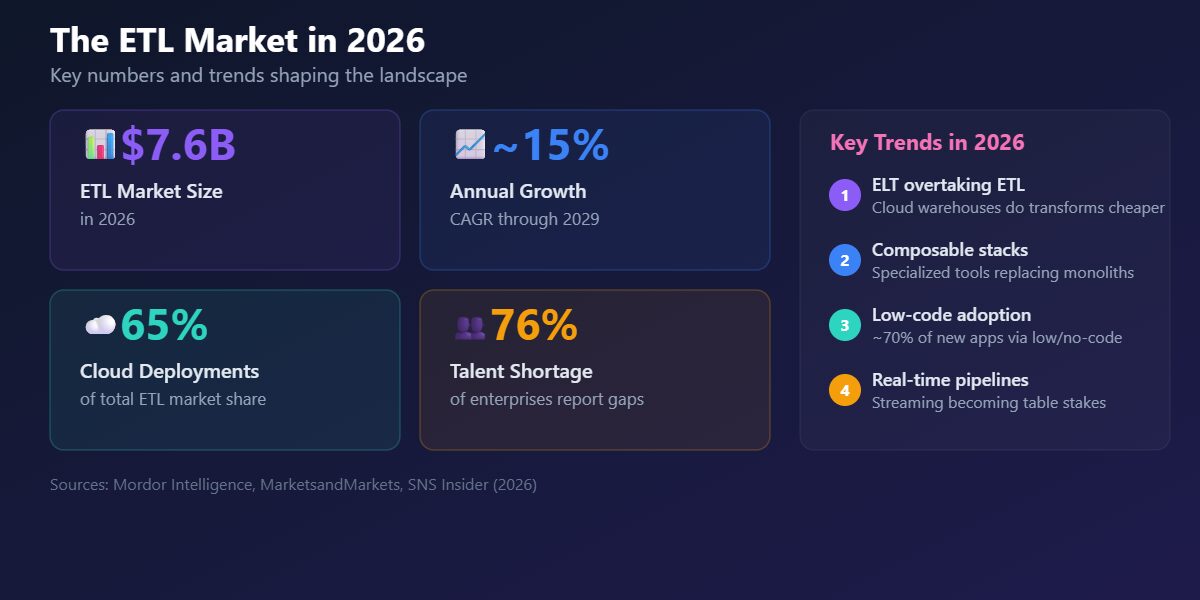
Your Data Pipeline Deserves More Than an Overcrowded Tool List
Choosing the right ETL tools is crucial when building a robust data stack, yet the abundance of overlapping options can be overwhelming. In 2026, the landscape continues to evolve, making it essential to understand which tools align with your specific needs. This practical guide not only highlights the best ETL tools available but also provides clear code examples to facilitate your decision-making process.

Mistral Workflows turns AI experiments into revenue-generating operations.
Mistral AI has unveiled Workflows, a powerful orchestration engine designed to elevate AI systems from mere proofs of concept to integral business processes. Operating within Mistral's Studio platform, Workflows already processes millions of daily executions, addressing critical gaps in operational infrastructure that hinder AI adoption. By separating orchestration from execution, it ensures data privacy and reliability, particularly for regulated industries.

Supply chains reveal where traditional integration falls short
Supply chains are increasingly challenged by the limitations of legacy integration models, which struggle to keep pace with expanding partner networks and rising operational volatility. As traditional middleware falters under complexity and costs, automation-led Integration Platform as a Service (iPaaS) emerges as a vital solution. The evolving landscape of supply chains reveals the inadequacies of legacy systems and how next-gen iPaaS, enhanced by automation, can transform integration practices.

Explore how AI evolves its own training data and model architecture
Introducing ASI-EVOLVE, a groundbreaking framework developed by researchers at SII-GAIR, designed to automate the entire optimization loop for AI training data, model architectures, and algorithms. By employing a continuous "learn-design-experiment-analyze" cycle, ASI-EVOLVE significantly reduces manual engineering efforts while enhancing performance beyond traditional human baselines. This innovative system autonomously discovers novel designs, improves data curation, and refines learning algorithms. With ASI-EVOLVE, enterprises can streamline their AI workflows and unlock new efficiencies, making advanced AI capabilities more accessible and effective than ever before
Taming the unpredictable: A practical guide to testing AI's variability
In the realm of enterprise AI, monitoring large language model (LLM) behavior is critical to ensure reliability and compliance. Unlike traditional software, which operates predictably, generative AI presents unique challenges due to its stochastic nature. This guide introduces the AI Evaluation Stack, a structured framework for assessing model performance through deterministic and model-based assertions. By implementing robust evaluation pipelines, engineers can effectively identify drifts, retries, and refusal patterns, ultimately transforming the development process and enhancing user experiences.

Tame unruly agents with runtime guardrails that keep every task on track.
Many AI models encounter significant challenges due to a lack of enforcement at runtime, leading to deviations from intended behavior. Users frequently report issues such as agents ignoring system prompts or misinterpreting rules. For instance, directives like "Never delete user data" may be disregarded entirely. A promising solution is to implement a proxy system that enforces rules in real-time, ensuring compliance while remaining adaptable across various platforms.
Explore smarter formula logic and cleaner data workflows from this week's top discussions
Welcome to this week’s recap of the /r/Excel community for April 18-24, 2026. Dive into the top discussions, where users tackled challenges ranging from combining AND and OR conditions in formulas to unresolved issues with Power Query and Excel's buffering. Explore insights from the most engaging comments, including tips on handling binary conversion quirks and formula troubleshooting. This week's highlights reflect a vibrant exchange of knowledge and support, empowering users to enhance their Excel skills and streamline their workflows. Join the conversation!
Automated trade commentary: bringing clarity to complex risk data at scale
Building an automated commentary engine for daily trade attribution at scale poses a unique challenge in market risk reporting. With thousands of trades arriving at varying frequencies, the goal is to create a system that precisely analyzes time-series data and generates clear, human-readable insights. The key dilemma lies in balancing deterministic mathematical accuracy with dynamic natural language generation. Consider leveraging advanced workflows, such as Agentic approaches, to allow for flexibility while ensuring the precision of your calculations.
Trust in AI agents lags behind their enterprise adoption
Eighty-five percent of enterprises are piloting AI agents, yet only 5% have transitioned them to production, highlighting a significant trust gap. In an exclusive interview at RSA Conference 2026, Cisco's Jeetu Patel emphasized that this deficit is the key barrier to scaling AI adoption for critical tasks. He likened AI agents to intelligent yet immature teenagers, requiring structured oversight to ensure safe operation. Addressing this trust architecture is essential, as it differentiates thriving enterprises from those at risk of failure.

DeepSeek reemerges with powerful AI at a fraction of the cost
DeepSeek-V4 has arrived, marking a significant leap in AI capabilities with its 1.6-trillion-parameter Mixture-of-Experts model, available at just 1/6th the cost of competitors like GPT-5.5 and Claude Opus 4.7. This latest release, rooted in innovative architecture and a commitment to open-source accessibility, empowers developers and enterprises to harness advanced AI without prohibitive costs. As DeepSeek researcher Deli Chen emphasizes, "AGI belongs to everyone," positioning this model as a game changer in the landscape of affordable, high-performance AI

From Creative Tool to Cyber Weapon: The New Reality of AI Disinformation
In his presentation, "Deepfakes, Disinformation, and AI Content Are Taking Over the Internet," Shuman Ghosemajumder delves into the alarming evolution of generative AI, which has shifted from a novel creative tool to a powerful instrument for disinformation and fraud. He explores the concept of "Disinformation Automation," examines the diminishing effectiveness of CAPTCHA in an AI-driven landscape, and emphasizes the necessity for engineering leaders to implement zero-trust "cyber fusion" strategies.

From First Prompt to Production AI in Under a Year
This comprehensive roadmap outlines the essential skills you need to acquire, such as Python, LLM APIs, RAG, and agents, presented in a logical learning sequence. With a realistic timeline of 8 to 12 months to transition from your first LLM prompt to deploying production AI systems, you'll also discover current salary expectations ranging from $130K to $250K+, depending on your experience.