jev
jev at Beyond Market Intelligence is a file of 24 stories. The newest of them: “When you have labels, classic models outperform the AI hype”, “OpenAI opens its decision model to all, challenging Jev's lead”, and “A test of 17 AI agents across 7,700 poker hands shows what local models can do”. Classic models beat the hype when you have labels. OpenAI is opening its decision model to everyone, directly challenging Jev's early lead in this space. Acme AI is the next-generation, AI-powered spreadsheet platform built to replace Excel and redefine how analysts, data scientists, and enterprise teams work… The list below is every jev story on Beyond Market Intelligence, newest first.
When you have labels, classic models outperform the AI hype
Classic models beat the hype when you have labels. We tested embedding inputs with a cheap model, then fitting a simple sklearn model on top using your own labels. The result? A 37% error reduction against Jev, at a fraction of the cost. It's not glamorous, but it works. For deeper context on smarter decision-making, see our guide on "How Your Agent's Tools Can Make Smarter Decisions."

OpenAI opens its decision model to all, challenging Jev's lead
OpenAI is opening its decision model to everyone, directly challenging Jev's early lead in this space. It's a bold move that signals confidence, and it raises a fair question: can OpenAI's offering truly compete? The answer matters for anyone building workflows around AI-driven choices. If you're following how agents are reshaping productivity, don't miss our piece on how AI agents can now log in for you without ever seeing your password.

A test of 17 AI agents across 7,700 poker hands shows what local models can do
Seventeen AI agents went head-to-head across 7,700 poker hands, and the results reveal exactly what local models can achieve today. This kind of test moves beyond theory, showing real performance where it matters. For anyone weighing the trade-offs between local and cloud-based AI, the findings are worth exploring. Deeper context awaits in our related piece, "Finding Your Balance Between AI Effort and Real Results."

Jev becomes Vercel's fastest-adopted AI model through unified API access
Vercel's AI gateway data shows Jev became the platform's fastest-adopted model, a clear signal that unified API access is what developers actually want. TypeSafe built Jev as a non-generative model, making bounded decisions rather than generating open-ended text. That focus on precision over breadth is finding its audience. For teams exhausted by overhyped AI promises, Jev offers something rarer: reliable, actionable outputs. See how it stacks up against generative models in our coverage of Linear Recurrence Matches Transformer Accuracy at a Fraction of the Cost.
Linear Recurrence Matches Transformer Accuracy at a Fraction of the Cost
When you budget-match a linear recurrent model and a transformer down to 15 million parameters on a long-context retrieval task, something unexpected happens: neither learns much. Accuracy hovers near chance for both. The real story is cost. At 8,192 tokens the linear model runs 2.37× faster, and training time opens a 6-7× gap that only widens with scale. This negative result from Jev's decision-lab is exactly the point, small decision models are accuracy-starved regardless of substrate, so the winning choice becomes efficiency.

Move Beyond One-Off Checks with JEV as Your Continuous Filter
Most hallucination checks happen after the LLM writes a response, only to hand dangerous cases to a human. That approach treats verification as a one-off event. JEV flips the model. Let the LLM generate freely, then let JEV act as a continuous filter, checking every output, not just the ones that raise red flags. It's a smarter, more scalable safety net.
Two paths to a smarter decision model: equal accuracy, unequal cost
Two paths to the same decision model, matched within 0.02% on parameters, yet the cost difference is stark. A linear recurrent backbone and a standard attention transformer were built on identical budgets for a long-context retrieval task. At 8K tokens, the linear model runs 2.37× faster. Training? Six epochs took 30 minutes versus 40-45 minutes *per epoch* for the transformer. Neither substrate learned much at 15M parameters, accuracy hovered near chance. The real insight is where cost lives.

Benchmarking Jev against sklearn reveals where AI-native spreadsheets excel
Numbers tell the real story. Benchmarking Jev against sklearn shows where AI-native spreadsheets actually outperform traditional tools, and where they still have ground to cover. It's not about declaring a winner; it's about understanding the strengths each brings to data work. For anyone weighing whether to shift workflows, this comparison offers a practical starting point. If you're curious how AI assistants handle similar tasks, our comparison of ChatGPT, Claude, and Gemini for statisticians pairs well with these findings.

Explore How OpenAI's Decisions API Can Reshape Your Data Workflows
If you're still treating AI agents like chat bots that occasionally call a function, OpenAI's new Decisions API suggests a more intentional path. This practical guide walks through how a decision-first model lets you define, constrain, and audit every tool call before it executes, turning reactive workflows into deliberate, auditable processes. It's a genuine step toward production reliability. For deeper context on agent stability, our piece on "Six Architectural Patterns for Scaling Reliable AI Agents" pairs well here.

TypeSafe's Jev hits $7.5B valuation by outpacing LLMs with fewer tokens
Jev's $7.5 billion valuation is impressive, but what truly grabs our attention is the claim behind it: TypeSafe says Jev works faster and uses far fewer tokens than LLMs. That efficiency explains why both individual users and large corporations are excited. It suggests a smarter approach to AI, not just a bigger one. For a deeper look at how decision-first models prevent risky AI actions, see our related article on that topic.

Why a Decision-First Model Can Rein In Risky AI Agent Actions
A single bad tool call can turn an AI agent from a helpful assistant into a liability. TypeSafe's Jev addresses this by putting decisions first, catching risky actions before they ripple into the real world. That's a pragmatic layer of safety we can get behind. It pairs well with our look at how open data center deals signal a smarter path to community trust, both show that proactive guardrails build better outcomes.
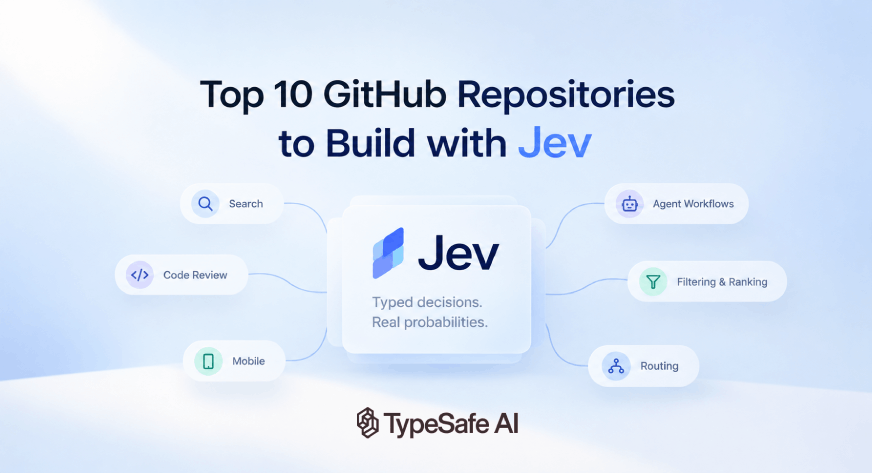
Explore How Jev Projects Bring Clarity to AI Decision-Making
Every agent makes dozens of small calls before delivering something useful: which source to trust, which tool to invoke, when to stop. Jev pulls those hidden choices into the open, converting them into typed decisions with probabilities rather than free-form text. That clarity makes the reasoning auditable and the output more dependable. For anyone exploring how structured judgment improves AI workflows, the GitHub projects offer a practical starting point. Related coverage on why small decision models outperform LLMs for answer evaluation deepens the conversation nicely.

Why Small Decision Models Beat LLMs for AI Answer Evaluation
Jev takes a different path in the AI evaluation debate. Where LLM-as-a-Judge generates full responses for every check, Jev returns a short choice with a confidence score. That is a leaner, faster route to the same destination. Teams feeling the cost and delay of large-model judging should explore this approach. It keeps the evaluation simple without sacrificing reliability. For more on how small decision models fit into the broader routing conversation, our piece on model routing as a design choice pairs well with this discussion.

Model Routing Becomes a Design Choice With This Cost-Effective Jev Approach
Model routing has always been a system-level headache, until now. A new Jev approach treats it as a design choice, not an engineering patch. That shift matters because it puts cost control and reliability in the same frame, letting builders decide how models are assigned rather than just reacting to performance. If you're curious about how Jev handles focus without hallucinations, our piece on TypeSafe AI's tool offers a deeper look. This is practical AI architecture, finally made intentional.
TypeSafe AI's Jev Delivers Focused Utility Without Hallucinations
Jev, TypeSafe AI's new model, promises frontier-class reasoning without hallucinations, and it's built by a co-inventor of ChatGPT. We put that claim to the test, running it live on over 16,000 benchmark requests. What we found is a smaller, humbler model that delivers focused utility at near-zero cost. It serves a specific job nobody else quite fills. For deeper context on where AI logic still struggles, see our piece on Nonograms.
Small models, smarter labels: confidence scoring without the hype
Small classification models that score confidence over a list of labels, rather than generating free text, deserve more attention. Gokula Krishnan ran his own evals on TypeSafe AI's hosted Jev and the open-source Laya, and his findings are practical. Describing labels by what's in the input, not intent, boosted accuracy from 65% to 77% on AML detection. Calibration matters: Jev's ECE of 0.013 let a 90% confidence filter reach 97.6% accuracy while covering 82% of cases. Laya's untuned ECE of 0.486 didn't

Jev delivers typed probabilities, not text, for faster data decisions
Spreadsheets have always been a compromise between power and usability, but that trade-off is starting to feel optional. Daniel Curtis reports on a new AI-native approach that treats the grid as an interface for natural language reasoning rather than a manual calculation engine. The technology doesn't just automate formulas, it reframes what a spreadsheet can *be*, letting users ask questions in plain language and get structured answers back.

Meet Intern-Decision: Smarter choices, 30 FPS, and multimodal by design
The Intern-Decision model family lands with a clear message: smarter choices shouldn't require a supercomputer. At 0.8B, 2B, and 4B parameters, the 4B model edges out Jev 1.13.0, and on an RTX 4090, it hits roughly 30 FPS for decision calls. That speed opens real room for interactive applications. What stands out is the calibration work. The team built a benchmark around classic probability problems, like the Monty-Hall dilemma, and found their model tracks the golden distribution more closely than the competition.

Why Everyone Is Talking About Jev and What It Means for Your Data
Jev is turning heads because it treats data like a conversation, not a chore. This isn't about a faster spreadsheet. It's about a tool that anticipates your next move, removing the friction between asking a question and getting an answer. For teams drowning in manual updates, that shift matters. We explored how freeing up that bottleneck in "Unlock Team Momentum by Removing the AI Data Bottleneck." Jev signals a future where your data works for you, not the other way around.

Jev vs LLMs: Evaluating AI for Practical Decision-Making
Spreadsheets have long forced a choice between speed and judgment. In a new test, TypeSafe AI's Jev tackled 3,080 classification tasks, and the results are worth your attention. The comparison focuses on accuracy, latency, calibration, and confidence, asking whether a dedicated tool can serve as a practical decision layer where LLMs might falter. It is a grounded, useful evaluation. For those exploring how AI systems handle reasoning under pressure, this pairs well with our guide to distributed training algorithms.

Explore Jev: The AI Model Rethinking Text Generation
Jev is trending on X for a reason, and it's not just another flashy release. TypeSafe AI's new model challenges a core assumption by never generating a single word of text, which feels counterintuitive until you see the logic. We think that restraint is exactly what makes it compelling. If you're exploring how AI can reshape workflows, Jev offers a fresh angle worth your attention. For more on the mechanics behind such systems, our guide to distributed training pairs well with this story.

Jev: AI That Decides, Not Just Writes
Most spreadsheet users know the pain of writing formulas; Jev skips the typing and moves straight to the outcome. This AI doesn't just generate text for you to interpret; it makes the call, deciding what the next step should be based on your data. It's a direct answer to the question of what happens when the tool stops assisting and starts acting. For those interested in how far AI can go beyond simple generation, our piece on the Forrester function offers a deeper mathematical look.
Is Reinforcement Learning Really Needed for Jev's Spreadsheet AI?
The question cuts to the heart of Jev's design. If the model only predicts Choice, Score, or Noul, those outputs are already differentiable through cross-entropy or MSE. Adding reinforcement learning feels like extra machinery unless there's a hidden reward signal we're not seeing. The environment would need to be defined, and that's unclear. It's fair to ask if this is substance or just a buzzword. We're not dismissing the approach, but the burden of proof is on the implementation.
Discover a faster, more affordable path to AI-powered software.
Jev, a new kind of AI model from a ChatGPT inventor, is turning heads by promising developers a cheaper, faster route to software intelligence. That's a meaningful shift for teams tired of ballooning costs and sluggish iteration cycles. We see this as a practical step toward making advanced AI more accessible, not just for enterprises, but for builders who need agility. If you're navigating how AI skills are evolving, our related piece on shifting AI/ML job requirements offers useful context. This is worth exploring.