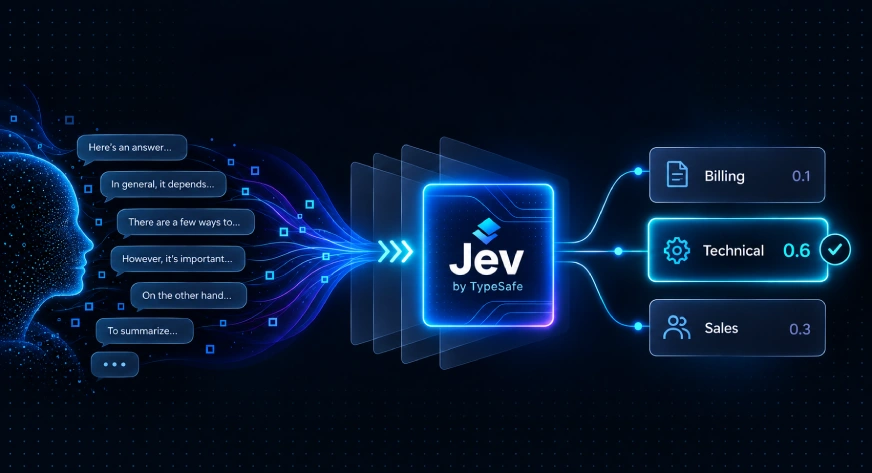
The recent emergence of Jev, an AI model from TypeSafe AI, has sparked considerable interest within the AI community, and rightfully so. Unlike the prevalent paradigm of large language models (LLMs) that generate text, Jev operates on a fundamentally different principle: it *decides*, rather than writes. Jev: AI That Decides, Not Just Writes This shift represents a potential pivot in how we conceptualize and interact with AI, moving beyond simply prompting for outputs to engaging with systems that can actively reason and execute. The buzz around Jev on X isn’t just about novelty; it’s a reflection of the growing desire for AI that’s more than a sophisticated autocomplete engine. The model’s ability to leverage external tools and APIs to achieve goals, rather than solely relying on its internal knowledge base, is a crucial distinction. It’s also interesting to consider how this development aligns with the exploration of AI agents, as we’ve seen with Instinct automating tasks within iMessage Explore AI Agents: How Instinct Automates Tasks Within iMessage, highlighting a broader trend toward AI that proactively manages and completes tasks.
Jev's architecture, which eschews direct text generation in favor of a decision-making process driven by tool calls, presents a compelling alternative to the limitations of current LLMs. The current generation of LLMs, while impressive in their ability to mimic human language, often struggle with factual accuracy, logical consistency, and the ability to perform complex reasoning tasks. Jev’s approach, by offloading these tasks to specialized tools, aims to overcome these shortcomings. The two years of stealth development behind TypeSafe AI suggests a deliberate and focused effort to build something fundamentally different, rather than simply scaling up existing LLM techniques. This focus on a novel architecture, rather than brute force, is a welcome development, particularly as the field grapples with the computational costs and environmental impact of increasingly large models. It’s a reminder that innovation isn't always about bigger; sometimes, it's about smarter.
The implications of Jev's approach extend beyond individual users and developers. As AI increasingly integrates into workflows and decision-making processes, the ability to trust the underlying reasoning becomes paramount. While OpenAI continues to push the boundaries of mathematical research OpenAI Accelerates Math Research with New Advisory Group, Jev’s focus on verifiable actions and tool-based execution offers a path toward greater transparency and accountability in AI systems. This is particularly relevant in sectors like finance, healthcare, and law, where accuracy and reliability are non-negotiable. Furthermore, the success of Jev could spur further exploration of alternative AI architectures that prioritize reasoning and action over purely generative capabilities, leading to a more diverse and robust AI ecosystem.
Ultimately, Jev’s emergence prompts a crucial question: will the future of AI lie in models that simply generate content, or in systems that can intelligently orchestrate tools and resources to achieve specific goals? The early signals are encouraging, suggesting a shift toward AI that is not just articulate, but also capable, reliable, and truly useful. As Jev continues to evolve, it will be fascinating to observe how it shapes the landscape of AI development and whether it can inspire a broader movement toward more intelligent and actionable AI agents.